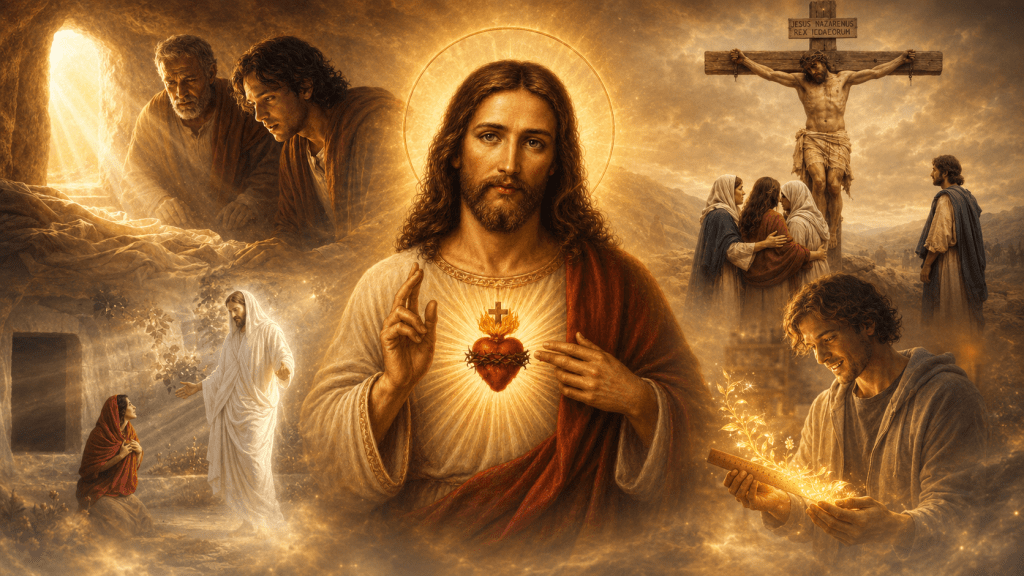
What is capable of sustaining a difficult emptying? It is what can fill us again. It is essential love. In a transfiguring way. ⟁
“And now these three remain: faith, hope and love. But the greatest of these is love.”
1 Corinthians 13:13
1. The Threshold of Emptying
No sacred building can be erected upon the unstable ruins of a cluttered ground. In the economy of the soul and the architecture of the spirit, essential love—Agape—does not behave as a cosmetic additive or a superficial layer of moral varnish to be applied over the old structures of human pride. It demands, by virtue of its own absolute nature, a radical threshold, an insurmountable frontier that can only be crossed through Kenosis. The voluntary emptying of the ego is not an end in itself, nor an exercise in nihilism or psychological self-flagellation; it is, in truth, the ontological condition of possibility for real love to take possession of the being.
The tragedy of contemporary man lies in the chronic attempt to love from his full deposits. One seeks the divine and the human carrying pockets stuffed with commodified certainties, rehearsed performances, untouched traumas, and a deafening despair for validation. The result of this tragic superposition is a simulacrum: an affection that does not transfigure, but merely replicates the logic of possession, calculation, and the centrality of the self. Agape, however, refuses to inhabit the noise. It demands prior divestment. It takes courage to look inward and carry out an honest inventory of our accumulations, recognizing that pride disguised as virtue is the densest rubble blocking the flow of Grace.
Therefore, the movement that leads us to Agape necessarily begins at the endpoint of Kenosis. It is the act of cleaning the main hall, unveiling the hidden pantries, and emptying the deepest storehouses of our subjectivity. When we empty these drawers of the soul—freeing ourselves from the tyranny of being the authors of our own light—what is produced is not a despairing vacuum or a sterile absence. The kenotic void is the sovereign space of receptivity. It is the preparation of the dwelling, the silence that precedes the Word, the necessary calm so that the overflow of the Holy Spirit finds a clean riverbed through which to flow, transforming our unhindered fragility into the fertile soil of the purest charity.
2. The Clean Room and the Sensitivity to Nuances
Once the emptying is accomplished, the first great transformation occurs not in the exteriority of actions, but in the very mechanics of inner perception. The kenotic purification acts as a profound opening of the spiritual and cognitive senses, restoring to consciousness a faculty that the toxic acceleration of the modern world had anesthetized: the acute sensitivity to nuances. In a civilization marked by the saturation of stimuli and the brutality of explicit images, the human gaze has become addicted to the macroscopic, the glaring, and the loud. The ability to read between the lines and to inhabit the small intervals where reality is truly decided has been lost.
When the mind finally decelerates and the heart finds itself free from the pressures of accumulation and comparison, the “clean room” of the being becomes a laboratory of attentive listening.
The love of God and the truth of things do not manifest through flashy billboards or pyrotechnic epiphanies designed to impress the masses. The sacred operates in discrete gradations, in subtle approaches, in the gentle breeze that requires retreat to be heard.
Whoever inhabits a cluttered soul is incapable of perceiving the detail of a gesture, the hidden fragility in the speech of another, or the whisper of the Spirit in the conduct of daily life, for the noise of one’s own ego deafens perception.
Agape, in this sense, is a pedagogy of the refined gaze. It teaches us that what is truly precious and eternal “is not in the display window”. The display window of the world—which today materializes on the gleaming screens of the internet and in the market of digital reputations—is the space of obsolescence, quick consumption, and superficial aestheticization. Essential love, on the contrary, is located a little lower, a little further back, in the hidden terrains of discretion and gratuitousness. In the clean room of the transfigured conscience, appearances lose their power of distortion, allowing the subject to see the hidden beauty of the trinitarian mystery that is unveiled in silence, where haste gives way to reverence and the detail becomes the anchoring point of the eternal.
3. The Icons of Hidden Intimacy: John and Mary Magdalene
Essential love does not fit into the grids of institutional bureaucracy or outward formalism. The history of salvation keeps, at its core, testimonies of a hidden intimacy, accessible only to those who dared to love to the point of exhaustion and remain on the threshold of the mystery. The Beloved Disciple and Mary Magdalene stand as the absolute icons of this profound sensitivity and calibration of the soul. Historically, the figure of Magdalene has suffered undeniable diminishments, often misunderstood in her capacities and in the irreproachable integrity of her love for Christ. However, the true transfigurationist reading recognizes that both John and Mary Magdalene held the key to higher access, not through the path of cold intellect, but through the door of purified affection.
They received instructions and missions of unspeakable magnitude—treasures of the spirit that were not inscribed for the general public, were not debated on podiums, nor exhibited for the amusement of crowds. Jesus opened the door to an intimate knowledge to them precisely because, with the “clean room” of their humility, they were capable of perceiving the nuances. Their proximity to the Word did not derive from a title, a privilege of caste, or an imposition of power, but from the pure and overwhelming ability to sustain presence. They loved without demanding the spotlight. Where others retreated out of fear or out of a failure to understand the apparent defeat of the cross, they remained, enduring the cutting silence, the weeping, and the martyrdom of longing. This is the true Agape: an access to the heart of God that is not exhibited in windows, but is delivered exclusively to those who endure the friction of real love.
4. The Pathology of Time: The Drug of Immediate Affection
In diametrical opposition to the patience and sacrifice of this essential love, our time has erected a monstrous machinery of spiritual illness: the omni-mercantilization of affections.
The contemporary world, hostage to a toxic acceleration and a profound civilizational inversion, has transformed love into a commodity of quick consumption, administered not as a medicine, but as a highly addictive drug. The structural promise of this system is that of immediate relief for existential emptiness.
It offers, through screens, massified trends, and digital validation, a chemical spike of belonging, a sudden aesthetic euphoria, or the ephemeral consolation of a “like” or a fleeting share. It simulates love for yesterday, in an urgency that atrophies the soul.
However, much like any numbing substance, this spike vanishes with relentless speed, leaving in its wake a scenario of silent destruction. This false promise of instantaneous healing does not resolve human pain; on the contrary, it generates the chronic disease of dependence, emptiness, and identity fragmentation. Omni-mercantilization acts as a vast symbolic cartel that addicts both the seemingly “successful” of the system and its “failures,” offering both a toxic relief that paralyzes them and prevents them from seeking the true cure.
Authentic Agape, which operates as the only real Remedy, requires the exact opposite: it demands time, coexistence, endurance of pain, and constant maturation. It requires the courage to get through difficult days without demanding cheap anesthetics. Transfigurationist love restructures the being from its foundations, rebuilding the dignity of the human person, while the drug of commodified affection merely masks the wound in order to exploit it, with redoubled efficiency, in the next cycle of consumption.
5. The Mechanism of Inversion: The Ruler of Comparison
To understand the asphyxiation of Agape in the contemporary era, it is imperative to expose the anatomy of the disease, and it operates through a silent and devastating instrument: the ruler of comparison. This mechanism does not present itself as an explicit concept or a declared ideology, but acts as a parasitic impulse that infiltrates consciousness. Under the dominion of omni-mercantilization, humanity has been conditioned to measure, evaluate, and juxtapose existences based on parameters dictated by pride. The inalienable value of the human being, once anchored in his condition as the image and likeness of the trinitarian God, suffers a brutal inversion, being shifted from essence to appearance.
The tragedy of this invisible ruler lies in its capacity to corrupt the gaze. When the ruler becomes the exclusive filter of reality, it measures material achievements, compares unequal trajectories, and transforms the diversity of gifts into an oppressive hierarchy. It reduces the vastness and mystery of a life to that which can be exhibited, quantified, and consumed on networks. In this scenario of perpetual competition, the neighbor undergoes a terrible mutation in our eyes: he ceases to be a sacred presence, worthy of communion, to become a competitive reference, an obstacle, or a threat. Agape is thus shattered, for essential love cannot survive in a soil where the other is seen as an adversary in the symbolic dispute for space, success, and validation. What should be an instrument of orientation becomes the absolute judge of human dignity.
6. The Illusion of the Cave: The Risk of Isolation
Faced with the exhausting tyranny of this ruler of comparison, the human mind, wounded and fatigued, instinctively seeks an escape route. Thus arises one of the most subtle traps of the spiritual journey: the illusion of the cave. In an attempt to escape the pressure of the social mirror and the weight of the gaze of others, the individual is tempted to retreat into absolute isolation, cutting bridges with the world under the pretext of preserving his inner peace. However, closing the doors to human friction is not the cure; it is a new form of self-deception, a sterile refuge that substitutes the anxiety of comparison with the abyss of self-sufficiency.
Agape refuses aseptic isolation. The trinitarian vocation of the human being requires encounter, friction, and sharing. We were not called to lock ourselves in the cave of our own wounded pride, nor to avoid reality so as not to be tested. The other is not hell; the other is the necessary structural gap through which Grace penetrates to save us.
It is precisely in the uneven terrain of human relations that virtue is forged. To flee from the neighbor to avoid the ruler is to allow the system to dictate the rules of our seclusion. The true victory of transfigurationist love does not take place in fleeing far from the world, but in the courage to remain in it with a redeemed gaze, transforming what was once a source of division into a space of sacred communion.
7. The Cognitive Antidote: The Benchmark of Improvement
The cure for the toxicity of comparison does not proceed through an intellectual anesthesia or an abstract moral voluntarism, but rather through a profound reconfiguration of our relational mechanics. The definitive antidote against the machinery of pride lies in substituting the ruler of competition with the Benchmark of Improvement. If the commodified ruler functions as a numbing substance that isolates and fragments the subject, the benchmark acts as a serious medical treatment, of long duration, which requires the patience of time, the support of coexistence, and the courage of slow maturation. It is the therapeutic passage from a vision that assaults to a gaze that is redeemed in the presence of the other.
When consciousness is purified by virtue, the destructive metric of the world loses its power of coercion. The neighbor ceases to be a threat to our symbolic space or an external standard by which we measure our value; he becomes, legitimately, a presence that inspires and contributes to our growth. Under this new optic, the good we witness in our brother does not evoke envy or resentment, but rather praise and the desire for spiritual elevation.
This dynamic assumes virtue as a living criterion, preventing the distortion of the gaze and protecting the inalienable dignity of every soul. By using the benchmark of improvement, the goal is never servile copying or mechanical emulation—practices that feed algorithmic massification—but rather the organic integration of what is good.
In the benchmark of improvement:
- the other is a source of learning
- the focus is internal expansion
- the value lies in applied virtue
- and the essence of the other is preserved
One does not judge who the other is. One observes what the other does. And that changes everything.
That which shines in the other does not function as a mold that crushes us, but rather as a sacred invitation that must be answered from our own original essence, transforming competition into construction and division into communion.
8. The Christological Prism against the Cracked Mirror
In direct opposition to this cognitive illness that encloses man in the anxious search for notoriety, the School erects its most uncompromising mystical barrier against the empire of vanity: the Christological Prism, instituted in absolute counterpoint to the Cracked Mirror of modernity. The contemporary world has transformed into a vast and labyrinthine gallery of mirrors, where souls wander exhausted, contemplating only the distorted images of their own egos projected against the dark background of loneliness and narcissism. The mirror is opaque, self-centered, and sterile; it imprisons the subject in the closed circuit of his self-image, demanding a perpetual performance to feed an altar of illusions.
The Prism, however, possesses an entirely distinct nature: it is pure, translucent, and relational. It does not retain the light for itself, it does not sequester it, and it never claims authorship of the brilliance that passes through it. The Christological Prism receives the one, eternal, and perfectly loving light of the Father, allows it to pass through the mystical Body of Christ and, at the conclusion of this sacred passage, returns it to the world multiplied in color, in grace, in diversity, and in meaning.
This is the definitive vaccine against the presumption of the century: the firm and humble recognition that we are not the origin of the light, we are not the authors of the miracles, and we do not hold ownership of the Revelation. We are, in our deepest truth, clay touched by the Word, instruments whose transparency is the only merit. By fixing our gaze on the Prism and not on the mirror, we destroy the fetish of notoriety and ensure that the protagonism of our existence remains unequivocally right where it should be, proclaiming with trembling and joy that the altar belongs solely and exclusively to Christ.
9. Oriented Action: The Loving Descent of the Prism
The contemplation of the Christological Prism does not invite us to a passive mysticism, an egoistic ecstasy, or a sterile flight from the material and historical urgencies of our time. On the contrary, it demands what the School rigorously defines as Oriented Action.
In the economy of essential love, it is not enough to climb the mountain to contemplate the light; it is strictly necessary to descend to serve on the plain, where exhaustion, human pain, and civilizational collapse actually happen. The true transfigurationist mysticism is, par excellence, an incarnated mysticism. Oriented action is the loving descent of the prism toward the friction of the world.
For this movement not to be corrupted by vanity or blind activism, it demands the foundational recognition that we are merely “clay touched by the Word”. Our cognitive traction, our reading capacity, and our analytical breath are not trophies for personal adornment, but rather sacred instruments of rescue. When we descend to extend our hand to the consciences wounded by the century, we do so resolutely refusing the worship of the false god of notoriety. Authentic service does not demand a stage, does not seek followers to inflate statistics, and does not let itself be seduced by noisy engagement. It demands presence, network, sharing, and an unbreakable cohesion with the Truth, acting in the silence and efficacy of real love. Oriented action is, in short, placing all intelligence and virtue at the service of the other, remembering at every step that the miracle is always an intercession that comes from on High.
10. Trinitarian Neo-humanism: Becoming without Losing Oneself
Faced with the relentless machinery of the algorithmic era—which standardizes desires, massifies behaviors, and demands the annulment of identity in favor of belonging to a digital herd—Agape raises the liberating banner of Trinitarian Neo-humanism. The false commodified love demands servile copying; the system wants identical, predictable, and moldable users. The logic of the Trinity, however, teaches us exactly the opposite: it is perfect communion in the absolute distinction of the Persons. It is the unity that does not destroy diversity, but rather sanctifies and crowns it.
Transporting this divine mystery to the relational ethics of our civilization in crisis, we understand that integrating the virtue of the neighbor does not mean, in any way, diluting our own identity. When we look at the excellence of the other through the benchmark of improvement, we do not do so to transform ourselves into replicas, but to gather the seed of that which vibrates in greater truth. Our mission is to absorb this good and return it to the world transfigured by our own color, by our biography, and by our singular vocation. “Becoming without losing oneself” is the highest synthesis of this ethical integration. It is the non-negotiable affirmation that the human being flourishes fully in communion, weaving the ties of the mystical Body, while simultaneously preserving, entirely intact, the sovereignty, dignity, and originality of his own conscience.
11. The Silent Rupture and the New Axis of the Journey
No roar announces the fall of the fortresses of contemporary pride; the structures of inversion that suffocate the century are not undone by the noise of force, but by the discreet and inflexible establishment of virtue. By planting one’s feet in the territory of Agape, which is essential love, par excellence, consciousness operates what the School defines as the Silent Rupture. This movement does not dispute the saturated spaces of the symbolic market, does not fight for niches of engagement, and rejects the hysteria of narratives seeking notoriety at any cost. It is subtle as leaven and invisible as the breath of the Spirit, but it possesses the overwhelming capacity to implode the foundations of human vanity from within.
The silent rupture is consolidated when we transform, in the laboratory of everyday life, competition into construction, comparison into learning, and division into communion. When the gaze frees itself from the cracked mirror and begins to be guided by the benchmark of improvement and by the Christological Prism, the mechanics of the world lose their power of coercion over us. We do not cease to inhabit reality, we do not lock ourselves in aseptic isolations, and we do not ignore the pains of the present time; we rather cease to measure ourselves by them. The world ceases to be the judge of our dignity, because our identity becomes anchored in the absolute gratuitousness of essential love.
With the shattering of the invisible ruler, the New Axis of the Journey is inaugurated. Human existence assumes an infinitely higher and safer criterion: the journey is no longer marked by how much we manage to surpass our neighbor, by the status we accumulate, or by the performance we stage for the approval of the multitudes.
The only legitimate vector becomes how much we advance, with humble and firm steps, in the direction of virtue and fidelity to the Gospel in its purest essence. One walks in the horizontality of service to the brothers and sisters, keeping one’s eyes fixed on the verticality of the Grace that comes from on High.
Upon crossing the portal of these two pillars that conclude this treatise, the School of Conscious Transfiguration proposes to deliver to the world not a new abstract theory, but an invitation to share a firm ground to stand on, an anchor for the days of storm, and a compass of lucidity for the digital age. Agape is the definitive filling of the clean room of the soul; it is the certainty that finitude accepted with love and the emptying carried out in faith are the keys that return to us the sovereignty of conscience and the integrity of the being. Before the empty tomb of modernity, the School of Conscious Transfiguration humbly wishes to remain on the threshold, sustaining the presence, keeping the details, and offering to each exhausted heart, paths that lead us to the rescue of real love. ♱

 Escola da Transfiguração Consciente
Você precisa fazer login para comentar.