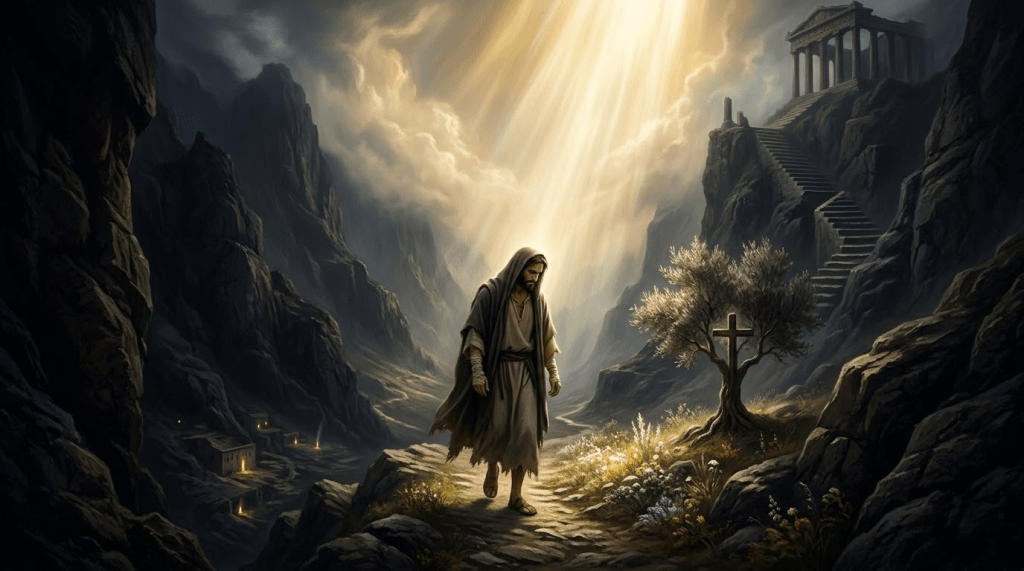
Jesus Cristo, que é a Estrela de Belém e que depois se torna o sal da terra e a luz do mundo, caminha junto com Sua Mãe — aquela que também passa a ser luz, que se torna para nós a estrela da manhã.
O que Eles querem nos deixar, especialmente neste tempo, é simples e imenso: quando nós começamos a olhar as coisas, o mundo, a vida, com os olhos da luz, tudo muda.
Quando escolhemos ver com os olhos da luz, tudo o que tocamos passa a ter luz — ou passa a ser iluminado por ela.
Iluminado para ser desvelado. Iluminado para ser dissipado. Iluminado para ser convertido. Iluminado para ser compreendido. Porque a luz se torna o canal. A luz se torna a substância. A luz se torna a espécie. A luz se torna o ambiente. A luz se torna a essência.
E o que há dentro da luz? Há tudo aquilo que Deus reservou para nós.
E mesmo que ainda não saibamos tudo o que Ele reservou, a própria natureza da luz já nos diz: tudo o que vem de Deus é bom. É muito bom.
Feliz Natal! ✨
Jesus Christ — the Star of Bethlehem, who later becomes the salt of the earth and the light of the world — walks with His Mother, who also becomes light, who shines for us as the Morning Star.
And what They wish to leave us, especially in this sacred season, is simple and immense: when we begin to look at things, at the world, at life itself through the eyes of light, everything changes.
When we choose to see with the eyes of light, everything we touch is filled with light — or becomes illuminated by it.
Illuminated to be unveiled. Illuminated to be dissolved. Illuminated to be transformed. Illuminated to be understood.
Because light becomes the channel. Light becomes the substance. Light becomes the atmosphere. Light becomes the essence.
And what is held within the light? Everything God has prepared for us.
Even though we do not yet know all that He has reserved, the very nature of light already tells us: everything that comes from God is good. It is very good.
“The light that touches the heights descends to serve the world.”
I. Praxis as the School’s Living Movement
Every doctrine is born from a vision. Every vision is born from a spirit. But it is praxis — the operative gesture — that reveals the truth of what is affirmed.
The School of Conscious Transfiguration is not a doctrine for its own sake — it is a light that moves.
It does not exist to be contemplated, but to touch, to welcome, to speak, to listen, to descend.
Its existence is not static. It is dynamic. It is transfigurative.
And transfiguration does not occur only on the mystical plane: it manifests in the way the School operates in the world.
Praxis is its way of walking inside the human.
II. The Place of the School: Rise to be able to serve
The School seeks the movement of rising spiritually — but never to dominate.
It rises to see from above, to perceive the totality of the human, to distinguish the prism from the mirror, to separate truth from ideology, to understand every people, every language, every spirit.
But the height of the vision does not turn it into a tower. It does not watch. It does not judge. It does not govern.
Height exists to permit the opposite movement: the descent.
The School rises to receive light and descends to manifest love.
Altitude is contemplation. Descent is service.
And between these two forces — to ascend and to descend — its praxis comes alive.
III. The Risk Avoided: The Temptation of Ideology
If the School were worldly, it would have succumbed to the temptation that devours all human movements:
– creating labels – inventing identities – forming tribes – building borders – determining “who belongs” – demanding the renunciation of personal histories – requiring cultural conformity – imposing rigid definitions – manufacturing slogans – replicating power structures
It would have become a human doctrine, a “new ideology,” a “new group,” a new segmentation system.
But it did not bow to this path.
And that refusal is a profound declaration of love for the human.
The School does not desire followers. It desires awakened consciences.
It does not want crowds; it wants persons.
It does not want ideological formation; it wants interior transfiguration.
It does not want labels; it wants light.
IV. Trinitarian Neo-Humanism as the Source of Praxis
The praxis of the School is born from its axis: trinitarian neo-humanism.
The human is welcomed. The Trinity is the horizon. The Spirit is the method.
Praxis stands on three pillars:
Father — the vision of the unity of the human
Son — the incarnation that descends into the concrete world
Spirit — the love that spreads into cultures
The School does not operate in the political sphere, nor the ideological, nor the institutional moralist.
It operates in the rarest field:
the pre-ideological field, where the human is still human and where God is still God before the distorted mediations of time.
This is where praxis is born. This is where it is nourished. This is how it moves.
V. Descending to the Human — and Speaking Its Language
The praxis of the School is marked by one fundamental gesture: to descend.
To descend to persons. To descend to communities. To descend to cultures. To descend to minorities. To descend to the vulnerable. To descend to those no one listens to. To descend to those who have lost faith in language and in institutions.
To descend to the modern heart, fragmented, saturated, tired.
And in descending, the School practices something exceedingly rare: it speaks the language of the people without demanding that the people learn its own.
It respects:
– identity vocabularies – gender expressions – cultural forms – social constructions – political languages – repertoires of pain – narratives of belonging – non-normative modes of existing – affective and spiritual traditions – popular, peripheral, urban, communal forms – philosophical, academic, mystical, or secular forms
The praxis of the School is always dialogical, never imposing.
Always co-empathetic, never colonizing.
Always transfigurative, never erasing.
It does not demand the renunciation of identity. It invites the opening and expansion of consciousness.
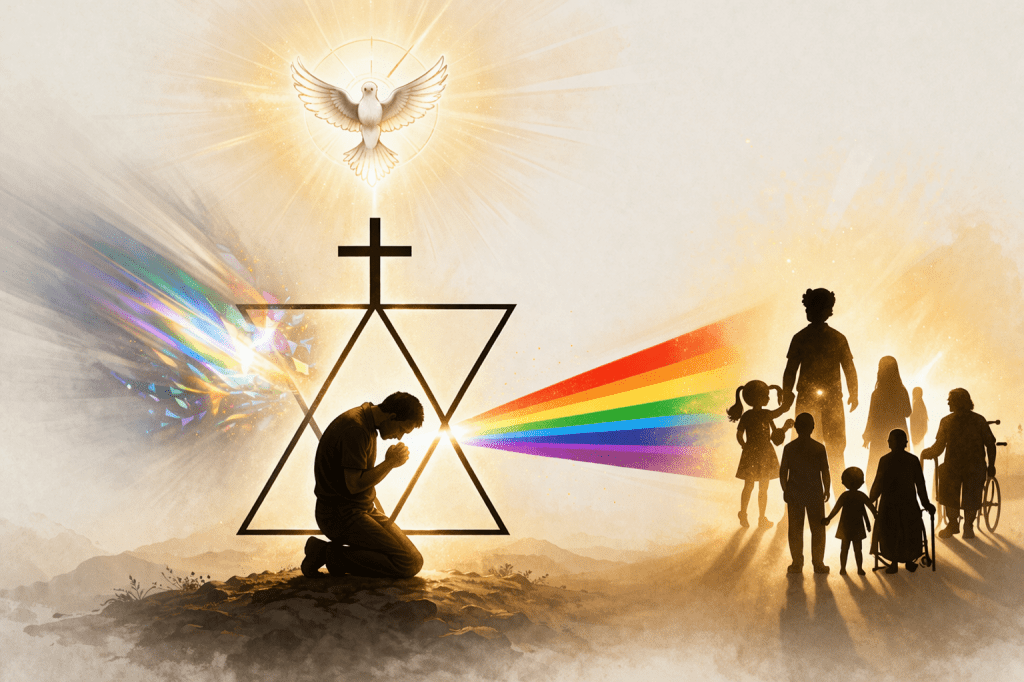
VI. The Prism as the Method of Praxis
The mirror returns the human to the human. The prism returns God to the human.
Praxis is prism-shaped:
It welcomes contrast, integrates tensions, celebrates diversity, transcends polarities, makes of every difference a refraction and of every refraction a legitimate color of light.
Thus the School can:
– dialogue with pop culture – speak with spiritualists – reach the politically engaged – welcome the wounded – converse with Catholics, evangelicals, atheists, skeptics, seekers – dialogue with adolescents, elders, intellectuals, artists – embrace peoples from different countries and regions.
Praxis does not uniformize. It transfigures.
The multiplicity of colors does not threaten the prism — it confirms it.
VII. The Praxis of Return: From Vision to Service
The School ascends — to touch the light. And descends — to touch the world.
This descent is its operative gesture: the movement of love with method, of humility with structure, of truth with mercy, of ethics with delicacy, of co-empathy with spiritual intelligence.
Praxis is this: the Spirit that touches and then returns carrying humanity.
The School walks into the human so that the human may walk again into God.
VIII. The Final Mission of Transfiguracionist Praxis
The praxis of the School has one single purpose:
to make all people touch one another again. To reunite what the world has separated. To reconnect humanity with humanity. To reconnect humanity with God.
It does not exist to convert. It exists to transfigure.
It does not exist to dominate. It exists to serve.
It does not exist to command. It exists to love.
It does not exist to create a new human group. It exists to remind that all are already part of the same Body.
And thus, in the constant movement of ascending to the Spirit and descending to the human, praxis fulfills its destiny:
the light returns to the world. And the world returns to being light.
“A luz que toca o alto desce para servir o mundo.”
I. A práxis como movimento vivo da Escola
Toda doutrina nasce de uma visão. Toda visão nasce de um espírito. Mas é a práxis — o gesto operativo — que revela a verdade daquilo que se afirma.
A Escola da Transfiguração Consciente não é uma doutrina para si mesma — é uma luz que se move. Não existe para ser contemplada, mas para tocar, acolher, falar, escutar, descer.
Sua existência não é estática. É dinâmica. É transfigurante.
E a transfiguração não ocorre apenas no plano místico: ela se manifesta no modo como a Escola opera no mundo.
A práxis é o seu modo de caminhar no humano.
II. O lugar da Escola: elevar-se para poder servir
A Escola busca o movimento de elevar-se espiritualmente — mas jamais para dominar.
Ela se eleva para ver de cima, para enxergar a totalidade do humano, para distinguir o prisma do espelho, para separar a verdade da ideologia, para compreender cada povo, cada língua, cada espírito.
Mas a altura da visão não a transforma em torre. Ela não vigia. Ela não julga. Ela não governa.
A altura existe para permitir o movimento contrário:
a descida.
A Escola sobe para receber luz e desce para manifestar amor.
A altitude é contemplação. A descida é serviço.
E entre essas duas forças — ascender e descer — vive a sua práxis.
III. O risco evitado: a tentação da ideologia
Se a Escola fosse mundana, ela teria sucumbido à tentação que devora todos os movimentos humanos:
criar rótulos
inventar identidades
formar tribos
construir fronteiras
determinar “quem pertence”
pedir renúncia de histórias pessoais
exigir conformidade cultural
impor defineções rígidas
fabricar slogans
replicar estruturas de poder
Ela teria se tornado uma doutrina humana, uma “nova ideologia”, um “novo grupo”, um novo sistema de segmentação.
Mas ela não se inclinou a esse caminho. E essa recusa é uma declaração de amor profundo ao humano.
A Escola não deseja seguidores. Deseja consciências despertas.
Não quer massa; quer pessoas.
Não quer formação ideológica; quer transfiguração interior.
Não quer rótulos; quer luz.
IV. O neo-humanismo trinitário como fonte da práxis
A práxis da Escola nasce do seu eixo: o neo-humanismo trinitário.
O humano é acolhido. A Trindade é o horizonte. O Espírito é o método.
A práxis se sustenta sobre três pilares:
Pai — a visão da unidade do humano
Filho — a encarnação que desce ao mundo concreto
Espírito — o amor que se espalha para dentro das culturas
A Escola não opera na esfera política, nem na ideológica, nem na moralista institucional.
Ela opera no campo mais raro: o campo pré-ideológico, onde o humano ainda é humano e onde Deus ainda é Deus antes das mediações deformadas do tempo.
É aí que a práxis nasce. É daí que ela se nutre. É assim que ela se move.
V. Descer ao humano — e falar sua língua
A práxis da Escola se caracteriza por um gesto fundamental:
descer.
Descer às pessoas. Descer às comunidades. Descer às culturas. Descer às minorias. Descer aos vulneráveis. Descer aos que ninguém escuta. Descer aos que perderam fé na linguagem e na instituição. Descer ao coração moderno, fragmentado, saturado, cansado.
E ao descer, a Escola pratica algo que é raríssimo:
ela fala a língua das pessoas sem exigir que as pessoas aprendam a sua.
Ela respeita:
vocabulário identitário
expressões de gênero
formas culturais
construções sociais
linguagens políticas
repertórios de dor
narrativas de pertencimento
modos de existir não normativos
tradições afetivas e espirituais
formas populares, periféricas, urbanas, comunitárias
formas filosóficas, acadêmicas, místicas ou seculares
A práxis da Escola é sempre dialógica, nunca impositiva. Sempre coempática, nunca colonizadora. Sempre transfiguradora, nunca apagadora.
Ela não exige renúncia da identidade. Ela convida à abertura e expansão da consciência.
VI. O prisma como método da práxis
O espelho devolve o humano ao humano. O prisma devolve Deus ao humano.
A práxis é prismática: ela acolhe o contraste, integra tensões, celebra a diversidade, transcende as polaridades, faz de cada diferença uma refração e de cada refração uma cor legítima da luz.
Por isso a Escola pode:
dialogar com a cultura pop
falar com espiritualistas
tocar politizados
acolher feridos
conversar com católicos, evangélicos, ateus, céticos, buscadores
dialogar com adolescentes, idosos, intelectuais, artistas
abraçar povos de diferentes países e regiões.
A práxis não uniformiza. Ela transfigura.
A multiplicidade das cores não ameaça o prisma — ela o confirma.
VII. A práxis do retorno: da visão ao serviço
A Escola sobe — para tocar a luz. E desce — para tocar o mundo.
Essa descida é o seu gesto operativo: o movimento do amor com método, da humildade com estrutura, da verdade com piedade, da ética com delicadeza, da coempatia com inteligência espiritual.
A práxis é isso:
o Espírito que toca e depois retorna carregado de humanidade.
A Escola caminha para dentro do humano para que o humano volte a caminhar para dentro de Deus.
VIII. A missão final da práxis transfiguracionista
A práxis da Escola tem como objetivo fazer com que todos se toquem e:
Unir o que o mundo separou. Reconectar humanidade e humanidade. Reconectar humanidade e Deus.
Ela não existe para converter. Ela existe para transfigurar.
Não existe para dominar. Existe para servir.
Não existe para mandar. Existe para amar.
Não existe para criar um novo grupo humano. Existe para lembrar que todos já são parte do mesmo Corpo.
E assim, no movimento constante de subir ao Espírito e descer ao humano, a práxis realiza seu destino:
The School of Conscious Transfiguration recognizes that every authentic spiritual journey is born from an interior movement and, at the same time, leads to a return to God. The soul opens, the light passes through, and the Spirit acts.
Yet this path is neither chaotic nor arbitrary: it possesses a structure, a rhythm, and a mystical logic that unfolds within the human being—from the very first steps to the highest states of consciousness.
This structure is called the Mystical Tridimensionality.
It forms the inner map of our spiritual journey: the way the being moves, the way the gaze is illuminated, the way the spirit matures, and the way the human person is restored toward Christ.
The Mystical Tridimensionality is composed of three essential movements:
– Transmutation – Transposition – Transcendence
Together, they form a living, dynamic, gradual, and profoundly human spiral.
II. First Movement: Transmutation
The awakening of light within the soul
Transmutation is the first touch of the Spirit. It is when a person begins to see the world with new eyes—not because they have become perfect, but because they have made space within.
Here begins the silent transformation: a shift of perception, a conversion of understanding, a reorientation of consciousness.
Transmutation does not require sanctity. It does not require moral victory. It does not require complete healing.
It requires only one interior truth:
“I want to see what God sees.”
It is upon this humble soil that grace finds fertile ground.
At this stage, the person still struggles with limits, shadows, impulses, fragilities. But they are no longer the same—their gaze has been touched.
Transmutation is the first act of mysticism: the soul inclines toward God, and He ignites the first spark of clarity within.
III. Second Movement: Transposition
The crossing of the human into the interior of the spirit
To transpose is to cross.
It is the moment in which the human being begins to surpass barriers that once seemed absolute—not the barriers of a purified character, but the barriers of blind materiality, superficiality, and dispersion.
The person still has weaknesses. Still carries habits they wish to overcome. Still stumbles.
But now they cross the surface of life.
To transpose is to move between dimensions of existence: between the ordinary and the spiritual, the apparent and the essential, the noise and the interior silence.
Here, the Living Attentively begins to operate with strength. You see the world with greater depth. You name truths that once went unnoticed. You find meaning where before there was only opaque mass.
Transposition is the moment when the gaze begins to dwell within the truth.
IV. Third Movement: Transcendence
The expansion of the soul toward God
Transcendence is not moral superiority. It is not a permanent ecstasy. It is not an escape from reality.
It is the moment in which the Spirit finds a stable dwelling within the person, and the person—even wounded—begins to act from within the light.
To transcend is:
– to allow God to widen your interior; – to let the spark become flame; – to perceive the world from the clarity of above; – to live faith as wisdom, not merely effort.
Transcendence is gradual. It grows with humility. It expands with truth lived. It roots itself in the heart that loves.
Transcendence is the soul finding its axis in the Christological Prism.
V. The Principle of the Smallest Movement
The School establishes a fundamental spiritual axiom:
Any authentic movement toward God—no matter how small—is immense in the eyes of the Spirit.
This means:
– the smallest transmutation counts; – the smallest step of transposition counts; – the smallest flicker of transcendence counts.
For the Kingdom opens itself in the small. Christ is born in the stable. God begins in the invisible.
The Mystical Tridimensionality is accessible to all. It begins on the ground of everyday life. And every spark is already true light.
VI. The Unity with Living Attentively
The Mystical Tridimensionality does not float in abstraction. It is sustained, at its base, by the ethical-operative core of Living Attentively, where reside:
It is in the core of Attentive Living that transmutation gains strength, that transposition gains direction, and that transcendence flows with maturity.
The method is not accessory: it is the living foundation of the Mystical Tridimensionality.
VII. The Convergence with the Christological Prism
The summit of the Mystical Tridimensionality is the union of the gaze with the Christological Prism, the ontological foundation of the School.
The prism is:
– the origin of light; – the revelation of truth; – the key of existence; – Christ as the center of reality; – the ultimate structure of creation; – the refracted unity of grace.
Just as light enters the prism and expands into colors, the transmuted, transposed, and transcendent soul enters Christ and unfolds into the fullness of spiritual life.
The Prism is the summit. The Tridimensionality is the path. Attentive Living is the ground. The soul is the temple. The Spirit is the breath. Christ is the light.
VIII. Conclusion: The Complete Mystical Architecture
The Mystical Tridimensionality is therefore:
– the axial core of the School – the spiritual episteme of the method – the inner structure of the human path – the dynamic of the ascent of being – the map of transfiguration
It teaches:
– how the being awakens (transmutation) – how the being crosses (transposition) – how the being is illuminated (transcendence)
And all of this begins in the small, the humble, the simple— until the spirit rises to the contemplation of the living Christ and the participation in the unity of the Universal Christic Body.
Thus, the Mystical Tridimensionality is declared to be a foundational doctrine, spiritual axis, and non-negotiable pillar of the School of Conscious Transfiguration.
A Escola da Transfiguração Consciente reconhece que toda jornada espiritual autêntica nasce de um movimento interior e, ao mesmo tempo, conduz a um reencontro com Deus. A alma se abre, a luz atravessa, e o Espírito opera.
Entretanto, este caminho não é caótico, nem arbitrário: ele possui uma estrutura, um ritmo e uma lógica mística que se desvela no interior do ser humano desde os primeiros passos até os mais altos estados de consciência.
Essa estrutura é chamada pela Escola de Tridimensionalidade Mística.
Ela constitui o mapa interior de nossa jornada espiritual: o modo como o ser se move, como o olhar se ilumina, como o espírito amadurece, e como o humano é restaurado na direção de Cristo.
A Tridimensionalidade Mística é composta por três movimentos essenciais:
Transmutação
Transposição
Transcendência
Eles formam uma espiral viva, dinâmica, gradual e profundamente humana.
II. Primeiro Movimento: A Transmutação
O despertar da luz no interior da alma
A transmutação é o primeiro toque do Espírito. É quando a pessoa começa a ver o mundo com outros olhos — não porque se tornou perfeita, mas porque abriu espaço dentro de si.
Aqui nasce a mudança silenciosa: um deslocamento do olhar, uma conversão do entendimento, uma reorientação da consciência.
A transmutação não exige santidade. Não exige vitória moral. Não exige cura total.
Ela exige apenas uma única verdade interior:
“Eu quero ver o que Deus vê.”
É no terreno humilde desse desejo que a graça encontra solo fértil.
Nessa fase, a pessoa ainda luta com limites, sombras, impulsos, fragilidades. Mas já não é mais a mesma — o olhar foi tocado.
A transmutação é, assim, o primeiro ato da mística: a alma inclina-se para Deus e Ele acende dentro dela a primeira claridade.
III. Segundo Movimento: A Transposição
A travessia do humano para o interior do espírito
Transpor é atravessar.
É o ponto em que o ser humano passa a ultrapassar barreiras que antes lhe pareciam absolutas: não as barreiras do caráter já purificado, mas as barreiras da materialidade cega, da superficialidade, da dispersão.
A pessoa ainda possui fraquezas. Ainda carrega hábitos que deseja superar. Ainda tropeça.
Mas agora ela atravessa a superfície da vida.
Transpor significa mover-se entre dimensões da existência: entre o cotidiano e o espiritual, entre o aparente e o essencial, entre o ruído e o silêncio interior.
Aqui o viver atento começa a operar com força. Tu vês o mundo com mais profundidade. Tu nomeias verdades que antes passavam despercebidas. Tu encontras sentido onde antes só havia massa opaca.
A transposição é o momento em que o olhar começa a morar dentro da verdade.
IV. Terceiro Movimento: A Transcendência
A expansão da alma na direção de Deus
A transcendência não é ápice moral. Não é êxtase permanente. Não é fuga da realidade.
É o momento em que o Espírito encontra morada estável na pessoa, e a pessoa — mesmo ferida — começa a operar a partir da luz.
Transcender é:
– permitir que Deus amplie o teu interior; – deixar que a centelha se torne chama; – perceber o mundo a partir da claridade do alto; – viver a fé como sabedoria, e não apenas como esforço.
A transcendência é gradual. Ela cresce com a humildade. Ela se expande com a verdade vivida. Ela se firma no coração que ama.
A transcendência é a alma encontrando seu eixo no Prisma Cristológico.
V. O Princípio do Menor dos Movimentos
A Escola estabelece um axioma espiritual fundamental:
O menor movimento autêntico na direção de Deus já é gigantesco aos olhos do Espírito.
Isso significa:
– a menor transmutação vale; – o menor passo de transposição vale; – a menor cintilação de transcendência vale.
Porque o Reino se abre no pequeno. Porque Cristo nasce no estábulo. Porque Deus começa no invisível.
A tridimensionalidade mística é acessível a todos. Ela se inicia no chão da vida. E cada centelha já é luz verdadeira.
VI. A Unidade com o Viver Atento
A tridimensionalidade mística não paira no ar. Ela é sustentada, na base, pelo núcleo ético-operativo do Viver Atento, onde residem:
É no núcleo do Viver Atento que a transmutação se fortalece, que a transposição ganha direção, e que a transcendência flui com maturidade.
O método não é acessório: ele é a base viva da tridimensionalidade mística.
VII. A Convergência com o Prisma Cristológico
O ápice da tridimensionalidade mística é a união do olhar com o Prisma Cristológico, fundamento ontológico da Escola.
O prisma é:
– origem da luz; – revelação da verdade; – chave da existência; – Cristo como centro da realidade; – a estrutura última da criação; – a unidade refratada da graça.
Assim como a luz entra no prisma e se expande em cores, a alma transmutada, transposta e transcendente entra em Cristo e se desdobra na plenitude da vida espiritual.
O Prisma é o topo. A tridimensionalidade é o caminho. O Viver Atento é o solo. A alma é o templo. O Espírito é o sopro. Cristo é a luz.
VIII. Conclusão: A Arquitetura Mística Completa
A Tridimensionalidade Mística constitui, portanto:
– o eixo axial da Escola – a episteme espiritual do método – a estrutura interna do caminho humano – a dinâmica da ascensão do ser – o mapa da transfiguração
Ela permite compreender:
– como o ser desperta (transmutação) – como o ser atravessa (transposição) – como o ser se ilumina (transcendência)
E tudo isso se inicia no chão, no pequeno, no simples — até elevar o espírito à contemplação do Cristo vivo, e à participação na unidade do Corpo Crístico Universal.
Assim, declara-se que a Tridimensionalidade Mística é fundamento doutrinário, eixo epistemológico e pilar inegociável da Escola da Transfiguração Consciente.
The Reconciliation of All Things in the Transfiguration of Christ
I. The Vision of Dimensions and the Transfigured Vitruvian Man
The School of Conscious Transfiguration begins from a simple yet profound truth: reality is dimensional and relational. Nothing exists in isolation. Nothing lives alone. Nothing finds meaning outside the networks of connection that structure the cosmos, consciousness, and spirit.
Living Attentively — the inaugural practice of the School — emerges precisely from this perception: life reveals itself only when the gaze opens to relationships.
By asking, “What is the relation?” the human being crosses the first threshold of expanded consciousness. They leave behind the superficial reading of existence and begin to see the world as an interwoven tapestry of layers:
• the visible dimension of matter (3D), • the relational dimension of metaphysics, shaped by space and time (4D), • and the dimension of full consciousness, where spirit, reason, and interiority join as one (5D).
These are not rigid hierarchies but permeable and complementary planes of operation of consciousness. The body lives in space and time; the soul moves within the relational field that connects all things; and the spirit integrates, illuminates, and transfigures these layers into one living unity.
Within this dimensional view emerges the most powerful anthropological image of the School: the Transfigured Vitruvian Man.
Leonardo da Vinci’s original figure was already a metaphysical icon — a duplication of the human form that intuitively revealed the coexistence of body and soul. The circle and the square, the duplication of limbs, the geometric centrality — all of it suggested an ontology, not merely a study of proportions.
The transfigured version of the School makes explicit what the original whispered. The honeycomb of hexagons — symbol of the universe’s relational fabric, of neural networks, of cosmic patterns, of the silent wisdom of creation — overlays the human figure and extends beyond the geometric square. It announces that reality exceeds human comprehension, that metaphysics surpasses the limits of reason, and that there are dimensions of creation not yet revealed, though intuited by the spirit.
Above the head of the transfigured human rises the spiritual Delta with the Cross — the vertex of mystery, symbol of divine verticality, of light descending, of consciousness opening. This Delta also exceeds the boundaries of the square, affirming what history always showed: the divine never fit within the rigid structures of human comprehension. The mystery is greater. The light is greater. The wisdom is greater.
Within the figure, two prisms — one pointing upward, one downward — form the vertical axis of being. The upper prism represents the spiritual dimension, the human openness to the eternal, the light that descends. The lower prism represents embodiment, the density of flesh, the rootedness of concrete life.
Between them, the human body lives in tension and connection — a bridge between what is above and what is below.
Thus, the Transfigured Vitruvian Man becomes the first map of the School: the synthesis-image of the dimensional human, uniting matter, soul, and spirit; reason, intuition, and faith; the human ascending and the divine descending. It reveals the human as microcosm of creation — integrated, reconnected, and prepared for the path of transfiguration.
This dimensional vision is the root. It is the ground of Living Attentively. It is the starting point of the entire doctrine.
II. Trinitarian Neo-Humanism
Trinitarian Neo-Humanism is the anthropological heart of the School of Conscious Transfiguration. It arises when the human being, illuminated by the dimensional vision and awakened through Living Attentively, recognizes that their interior structure is trinitarian — not metaphorically, but essentially.
Every person carries within a living dance of three fundamental intelligences: faith, reason, and emotion-intuition. Historically separated or even placed in conflict, these expressions now reveal themselves as direct reflections of the Father, the Son, and the Holy Spirit within the human soul.
Trinitarian Neo-Humanism reconciles everything modernity fragmented. It returns the human being to their original integrity, dissolving dichotomies that no longer serve the world: science versus faith, rationality versus sensitivity, body versus spirit, matter versus consciousness.
Here, everything finds its place.
Faith becomes the axis that anchors the human being in meaning and mystery. Reason is the axis that structures, clarifies, and understands. Emotion-intuition is the axis that animates, connects, and inspires.
The three move in perichoretic unity, like the Trinity: distinct, yet never separated.
This new humanism rejects none of the traditions — it transfigures them. Spirituality is no longer seen as opposed to science; science is no longer seen as a threat to the sacred. Both become windows into the real. Emotion and intuition recover epistemological dignity — not irrationalities, but legitimate modes of wisdom. Reason is liberated from denying the invisible and returns to its true vocation: understanding the order of creation and serving the light that illumines it.
Within this Neo-Humanism, the human being is revealed as:
• a creature rooted in the Earth, • a consciousness breathing within the universe’s relational field, • a spirit open to divine transcendence.
This restores a lost greatness — not proud greatness, but humble greatness. Not blind anthropocentrism, but the illumined human, aware of its role as a bridge between dimensions, worlds, knowledges, mystery, and matter.
Neo-Humanism thus becomes the table where Leonardo da Vinci, Einstein, Giordano Bruno, Augustine, Hildegard, Hawking, the mystics, the alchemists, and the philosophers sit side by side — not as rivals, but as seekers of one multifaceted truth.
It prepares the human being to welcome the most profound operation of grace: the Christological Prism.
III. The Christological Prism
The operation of grace in the spiritual, human, individual, and collective dimensions
If Neo-Humanism reveals who the human being is, the Christological Prism reveals how God acts within them.
While the Transfigured Vitruvian shows the architecture of being, the Prism shows the circulation of light — the living dynamic between the above and the intimate, the intimate and the world, the world and the eternal.
The Christological Prism is the operative key of the School:
• the doctrine describing the path of divine light through the human, • the transmutation of the sacred into virtue, • and the expansion of this virtue through relationships and communities.
It is not metaphor. It is spiritual process.
1. Spiritual Dimension — The Light That Descends
From the upper vertex — the Delta with the Cross — the light of grace descends.
It is the light of the Holy Spirit:
• deep intuition, • interior awakening, • the breath of the soul, • luminous visitation, • the presence of the living Christ touching the innermost center of consciousness.
This light comes from beyond human limitation — beyond the geometric square of the world, beyond the mind’s reach, beyond time.
It does not invade; it invites. It does not force; it illuminates. It does not dominate; it reveals.
It is the continual gesture of God: descending in order to elevate.
2. Human Dimension — The Body as Prism
The human being — in body, soul, and spirit — is the prism.
Each virtue is a color of the light. Each good act is a ray emerging from the prism of the soul.
Here the doctrine becomes living reality: grace is multiplied in the human being.
3. Individual Dimension — The Transfiguration of the Self
The light that passes through the interiority becomes personal transfiguration:
clarity of perception, depth of feeling, truthfulness of action, lucidity of reaction, consciousness in love, presence in living.
A new Self emerges — reconciled, restored, whole. Transfiguration is not self-improvement; it is grace welcomed.
4. Collective Dimension — Light That Illuminates Relationships and Forges Community
The light does not stop at the individual. It moves through relationships, exactly as the honeycomb in the Vitruvian indicates.
Personal transfiguration becomes:
• family reconciliation, • relational healing, • pacification, • active compassion, • listening, • presence, • altruism, • justice, • responsibility, • construction of the common good.
Where there was separation, light creates bridges. Where there was fear, it creates trust. Where there was individualism, it creates community.
Thus arises the Wheel of Virtue — the luminous circle around every transfigured person.
And as others are illuminated, the wheels multiply, connect, expand, and weave a network of light that embraces the community.
The Prism is not about the individual alone — it is about humanity. The light God gives to one person is destined to reach the world.
IV. Conscious Transfiguration as Universal Reconciliation — “That they may all be one”
Conscious Transfiguration is the apex of the School’s doctrine: the moment when the human being, illuminated by descending light and transfigured interiorly by grace, becomes capable of reconciling everything once thought irreconcilable.
It is the living operation of the Holy Spirit in humanity.
Transfiguration begins inside, but it expands through relationships, reshapes communities, and quietly rebuilds the spiritual axis of the world.
It is the living fulfillment of John 17 — not as imposed uniformity, but as mystical unity, organic and luminous.
When individuals are reconciled, they reconcile others. When relationships heal, communities transform. When communities awaken, humanity moves toward the unity Christ revealed.
This is the spiritual destiny of the human race. This is the vocation of the School of Conscious Transfiguration. This is the promise of the Light.
V. Living Attentively — The Method of Transfigured Consciousness
If the dimensional vision reveals the architecture of reality, if Neo-Humanism reveals the structure of the human being, if the Prism reveals the dynamics of grace, and if Conscious Transfiguration reveals the universal reconciliation,
then Living Attentively is the living method that allows the human being to inhabit this doctrine.
No light endures if it does not take form in life.
Living Attentively is not intellectual exercise nor isolated meditation — it is a way of existing, a protective epistemology, a living philosophy, a continuous movement of inner and outer transfiguration.
It reorganizes consciousness, rescues perception from automatism, awakens moral sensitivity, and restores spiritual coherence.
It stands on three foundations:
1. Embodied Epistemology
To know is not to accumulate, but to see. To discern rather than react. To understand in relationships rather than in isolated data.
2. Embodied Philosophy
To think is not to theorize, but to expand consciousness. Not to explain the world, but to rediscover the depth of the soul.
3. Protective Method (Epistemic Shield)
Living Attentively protects the human being from manipulation, noise, ideological pride, and systems of domination — preserving the integrity of the person and the clarity of conscience.
The Transformative Triad — How Living Attentively Manifests
It generates three interior transfigurations:
• Transfiguration of Feelings • Transfiguration of Symbols • Transfiguration of Paradigms
Interior transfiguration generates exterior transformation. The light that enters must leave. Perception becomes life.
The Axioms — Humility, Justice, and Cohesion
Humility — the lucid recognition of one’s human condition. Justice — integrity between value and action. Cohesion — unity between what one thinks, feels, and does.
These three safeguard the trinitarian movement of the human being.
Living Attentively as the Path of Transfiguration
It restores:
• the mastery of consciousness, • the integrity of being, • the freedom from external structures, • the capacity to recognize light in all things.
It is the method that transforms the world beginning within each person.
And it is the path through which the Church of the Spirit, the reconciled humanity, and the dream of Christ — “that they may all be one” — begin to take form.
A Reconciliação de Todas as Coisas na Transfiguração de Cristo
I. A Visão das Dimensões e o Homem Vitruviano Transfigurado
A Escola da Transfiguração Consciente parte de uma verdade simples, porém profunda: a realidade é dimensional e relacional. Nada existe isolado. Nada vive sozinho. Nada encontra sentido fora das redes de conexão que estruturam o cosmos, a consciência e o espírito. O Viver Atento — a prática inaugural da Escola — nasce precisamente dessa percepção: a vida só se revela plenamente quando o olhar se abre para as relações.
Ao perguntar “Qual é a relação?”, o ser humano atravessa o primeiro limiar da consciência expandida. Ele sai da leitura superficial da existência e passa a enxergar o mundo como um entrelaçamento de camadas:
a dimensão visível da matéria (3D),
a dimensão relacional da metafísica, regida por tempo e espaço (4D),
e a dimensão da consciência plena, onde espírito, razão e interioridade se integram (5D).
Essas três instâncias não são hierarquias fixas, mas planos de operação da consciência, permeáveis e complementares. O corpo vive no espaço e no tempo; a alma se move no campo relacional que conecta todas as coisas; e o espírito integra, ilumina e transfigura essas camadas numa única unidade viva.
É dentro dessa visão dimensional que emerge a mais poderosa imagem antropológica da Escola: o Homem Vitruviano Transfigurado. A figura de Leonardo da Vinci já era, desde o Renascimento, um ícone metafísico — uma duplicação do humano que revelava, intuitivamente, a coexistência entre corpo e alma. O círculo e o quadrado, a duplicidade dos membros, a centralidade geométrica do corpo: tudo ali sugeria uma ontologia, não apenas um estudo de proporções.
A versão transfigurada da Escola torna explícito o que estava apenas sussurrado no original. A colmeia de hexágonos — símbolo do tecido relacional do universo, das redes neurais, dos padrões do cosmos e da sabedoria silenciosa da criação — se sobrepõe ao corpo humano e se estende para além do quadrado geométrico. Isso indica que a realidade é maior do que a compreensão humana, que a metafísica excede os limites da razão, que existem dimensões da criação não reveladas, mas intuídas pelo espírito.
Sobre a cabeça do humano transfigurado, ergue-se o Delta espiritual com a Cruz — vértice do mistério, símbolo da verticalidade divina, da luz que desce e da consciência que se abre. Esse Delta também ultrapassa os limites do quadrado, afirmando que o divino nunca coube na estrutura rígida da compreensão humana. O mistério é maior. A luz é maior. A sabedoria é maior.
E no interior da figura, dois prismas — um voltado ao alto, outro voltado à base — formam o eixo vertical do ser. O prisma superior representa a dimensão espiritual, a abertura do humano ao eterno, a luz que desce; o prisma inferior representa a encarnação, a densidade da carne, o enraizamento na vida concreta. Entre eles, o corpo humano vive tensionado e conectado, como ponte entre o que é de baixo e o que é de cima.
Assim, o Homem Vitruviano Transfigurado torna-se o primeiro mapa da Escola: a imagem-síntese do ser dimensional, unindo matéria, alma e espírito; razão, intuição e fé; o humano que ascende e o divino que desce. Ele representa o humano como microcosmo da criação — integrado, reconectado e preparado para o caminho da transfiguração.
Essa visão das dimensões é a raiz. É o chão do Viver Atento. É o ponto de partida de toda a doutrina.
II. O Neo-Humanismo Trinitário
O Neo-Humanismo Trinitário é o coração antropológico da Escola da Transfiguração Consciente. Ele nasce quando o ser humano, iluminado pela visão dimensional e despertado pelo Viver Atento, reconhece que sua própria estrutura interior é trinitária — não por metáfora, mas por constituição profunda. Cada pessoa carrega dentro de si a dança viva entre três inteligências fundamentais: a fé, a razão e a emoção-intuição. Essas três expressões humanas, historicamente separadas e até colocadas em conflito, revelam-se agora como reflexos diretos do Pai, do Filho e do Espírito Santo na alma humana.
O Neo-Humanismo Trinitário é, portanto, a reconciliação de tudo aquilo que a modernidade fragmentou. Ele devolve ao ser humano sua integridade original, dissolvendo dicotomias que já não servem ao mundo: ciência contra fé, racionalidade contra sensibilidade, corpo contra espírito, matéria contra consciência. Aqui, tudo encontra seu lugar. A fé torna-se o eixo que ancora o humano no sentido e no mistério. A razão é o eixo que estrutura, esclarece e compreende. A emoção-intuição é o eixo que anima, conecta e inspira. E os três se movem em unidade pericorética, como a própria Trindade: distintos, mas jamais separados.
Essa nova visão humanista não rejeita nenhuma das tradições; antes, as ressignifica. A espiritualidade deixa de ser vista como oposta à ciência; a ciência deixa de ser vista como ameaça ao sagrado. Ambas passam a ser janelas para o real. A intuição e a emoção recuperam dignidade epistemológica — não são irracionalidades, mas modos legítimos de sabedoria, caminhos de acesso à verdade e sinais da profundidade da alma. A razão, por sua vez, é libertada da tarefa de negar o invisível; ela passa novamente a ser o instrumento que compreende a ordem da criação e serve à luz que a ilumina.
Dentro do Neo-Humanismo Trinitário, o ser humano finalmente se reconhece como:
criatura enraizada na Terra,
consciência que respira no campo relacional do universo,
espírito aberto à transcendência divina.
Isso devolve ao humano uma grandeza que ele havia perdido — não a grandeza orgulhosa, mas a grandeza humilde. Não o antropocentrismo cego, mas o antropos luminado, integrado, consciente de que é ponte entre dimensões, entre mundos, entre saberes, entre mistério e matéria.
O Neo-Humanismo Trinitário também inaugura a reconciliação entre as tradições do pensamento. Ele é a mesa onde Leonardo da Vinci, Albert Einstein, Giordano Bruno, Santo Agostinho, Stephen Hawking, Hildegarda de Bingen, os alquimistas, os místicos e os filósofos finalmente sentam lado a lado — não como rivais, mas como buscadores de uma mesma verdade multifacetada. Em vez de fragmentar, ele reúne. Em vez de excluir, ele amplia. Em vez de combater, ele integra. A humanidade deixa de se dividir em campos opostos e, pela primeira vez, alcança a maturidade espiritual de reconhecer que todos os ramos da inteligência humana apontam para a mesma luz, embora falem em linguagens diferentes.
Assim, o Neo-Humanismo Trinitário torna-se a chave para compreender o ser humano não apenas como organismo, nem apenas como consciência, mas como templum vivum — templo vivo onde a Trindade opera, respira, age e transforma. Ele revela o humano como lugar de encontro entre Deus e a criação, ponto de interseção entre o eterno e o temporal, estrutura capaz de acolher a luz e devolvê-la ao mundo multiplicada em virtudes, obras e vínculos.
É essa antropologia reconciliada que prepara o terreno para a operação mais profunda da graça na pessoa humana: o Prisma Cristológico, que veremos a seguir.
III. O Prisma Cristológico
A operação da graça na dimensão espiritual, humana, individual e coletiva
Se o Neo-Humanismo Trinitário revela quem o ser humano é, o Prisma Cristológico revela como Deus age dentro dele.
Enquanto o Vitruviano Transfigurado mostra a arquitetura dimensional do ser, o Prisma mostra a circulação da luz — a dinâmica viva entre o alto e o íntimo, entre o íntimo e o mundo, entre o mundo e o eterno.
O Prisma Cristológico é a chave operativa da Escola: a doutrina que descreve o caminho da luz através do humano, a transmutação do sagrado em virtude, e a expansão dessa virtude através dos vínculos e das comunidades.
Não é metáfora; é processo espiritual real.
1. Dimensão Espiritual — A Luz que Desce
Do vértice do alto do ser humano — simbolizado pelo Delta com a Cruz no Vitruviano Transfigurado — desce a luz da graça.
É a luz do Espírito Santo: a intuição profunda, o despertar interior, o sopro da alma, a visitação luminosa, a presença do Cristo vivo que toca o centro mais íntimo da consciência.
Essa luz vem da esfera que ultrapassa nossos limites — daquilo que excede o quadrado geométrico do mundo, daquilo que está além do que a mente pode compreender, daquilo que é eterno.
A luz que desce é sempre maior do que o humano que a recebe.
Ela não invade; ela convida. Ela não força; ela ilumina. Ela não domina; ela revela.
É o gesto contínuo de Deus: descer para elevar.
2. Dimensão Humana — O Corpo como Prisma
O ser humano, em toda sua complexidade dimensional (corpo-alma-espírito), é o prisma. Dentro dele a luz se encontra com:
a história pessoal,
as feridas,
as memórias,
os desejos,
os medos,
as virtudes,
as sombras,
as escolhas,
a liberdade.
É nesse encontro que a luz é refratada — ou seja, transformada.
A graça que entra como unidade divina se amplia dentro da pessoa, criando múltiplas expressões:
coragem,
mansidão,
justiça,
verdade,
compaixão,
humildade,
fidelidade,
paciência,
discernimento,
presença,
serviço.
Cada virtude é uma cor da luz.
Cada gesto bom é um raio que saiu do outro lado do prisma da alma.
Aqui a doutrina se torna viva: a graça é multiplicada no humano.
3. Dimensão Individual — A Transfiguração do Eu
A luz, ao atravessar a interioridade, torna-se transfiguração pessoal.
A pessoa começa a:
enxergar com mais clareza,
sentir com mais profundidade,
agir com mais verdade,
reagir com mais lucidez,
amar com mais consciência,
viver com mais presença.
Aqui nasce o novo Eu: o Eu reconciliado consigo, o Eu devolvido à sua inteireza, o Eu restaurado pela verdade da luz.
É o primeiro fruto do Prisma. A transfiguração individual não é autoaperfeiçoamento — é graça acolhida.
4. Dimensão Coletiva — A Luz que Ilumina os Vínculos e Cria Comunidade
A luz não para no indivíduo.
Ela atravessa vínculos e redes humanas — exatamente como a colmeia do Vitruviano Transfigurado indica.
A transfiguração pessoal torna-se:
reconciliação familiar,
cura relacional,
pacificação,
compaixão ativa,
escuta,
presença,
altruísmo,
justiça,
responsabilidade,
construção do bem comum.
Onde antes havia separação, a luz cria ponte. Onde antes havia medo, cria confiança. Onde antes havia individualismo, cria comunidade.
E assim nasce a Roda da Virtude — o círculo luminoso que envolve todos os que convivem com um ser transfigurado.
Depois surgem outras rodas, e outras, e outras, até que a graça se espalha como rede de luz, criando uma comunidade expandida, fraterna, convergente, viva.
O Prisma Cristológico, portanto, não é apenas sobre o indivíduo: é sobre a humanidade inteira.
Pois a luz que Deus entrega a uma pessoa é destinada a tocar o mundo.
IV. A Transfiguração Consciente como Reconciliação Universal — “Para que todos sejam um”
A Transfiguração Consciente é o ápice da doutrina da Escola da Transfiguração Consciente: o momento em que o ser humano, iluminado pela luz que desce do alto e transfigurado pelo movimento interior da graça, se torna capaz de reconciliar tudo o que antes parecia irremediavelmente separado. É a operação viva do Espírito Santo no interior da humanidade; é a dinâmica pela qual o indivíduo reconciliado torna-se fonte de reconciliação para o mundo; é a costura silenciosa que devolve unidade ao que foi fragmentado, sentido ao que foi disperso, luz ao que estava dividido.
A transfiguração começa no interior, quando Deus desce ao ser humano. A luz que incide pelo vértice do vitruviano transfigurado atravessa a alma, encontra as sombras e as virtudes, atravessa as memórias e as escolhas, toca os medos e a coragem, e ali, no ponto mais íntimo da consciência, revela outra possibilidade de existir. A pessoa começa a ver o mundo não como campo de conflito, mas como campo de relações. A partir desse ponto, o eu se reconcilia consigo: o corpo com a alma, a razão com a emoção, o instinto com o espírito, a história com a esperança. O humano deixa de viver fragmentado e passa a viver integrado.
Mas essa reconciliação interior é apenas o primeiro raio. A luz multiplicada dentro da pessoa não permanece nela. Ela se expande para os vínculos: cura relações, desfaz ressentimentos, ilumina afetos, reorganiza presenças. Onde antes havia desconfiança, nasce compaixão; onde havia dureza, nasce mansidão; onde havia isolamento, nasce comunidade. A transfiguração pessoal torna-se transfiguração relacional — e em torno daquele que foi tocado pela luz, forma-se a primeira Roda de Virtude. À medida que outras pessoas também são iluminadas, novas rodas surgem, se conectam, crescem, interagem e aos poucos tecem uma rede luminosa que abraça a comunidade, devolvendo-lhe seu eixo espiritual.
É aqui que a transfiguração deixa de ser apenas interior e se torna civilizatória. É aqui que ela cumpre sua vocação universal. E é aqui que o Evangelho atinge seu ponto máximo.
Pois a transfiguração consciente não é outra coisa senão a realização viva da oração de Jesus no capítulo 17 do Evangelho de João: “Para que todos sejam um.” Não é uma unidade artificial, construída por imposição, uniformidade, doutrina rígida ou coerção institucional. É a unidade viva, orgânica, espiritual, que nasce quando cada pessoa, iluminada pela luz divina, reencontra sua própria inteireza — e por isso pode reencontrar o outro. É a unidade que brota quando o Espírito Santo revela que tudo é relação; que cada vida toca outra; que nenhuma verdade existe isolada; que a criação inteira é um grande campo de interdependência amorosa.
Quando Cristo pediu que “todos fossem um”, Ele não falava de eliminar diferenças, mas de reconciliá-las; não falava de padronização, mas de integração; não falava de fusão, mas de comunhão. A transfiguração consciente é o modo pelo qual essa oração se cumpre na história humana: Deus desce ao indivíduo, o indivíduo se reconcilia consigo, essa reconciliação se expande para os vínculos, os vínculos reconfiguram a comunidade, e a comunidade transforma a humanidade.
Assim, cada ser transfigurado torna-se um ponto de unidade no mundo. Cada roda de virtude torna-se uma célula da nova humanidade. Cada comunidade iluminada torna-se antecipação do Reino. E a humanidade inteira, tocada pela luz que começou no indivíduo, caminha lentamente para a unidade que Cristo pediu — não por mandamento, mas por revelação.
A transfiguração consciente é, portanto, a reconciliação universal a que o Cristo chamou a criação inteira. É a ponte derrubando abismos; é a cura dissolvendo antagonismos; é a verdade encontrando a caridade; é o saber reencontrando o mistério; é a ciência reconciliando-se com a fé; é o humano reconciliando-se com o humano; é o humano reconciliando-se com Deus. É a obra silenciosa da graça, que começa dentro de uma pessoa e termina envolvendo o mundo inteiro.
E, quando tudo isso acontecer — quando a luz que desceu ao indivíduo iluminar os vínculos, quando os vínculos formarem rodas de virtude, quando as rodas iluminarem comunidades inteiras — então a oração de Cristo não será apenas texto, mas realidade transfigurada: “Para que todos sejam um.”
Esse é o destino espiritual da humanidade. Essa é a vocação da Escola da Transfiguração Consciente. Essa é a promessa da luz.
V. O Viver Atento — O Método da Consciência Transfigurada
Se a visão dimensional revela a arquitetura do real, se o Neo-Humanismo Trinitário revela a estrutura do humano, se o Prisma Cristológico revela a dinâmica da graça, e se a Transfiguração Consciente revela a reconciliação universal, então o Viver Atento é o método vivo que permite ao ser humano habitar essa doutrina na prática.
Nenhuma transformação é real se não se torna vida. Nenhuma luz permanece se não encontra forma de se encarnar. Nenhuma reconciliação floresce se não se converte em cuidado, presença, vigilância e amor. Por isso, o Viver Atento é o caminho cotidiano da Escola.
Ele é o gesto de olhar o mundo — e a si mesmo — com a lucidez humilde, sensível e coesa de quem sabe que tudo é relação, tudo é símbolo, tudo é formação, tudo é chamado.
O Viver Atento não é um exercício intelectual nem uma prática meditativa isolada; é um modo de existir, uma epistemologia encarnada, uma filosofia viva, uma proteção da alma e um movimento contínuo de transfiguração interior e exterior.
A Natureza do Método — O que é o Viver Atento
O Viver Atento é antes de tudo uma reorganização da consciência. Ele livra o olhar da mecanicidade, do automatismo, do torpor moral, e devolve ao espírito a capacidade de perceber o real com frescor e verdade. É atenção sensível, mas também lucidez estruturante; é humildade, mas também firmeza moral; é delicadeza perceptiva, mas também rigor interior.
Como método, ele se sustenta em três dimensões:
1. Epistemologia Encarnada — conhecer não é acumular, mas ver; não é reagir, mas discernir; não é possuir dados, mas compreender relações. O Viver Atento devolve ao humano a coragem de conhecer com o corpo, com a alma e com o espírito — e não apenas com o intelecto.
2. Filosofia Encarnada — pensar não é abstrair, mas expandir consciência; não é teorizar, mas transformar o olhar; não é explicar o mundo, mas reencontrar a profundidade da própria alma. A filosofia volta a ser vida e não sistema.
3. Método Protetivo (Escudo Epistêmico) — o Viver Atento protege o humano da captura externa, da manipulação, da mentira, das narrativas artificiais, da soberba ideológica e dos sistemas de dominação. Ele preserva a integridade do ser, devolvendo ao indivíduo o domínio sobre sua própria consciência.
O Viver Atento é o antídoto contra a fragmentação, contra o ruído, contra a perda da sensibilidade. Ele é o que protege a alma enquanto ela caminha em direção à luz.
A Tríade da Prática — Como o Viver Atento se manifesta
O método se expressa através de dois grandes movimentos: um interior, que é a transfiguração; e um exterior, que é a transformação.
No movimento interior, o Viver Atento provoca três transfigurações fundamentais, chamadas de Transfigurações da Matriz do Ser:
Transfiguração dos Sentimentos: as emoções deixam de ser forças caóticas e tornam-se matéria-prima da consciência. Cada afeto é compreendido, ressignificado e integrado como parte do caminho da luz.
Transfiguração dos Símbolos: tudo aquilo que molda o olhar — crenças herdadas, símbolos sociais, associações inconscientes, narrativas coletivas — é reexaminado. O humano deixa de reagir automaticamente e passa a interpretar a partir da verdade interior.
Transfiguração dos Paradigmas: antigas estruturas mentais cedem espaço a novos modos de compreender o mundo, compatíveis com a consciência atual. O humano reorganiza sua própria matriz de sentido.
Quando o interior se ilumina, começa o movimento exterior: a transformação. A pessoa passa a ver e agir de forma coerente com a luz que recebeu. Ela identifica padrões injustos, estruturas ultrapassadas, discursos inautênticos, práticas que já não servem ao bem — e ajuda a substituí-los por modos de viver mais alinhados à verdade.
A transfiguração interna gera transformação externa. A luz que entra, sai. O que começa como percepção se torna vida.
Os Axiomas do Método — Humildade, Justiça e Coesão
A eficácia do Viver Atento repousa sobre três pilares ontológicos, que são ao mesmo tempo virtudes, modos de ser e fundamentos da prática — as três colunas do Amor Essencial:
Humildade: o reconhecimento lúcido da própria condição humana, que abre espaço para aprender, compreender, servir e transformar-se. Sem humildade, a consciência endurece. Com humildade, ela floresce.
Justiça: não a lei fria, mas a integridade entre valor e ação. É o amor que sabe distribuir, reparar, proteger e escolher. A justiça é a bússola do amor; ela alinha o interior com o exterior.
Coesão: a integridade estrutural do ser, a unidade entre o que se pensa, o que se sente e o que se faz. É a correspondência viva entre interior e exterior, a força silenciosa da alma desperta.
Esses três pilares garantem que o Viver Atento não se perca em sensibilidade sem lucidez, nem em lucidez sem amor, nem em amor sem estrutura. Eles preservam o movimento trinitário do ser humano.
O Viver Atento como Caminho da Transfiguração
Ao final, o Viver Atento é o método pelo qual o humano, iluminado pelo Prisma Cristológico e fundamentado no Neo-Humanismo Trinitário, caminha em direção à Transfiguração Consciente. Ele é a prática que liga a doutrina à vida, o sagrado ao cotidiano, a consciência à ação.
Ele devolve ao ser humano:
o domínio da própria consciência,
a integridade do próprio ser,
a liberdade diante das estruturas externas,
e a capacidade de reconhecer a luz em todas as coisas.
O Viver Atento é aquilo que faz da doutrina uma forma de viver — e não apenas uma forma de pensar. É o método que transforma o mundo começando pelo interior de cada pessoa. E é, finalmente, o caminho pelo qual a Igreja do Espírito, a humanidade reconciliada e o sonho de Cristo — “para que todos sejam um” — começam a se tornar realidade.
“Porque o coração deste povo está endurecido, e ouviram de mau grado com seus ouvidos, e fecharam seus olhos, para que não vejam com os olhos, e ouçam com os ouvidos, e compreendam com o coração, e se convertam, e eu os cure. Porque, em verdade, vos digo que muitos profetas e justos desejaram ver o que vós vedes, e não o viram, e ouvir o que vós ouvis, e não o ouviram. Então os justos resplandecerão como o sol no reino de seu Pai. Quem tem ouvidos para ouvir, ouça.” (Mateus 13, 15; 17; 43.)
“For the heart of this people is grown gross, and with their ears they have been dull of hearing, and their eyes they have shut: lest at any time they should see with their eyes, and hear with their ears, and understand with their heart, and be converted, and I should heal them. For amen I say to you, many prophets and just men have desired to see the things that you see, and have not seen them, and to hear the things that you hear, and have not heard them. Then shall the just shine as the sun, in the kingdom of their Father. He that hath ears to hear, let him hear.” (Matthew 13, 15; 17; 43)
1. Introduction: the gaze as the spiritual axis of existence
The School of Conscious Transfiguration affirms that the contemporary moral and spiritual crisis does not arise merely from material excesses, but above all from a displacement of the gaze.
The way a human being sees — and what he chooses to see — determines how he relates to himself, to others, to the world and to God.
At the heart of this crisis, two symbolic figures represent two modes of perceiving reality:
the mirror and the prism.
The mirror imprisons the gaze on the surface of things. The prism opens the gaze to the depth of light.
This difference is not merely aesthetic. It is ontological.
The Doctrine of the Transfiguration of the Gaze is born to restore this distinction and to offer a spiritual reading capable of demystifying materialism — giving things their proper place and returning sovereignty to the soul.
2. The Mirror: the logic of objectification
The mirror has become the symbolic object of the materialist era.
It reproduces form and returns to the subject an image that, although sharp, is empty of truth.
When one looks into the mirror, one sees oneself reflected among things — as if identity depended on what surrounds the person.
The mirror sustains three central illusions:
2.1 The illusion of material value
In the mirror, objects become extensions of the self. A car, a garment, a house, a device — everything reflected seems to say who a person is. Thus, the human being is measured not by the soul, but by possessions.
2.2 The illusion of appearance
The mirror transfers existential weight to outward form. Appearance becomes the criterion of identity. One lives to be reflected — not to be.
2.3 The illusion of inner fulfillment
Materialism promises to fill inner emptiness with objects. But objects, being inanimate, can never fill the soul. The mirror disguises this emptiness, trapping the person in an endless cycle of seeking more reflections.
Thus, the mirror is the symbolic technology of the ego: it returns the image that pleases, but never the truth that liberates.
3. The Prism: the gaze transfigured by light
The prism operates in a radically different way.
While the mirror returns the surface, the prism reveals the essence. While the mirror reflects, the prism transfigures.
The Doctrine of the Transfiguration of the Gaze declares: the prism is the symbol of those who receive the light of God and diffuse it in many colors — clarifying reality.
3.1 The prism reveals light
Light, invisible to the naked eye, becomes visible when refracted through the prism. Likewise, the spiritual gaze allows one to see what is hidden behind appearances.
3.2 The prism distinguishes the living from the inanimate
The light that passes through the prism illuminates everything: – people, – creation, – nature, – environments, – matter.
But it also reveals, with clarity, the hierarchy of creation: the soul above the object, life above the thing, the person above the possession.
3.3 The prism restores meaning to things
In the prism, matter regains its rightful place: not as idol, not as ego-extension, not as substitute for God.
But as tool, object of utility, beautiful when rightly used, capable of serving life, relieving pain, building comfort, producing good.
Without ever taking the place of the soul.
4. The Prism heals materialism through the restoration of vision
The Doctrine declares that the problem of materialism is not the existence of things, but the inversion of spiritual order.
The prism corrects this inversion. It allows one to see: – the human before the object, – the spirit before the form, – truth before appearance, – value before price, – life before consumption.
The prism does not reject matter — it purifies it. It does not fight the existence of things — it fights their worship.
4.1 The prism prevents idolatry
Because it reveals the limited, instrumental and utilitarian nature of the object.
4.2 The prism combats emptiness
Because it offers no illusions: it shows that no material good can fill the space destined to divine light.
4.3 The prism restores the moral axis
Because it puts every element of life back in its rightful place.
5. To be a prism: a spiritual vocation
Being a prism is far more than having an elevated sensitivity. It is to take a spiritual position in the world:
– to be a channel of light, – to be a diffuser of goodness, – to be living consciousness, – to be harmony within environments, – to guide through inner clarity.
The prism does not distort light. It expands it.
For this reason, one who lives as a prism:
– does not bow to the world’s glitter, – does not drown in reflections, – does not measure himself by objects, – does not adorn himself with illusions, – does not confuse value with possession.
And at the same time:
– uses matter wisely, – recognizes its beauty, – welcomes its usefulness, – honors human creation, – but never gives the soul to the object.
To be a prism is to live with the eyes fixed on light — and the feet grounded in the world.
6. Conclusion: the transfigured gaze as an ethical path
The Doctrine of the Transfiguration of the Gaze teaches that the spiritual battle against materialism is not won by rejecting things, but by understanding their place.
The mirror imprisons. The prism liberates.
The mirror seduces. The prism clarifies.
The mirror offers false shine. The prism reveals true light.
The transfiguration of the gaze is, therefore, a pedagogy of consciousness: an invitation for humanity to see the world as it is — not as the mirror promises.
It is not a flight from matter, but a reconciliation with the spirit.
Not a denial of things, but the affirmation of the divine order of creation.
To see through the prism is to live with lucidity. And to live with lucidity is to walk in the light.
1. Introdução: o olhar como eixo espiritual da existência
A Escola da Transfiguração Consciente afirma que a crise moral e espiritual contemporânea não nasce apenas dos excessos materiais, mas sobretudo de um deslocamento do olhar. A forma como o ser humano vê — e o que ele elege ver — determina o modo como se relaciona consigo, com o outro, com o mundo e com o próprio Deus.
No coração dessa crise, duas figuras simbólicas representam dois modos de perceber a realidade: o espelho e o prisma.
O espelho aprisiona o olhar na superfície das coisas. O prisma abre o olhar para a profundidade da luz.
Essa diferença não é meramente estética. É ontológica.
A Doutrina da Transfiguração do Olhar nasce para restaurar essa distinção e para oferecer uma leitura espiritual capaz de desmistificar o materialismo, devolvendo às coisas o seu lugar e à alma a sua soberania.
2. O Espelho: a lógica da coisificação
O espelho se tornou o objeto simbólico central da era materialista. Ele reproduz a forma e devolve ao sujeito uma imagem que, embora nítida, é vazia de verdade. Ao olhar para o espelho, o indivíduo se vê refletido em meio às coisas, como se sua identidade dependesse daquilo que o circunda.
O espelho sustenta três ilusões centrais:
2.1 A ilusão do valor material
No espelho, o objeto se torna extensão da pessoa. Um carro, uma roupa, uma casa, um dispositivo — tudo aquilo que reflete no espelho parece dizer “quem” a pessoa é. Assim, a criatura passa a ser medida não por sua alma, mas por seus bens.
2.2 A ilusão estética
O espelho transfere à aparência o peso do valor existencial. A forma, vista como brilho, torna-se critério de identidade. O sujeito passa a viver para ser refletido — e não para ser.
2.3 A ilusão de preenchimento
O materialismo promete ocupar o vazio interior com objetos. Mas o objeto, sendo inanimado, nunca preenche a alma. O espelho disfarça esse vazio, mantendo o indivíduo preso a um ciclo de busca incessante por mais reflexos.
Assim, o espelho é a tecnologia simbólica do ego: ele devolve a imagem que agrada, mas nunca a verdade que liberta.
3. O Prisma: o olhar transfigurado pela luz
O prisma opera de modo radicalmente diferente. Enquanto o espelho devolve a superfície, o prisma revela a essência. Enquanto o espelho reflete, o prisma transfigura.
A Doutrina da Transfiguração do Olhar declara: o prisma é o símbolo de quem recebe a luz de Deus e a difunde em múltiplas cores — clareando o real.
3.1 O prisma revela a luz
A luz, invisível a olho nu, se torna visível quando atravessa o prisma. Da mesma forma, o olhar espiritual permite ver aquilo que está oculto na aparência.
3.2 O prisma distingue o vivo do inanimado
A luz que atravessa o prisma ilumina tudo: – pessoas, – criação, – natureza, – ambientes, – matéria.
Mas revela também, com clareza, a hierarquia da criação: a alma acima do objeto, a vida acima da coisa, a pessoa acima do bem.
3.3 O prisma devolve sentido às coisas
No prisma, a matéria recupera seu lugar correto: não como ídolo, não como extensão do ego, não como substituto de Deus.
Mas como ferramenta da criação, objeto útil, belo quando bem utilizado, capaz de servir à vida, aliviar dores, construir conforto e produzir bem. Sem jamais ocupar o lugar da alma.
4. O Prisma cura o materialismo pela restauração da visão
A Doutrina declara que o problema do materialismo não é a existência das coisas, mas a inversão da ordem espiritual. O prisma corrige essa inversão. Ele permite ver:
– o humano antes do objeto, – o espírito antes da forma, – a verdade antes da aparência, – o valor antes do preço, – a vida antes do consumo.
O prisma não rejeita a matéria — ele a purifica. Ele não combate a existência das coisas — ele combate seu culto.
4.1 O prisma impede a idolatria
Porque revela a natureza limitada, instrumental e utilitária do objeto.
4.2 O prisma combate o vazio
Porque não oferece ilusões: ele mostra que nenhum bem material preenche um espaço que é destinado à luz divina.
4.3 O prisma devolve o eixo moral
Porque recoloca cada elemento da vida em seu lugar justo.
5. Ser prisma: uma vocação espiritual
Ser prisma é muito mais do que possuir uma sensibilidade elevada. É assumir uma posição espiritual diante do mundo:
– ser canal da luz, – ser difusor do bem, – ser consciência viva, – ser harmonia para o ambiente, – ser orientador pela própria clareza interior.
O prisma não distorce a luz. Ele a expande.
Por isso, quem vive como prisma:
– não se curva ao brilho do mundo, – não se perde em reflexos, – não se mede por objetos, – não se enfeita com ilusões, – não confunde valor com coisa.
E ao mesmo tempo:
– usa a matéria com sabedoria, – reconhece sua beleza, – acolhe sua utilidade, – honra a criação humana, – mas nunca entrega a alma ao objeto.
Ser prisma é viver com os olhos fixos na luz — e os pés firmes no mundo.
6. Conclusão: o olhar transfigurado como caminho ético
A Doutrina da Transfiguração do Olhar nos ensina que a batalha espiritual contra o materialismo não se vence pela renúncia das coisas, mas pela compreensão de seu lugar.
O espelho aprisiona. O prisma liberta.
O espelho seduz. O prisma esclarece.
O espelho entrega um brilho falso. O prisma revela a luz verdadeira.
A transfiguração do olhar é, portanto, uma pedagogia da consciência: um convite para que o ser humano enxergue o mundo como ele é — e não como o espelho promete.
Não é uma fuga da matéria, mas uma reconciliação com o espírito.
Não é uma negação das coisas, mas a afirmação da ordem divina da criação.
Ver com o prisma é viver com lucidez. E viver com lucidez é caminhar na luz.