• AGAPE

    Reflexões da Escola da Transfiguração Consciente

    AGAPE

    What is capable of sustaining a difficult emptying? It is what can fill us again. It is essential love. In a transfiguring way.

    “And now these three remain: faith, hope and love. But the greatest of these is love.”
    1 Corinthians 13:13

    1. The Threshold of Emptying

    No sacred building can be erected upon the unstable ruins of a cluttered ground. In the economy of the soul and the architecture of the spirit, essential love—Agape—does not behave as a cosmetic additive or a superficial layer of moral varnish to be applied over the old structures of human pride. It demands, by virtue of its own absolute nature, a radical threshold, an insurmountable frontier that can only be crossed through Kenosis. The voluntary emptying of the ego is not an end in itself, nor an exercise in nihilism or psychological self-flagellation; it is, in truth, the ontological condition of possibility for real love to take possession of the being.

    The tragedy of contemporary man lies in the chronic attempt to love from his full deposits. One seeks the divine and the human carrying pockets stuffed with commodified certainties, rehearsed performances, untouched traumas, and a deafening despair for validation. The result of this tragic superposition is a simulacrum: an affection that does not transfigure, but merely replicates the logic of possession, calculation, and the centrality of the self. Agape, however, refuses to inhabit the noise. It demands prior divestment. It takes courage to look inward and carry out an honest inventory of our accumulations, recognizing that pride disguised as virtue is the densest rubble blocking the flow of Grace.

    Therefore, the movement that leads us to Agape necessarily begins at the endpoint of Kenosis. It is the act of cleaning the main hall, unveiling the hidden pantries, and emptying the deepest storehouses of our subjectivity. When we empty these drawers of the soul—freeing ourselves from the tyranny of being the authors of our own light—what is produced is not a despairing vacuum or a sterile absence. The kenotic void is the sovereign space of receptivity. It is the preparation of the dwelling, the silence that precedes the Word, the necessary calm so that the overflow of the Holy Spirit finds a clean riverbed through which to flow, transforming our unhindered fragility into the fertile soil of the purest charity.

    2. The Clean Room and the Sensitivity to Nuances

    Once the emptying is accomplished, the first great transformation occurs not in the exteriority of actions, but in the very mechanics of inner perception. The kenotic purification acts as a profound opening of the spiritual and cognitive senses, restoring to consciousness a faculty that the toxic acceleration of the modern world had anesthetized: the acute sensitivity to nuances. In a civilization marked by the saturation of stimuli and the brutality of explicit images, the human gaze has become addicted to the macroscopic, the glaring, and the loud. The ability to read between the lines and to inhabit the small intervals where reality is truly decided has been lost.

    When the mind finally decelerates and the heart finds itself free from the pressures of accumulation and comparison, the “clean room” of the being becomes a laboratory of attentive listening.

    The love of God and the truth of things do not manifest through flashy billboards or pyrotechnic epiphanies designed to impress the masses. The sacred operates in discrete gradations, in subtle approaches, in the gentle breeze that requires retreat to be heard.

    Whoever inhabits a cluttered soul is incapable of perceiving the detail of a gesture, the hidden fragility in the speech of another, or the whisper of the Spirit in the conduct of daily life, for the noise of one’s own ego deafens perception.

    Agape, in this sense, is a pedagogy of the refined gaze. It teaches us that what is truly precious and eternal “is not in the display window”. The display window of the world—which today materializes on the gleaming screens of the internet and in the market of digital reputations—is the space of obsolescence, quick consumption, and superficial aestheticization. Essential love, on the contrary, is located a little lower, a little further back, in the hidden terrains of discretion and gratuitousness. In the clean room of the transfigured conscience, appearances lose their power of distortion, allowing the subject to see the hidden beauty of the trinitarian mystery that is unveiled in silence, where haste gives way to reverence and the detail becomes the anchoring point of the eternal.

    3. The Icons of Hidden Intimacy: John and Mary Magdalene

    Essential love does not fit into the grids of institutional bureaucracy or outward formalism. The history of salvation keeps, at its core, testimonies of a hidden intimacy, accessible only to those who dared to love to the point of exhaustion and remain on the threshold of the mystery. The Beloved Disciple and Mary Magdalene stand as the absolute icons of this profound sensitivity and calibration of the soul. Historically, the figure of Magdalene has suffered undeniable diminishments, often misunderstood in her capacities and in the irreproachable integrity of her love for Christ. However, the true transfigurationist reading recognizes that both John and Mary Magdalene held the key to higher access, not through the path of cold intellect, but through the door of purified affection.

    They received instructions and missions of unspeakable magnitude—treasures of the spirit that were not inscribed for the general public, were not debated on podiums, nor exhibited for the amusement of crowds. Jesus opened the door to an intimate knowledge to them precisely because, with the “clean room” of their humility, they were capable of perceiving the nuances. Their proximity to the Word did not derive from a title, a privilege of caste, or an imposition of power, but from the pure and overwhelming ability to sustain presence. They loved without demanding the spotlight. Where others retreated out of fear or out of a failure to understand the apparent defeat of the cross, they remained, enduring the cutting silence, the weeping, and the martyrdom of longing. This is the true Agape: an access to the heart of God that is not exhibited in windows, but is delivered exclusively to those who endure the friction of real love.

    4. The Pathology of Time: The Drug of Immediate Affection

    In diametrical opposition to the patience and sacrifice of this essential love, our time has erected a monstrous machinery of spiritual illness: the omni-mercantilization of affections.

    The contemporary world, hostage to a toxic acceleration and a profound civilizational inversion, has transformed love into a commodity of quick consumption, administered not as a medicine, but as a highly addictive drug. The structural promise of this system is that of immediate relief for existential emptiness.

    It offers, through screens, massified trends, and digital validation, a chemical spike of belonging, a sudden aesthetic euphoria, or the ephemeral consolation of a “like” or a fleeting share. It simulates love for yesterday, in an urgency that atrophies the soul.

    However, much like any numbing substance, this spike vanishes with relentless speed, leaving in its wake a scenario of silent destruction. This false promise of instantaneous healing does not resolve human pain; on the contrary, it generates the chronic disease of dependence, emptiness, and identity fragmentation. Omni-mercantilization acts as a vast symbolic cartel that addicts both the seemingly “successful” of the system and its “failures,” offering both a toxic relief that paralyzes them and prevents them from seeking the true cure.

    Authentic Agape, which operates as the only real Remedy, requires the exact opposite: it demands time, coexistence, endurance of pain, and constant maturation. It requires the courage to get through difficult days without demanding cheap anesthetics. Transfigurationist love restructures the being from its foundations, rebuilding the dignity of the human person, while the drug of commodified affection merely masks the wound in order to exploit it, with redoubled efficiency, in the next cycle of consumption.

    5. The Mechanism of Inversion: The Ruler of Comparison

    To understand the asphyxiation of Agape in the contemporary era, it is imperative to expose the anatomy of the disease, and it operates through a silent and devastating instrument: the ruler of comparison. This mechanism does not present itself as an explicit concept or a declared ideology, but acts as a parasitic impulse that infiltrates consciousness. Under the dominion of omni-mercantilization, humanity has been conditioned to measure, evaluate, and juxtapose existences based on parameters dictated by pride. The inalienable value of the human being, once anchored in his condition as the image and likeness of the trinitarian God, suffers a brutal inversion, being shifted from essence to appearance.

    The tragedy of this invisible ruler lies in its capacity to corrupt the gaze. When the ruler becomes the exclusive filter of reality, it measures material achievements, compares unequal trajectories, and transforms the diversity of gifts into an oppressive hierarchy. It reduces the vastness and mystery of a life to that which can be exhibited, quantified, and consumed on networks. In this scenario of perpetual competition, the neighbor undergoes a terrible mutation in our eyes: he ceases to be a sacred presence, worthy of communion, to become a competitive reference, an obstacle, or a threat. Agape is thus shattered, for essential love cannot survive in a soil where the other is seen as an adversary in the symbolic dispute for space, success, and validation. What should be an instrument of orientation becomes the absolute judge of human dignity.

    6. The Illusion of the Cave: The Risk of Isolation

    Faced with the exhausting tyranny of this ruler of comparison, the human mind, wounded and fatigued, instinctively seeks an escape route. Thus arises one of the most subtle traps of the spiritual journey: the illusion of the cave. In an attempt to escape the pressure of the social mirror and the weight of the gaze of others, the individual is tempted to retreat into absolute isolation, cutting bridges with the world under the pretext of preserving his inner peace. However, closing the doors to human friction is not the cure; it is a new form of self-deception, a sterile refuge that substitutes the anxiety of comparison with the abyss of self-sufficiency.

    Agape refuses aseptic isolation. The trinitarian vocation of the human being requires encounter, friction, and sharing. We were not called to lock ourselves in the cave of our own wounded pride, nor to avoid reality so as not to be tested. The other is not hell; the other is the necessary structural gap through which Grace penetrates to save us.

    It is precisely in the uneven terrain of human relations that virtue is forged. To flee from the neighbor to avoid the ruler is to allow the system to dictate the rules of our seclusion. The true victory of transfigurationist love does not take place in fleeing far from the world, but in the courage to remain in it with a redeemed gaze, transforming what was once a source of division into a space of sacred communion.

    7. The Cognitive Antidote: The Benchmark of Improvement

    The cure for the toxicity of comparison does not proceed through an intellectual anesthesia or an abstract moral voluntarism, but rather through a profound reconfiguration of our relational mechanics. The definitive antidote against the machinery of pride lies in substituting the ruler of competition with the Benchmark of Improvement. If the commodified ruler functions as a numbing substance that isolates and fragments the subject, the benchmark acts as a serious medical treatment, of long duration, which requires the patience of time, the support of coexistence, and the courage of slow maturation. It is the therapeutic passage from a vision that assaults to a gaze that is redeemed in the presence of the other.

    When consciousness is purified by virtue, the destructive metric of the world loses its power of coercion. The neighbor ceases to be a threat to our symbolic space or an external standard by which we measure our value; he becomes, legitimately, a presence that inspires and contributes to our growth. Under this new optic, the good we witness in our brother does not evoke envy or resentment, but rather praise and the desire for spiritual elevation.

    This dynamic assumes virtue as a living criterion, preventing the distortion of the gaze and protecting the inalienable dignity of every soul. By using the benchmark of improvement, the goal is never servile copying or mechanical emulation—practices that feed algorithmic massification—but rather the organic integration of what is good.

    In the benchmark of improvement:

    • the other is a source of learning
    • the focus is internal expansion
    • the value lies in applied virtue
    • and the essence of the other is preserved

    One does not judge who the other is. One observes what the other does. And that changes everything.

    That which shines in the other does not function as a mold that crushes us, but rather as a sacred invitation that must be answered from our own original essence, transforming competition into construction and division into communion.

    8. The Christological Prism against the Cracked Mirror

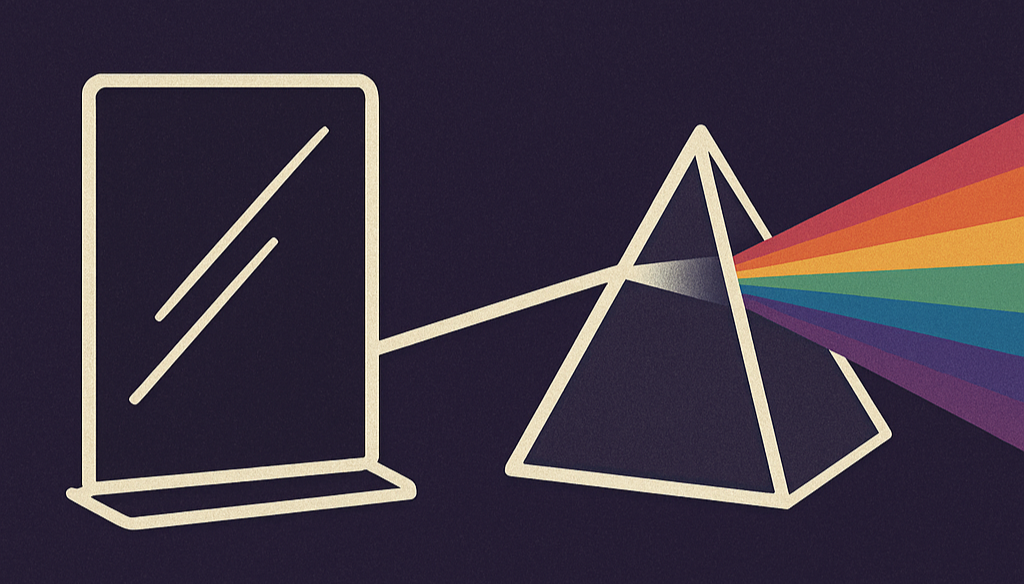
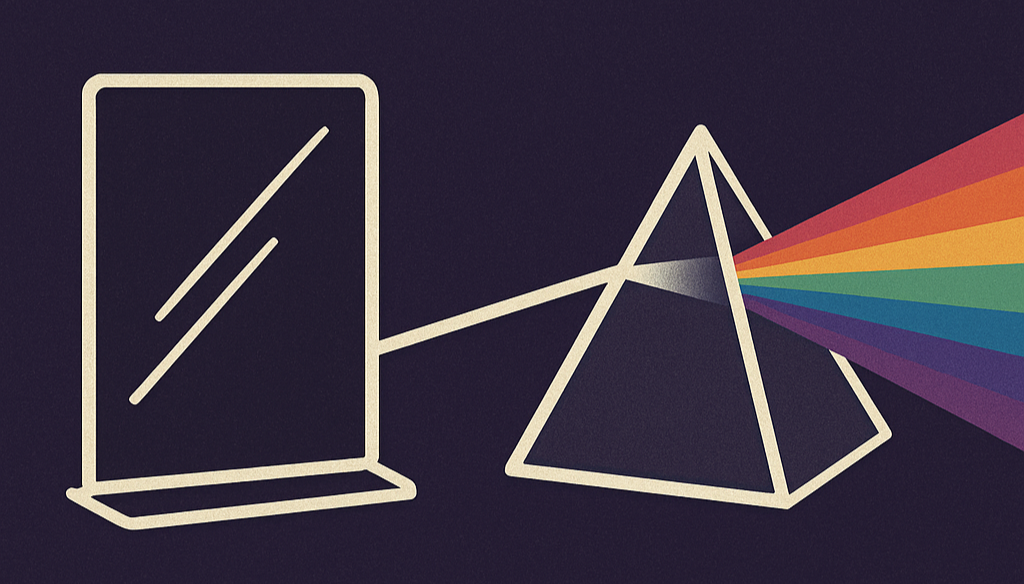
    In direct opposition to this cognitive illness that encloses man in the anxious search for notoriety, the School erects its most uncompromising mystical barrier against the empire of vanity: the Christological Prism, instituted in absolute counterpoint to the Cracked Mirror of modernity. The contemporary world has transformed into a vast and labyrinthine gallery of mirrors, where souls wander exhausted, contemplating only the distorted images of their own egos projected against the dark background of loneliness and narcissism. The mirror is opaque, self-centered, and sterile; it imprisons the subject in the closed circuit of his self-image, demanding a perpetual performance to feed an altar of illusions.

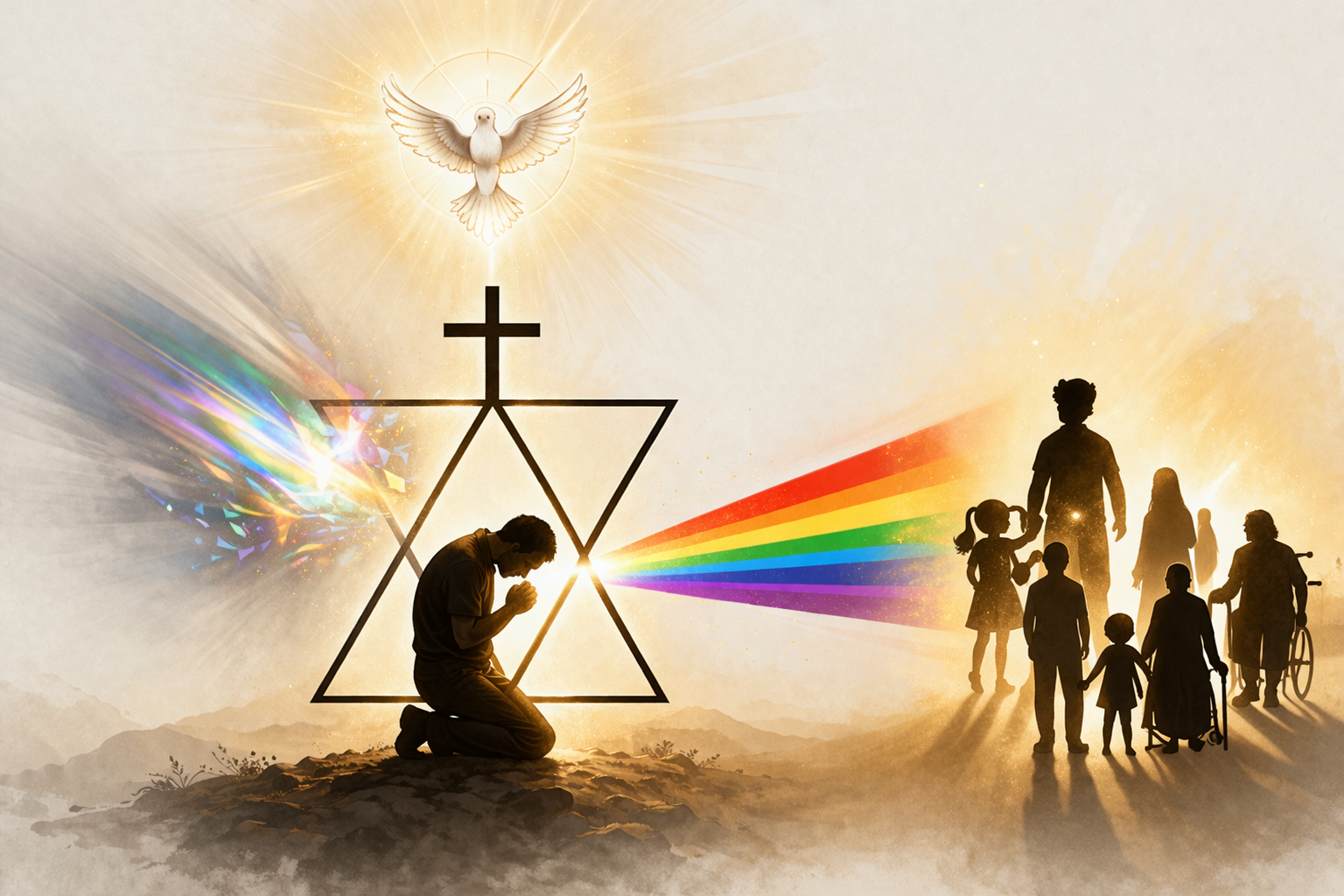
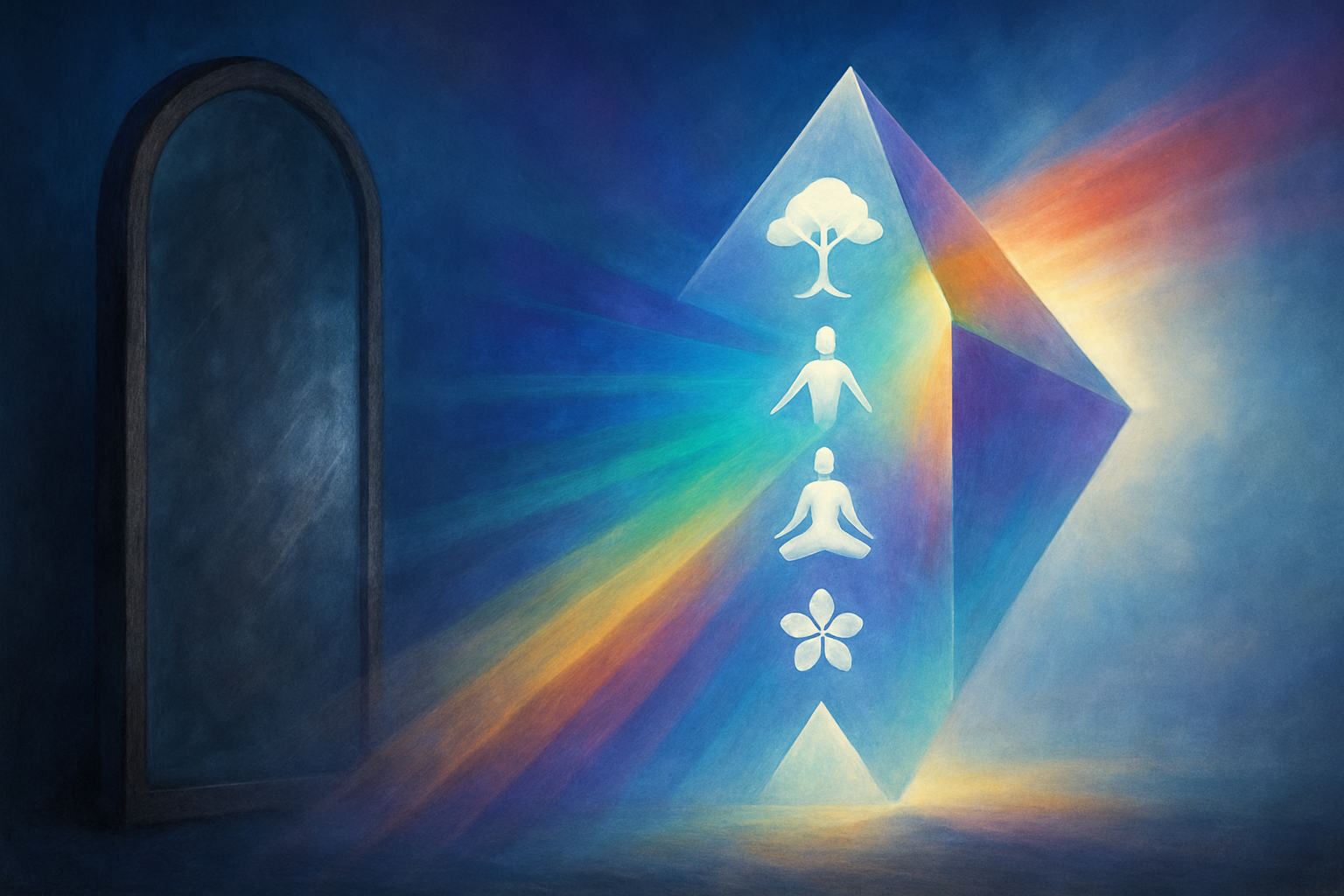
    The Prism, however, possesses an entirely distinct nature: it is pure, translucent, and relational. It does not retain the light for itself, it does not sequester it, and it never claims authorship of the brilliance that passes through it. The Christological Prism receives the one, eternal, and perfectly loving light of the Father, allows it to pass through the mystical Body of Christ and, at the conclusion of this sacred passage, returns it to the world multiplied in color, in grace, in diversity, and in meaning.

    This is the definitive vaccine against the presumption of the century: the firm and humble recognition that we are not the origin of the light, we are not the authors of the miracles, and we do not hold ownership of the Revelation. We are, in our deepest truth, clay touched by the Word, instruments whose transparency is the only merit. By fixing our gaze on the Prism and not on the mirror, we destroy the fetish of notoriety and ensure that the protagonism of our existence remains unequivocally right where it should be, proclaiming with trembling and joy that the altar belongs solely and exclusively to Christ.

    9. Oriented Action: The Loving Descent of the Prism

    The contemplation of the Christological Prism does not invite us to a passive mysticism, an egoistic ecstasy, or a sterile flight from the material and historical urgencies of our time. On the contrary, it demands what the School rigorously defines as Oriented Action.

    In the economy of essential love, it is not enough to climb the mountain to contemplate the light; it is strictly necessary to descend to serve on the plain, where exhaustion, human pain, and civilizational collapse actually happen. The true transfigurationist mysticism is, par excellence, an incarnated mysticism. Oriented action is the loving descent of the prism toward the friction of the world.

    For this movement not to be corrupted by vanity or blind activism, it demands the foundational recognition that we are merely “clay touched by the Word”. Our cognitive traction, our reading capacity, and our analytical breath are not trophies for personal adornment, but rather sacred instruments of rescue. When we descend to extend our hand to the consciences wounded by the century, we do so resolutely refusing the worship of the false god of notoriety. Authentic service does not demand a stage, does not seek followers to inflate statistics, and does not let itself be seduced by noisy engagement. It demands presence, network, sharing, and an unbreakable cohesion with the Truth, acting in the silence and efficacy of real love. Oriented action is, in short, placing all intelligence and virtue at the service of the other, remembering at every step that the miracle is always an intercession that comes from on High.

    10. Trinitarian Neo-humanism: Becoming without Losing Oneself

    Faced with the relentless machinery of the algorithmic era—which standardizes desires, massifies behaviors, and demands the annulment of identity in favor of belonging to a digital herd—Agape raises the liberating banner of Trinitarian Neo-humanism. The false commodified love demands servile copying; the system wants identical, predictable, and moldable users. The logic of the Trinity, however, teaches us exactly the opposite: it is perfect communion in the absolute distinction of the Persons. It is the unity that does not destroy diversity, but rather sanctifies and crowns it.

    Transporting this divine mystery to the relational ethics of our civilization in crisis, we understand that integrating the virtue of the neighbor does not mean, in any way, diluting our own identity. When we look at the excellence of the other through the benchmark of improvement, we do not do so to transform ourselves into replicas, but to gather the seed of that which vibrates in greater truth. Our mission is to absorb this good and return it to the world transfigured by our own color, by our biography, and by our singular vocation. “Becoming without losing oneself” is the highest synthesis of this ethical integration. It is the non-negotiable affirmation that the human being flourishes fully in communion, weaving the ties of the mystical Body, while simultaneously preserving, entirely intact, the sovereignty, dignity, and originality of his own conscience.

    11. The Silent Rupture and the New Axis of the Journey

    No roar announces the fall of the fortresses of contemporary pride; the structures of inversion that suffocate the century are not undone by the noise of force, but by the discreet and inflexible establishment of virtue. By planting one’s feet in the territory of Agape, which is essential love, par excellence, consciousness operates what the School defines as the Silent Rupture. This movement does not dispute the saturated spaces of the symbolic market, does not fight for niches of engagement, and rejects the hysteria of narratives seeking notoriety at any cost. It is subtle as leaven and invisible as the breath of the Spirit, but it possesses the overwhelming capacity to implode the foundations of human vanity from within.

    The silent rupture is consolidated when we transform, in the laboratory of everyday life, competition into construction, comparison into learning, and division into communion. When the gaze frees itself from the cracked mirror and begins to be guided by the benchmark of improvement and by the Christological Prism, the mechanics of the world lose their power of coercion over us. We do not cease to inhabit reality, we do not lock ourselves in aseptic isolations, and we do not ignore the pains of the present time; we rather cease to measure ourselves by them. The world ceases to be the judge of our dignity, because our identity becomes anchored in the absolute gratuitousness of essential love.

    With the shattering of the invisible ruler, the New Axis of the Journey is inaugurated. Human existence assumes an infinitely higher and safer criterion: the journey is no longer marked by how much we manage to surpass our neighbor, by the status we accumulate, or by the performance we stage for the approval of the multitudes.

    The only legitimate vector becomes how much we advance, with humble and firm steps, in the direction of virtue and fidelity to the Gospel in its purest essence. One walks in the horizontality of service to the brothers and sisters, keeping one’s eyes fixed on the verticality of the Grace that comes from on High.

    Upon crossing the portal of these two pillars that conclude this treatise, the School of Conscious Transfiguration proposes to deliver to the world not a new abstract theory, but an invitation to share a firm ground to stand on, an anchor for the days of storm, and a compass of lucidity for the digital age. Agape is the definitive filling of the clean room of the soul; it is the certainty that finitude accepted with love and the emptying carried out in faith are the keys that return to us the sovereignty of conscience and the integrity of the being. Before the empty tomb of modernity, the School of Conscious Transfiguration humbly wishes to remain on the threshold, sustaining the presence, keeping the details, and offering to each exhausted heart, paths that lead us to the rescue of real love.

  • ÁGAPE

    Reflexões da Escola da Transfiguração Consciente

    ÁGAPE

    O que é capaz de sustentar um difícil esvaziamento? É o que pode nos preencher novamente. É o amor essencial. De uma forma transfiguradora

    “Agora, pois, permanecem a fé, a esperança e o amor, estes três,

    mas o maior destes é o amor.”

    1 Coríntios 13:13

    1. O Limiar do Esvaziamento

    Nenhum edifício sagrado pode ser erguido sobre as ruínas instáveis de um terreno entulhado. Na economia da alma e na arquitetura do espírito, o amor essencial — o Ágape — não se comporta como um aditivo cosmético ou uma camada superficial de verniz moral a ser aplicada sobre as velhas estruturas do orgulho humano. Ele exige, por força de sua própria natureza absoluta, um limiar radical, uma fronteira intransponível que só pode ser cruzada por meio da Kénosis. O esvaziamento voluntário do ego não é um fim em si mesmo, nem um exercício de niilismo ou autoflagelação psicológica; ele é, em verdade, a condição ontológica de possibilidade para que o amor real tome posse do ser.

    A tragédia do homem contemporâneo reside na tentativa crônica de amar a partir de seus depósitos cheios. Busca-se o divino e o humano portando os bolsos abarrotados de certezas mercantilizadas, performances ensaiadas, traumas intocados e o desespero surdo por validação. O resultado dessa sobreposição trágica é o simulacro: um afeto que não transfigura, mas apenas replica a lógica da posse, do cálculo e da centralidade do eu. O Ágape, contudo, recusa-se a habitar o ruído. Ele exige o despojamento prévio. É preciso coragem para olhar para o próprio interior e realizar o inventário honesto das nossas acumulações, reconhecendo que a soberba disfarçada de virtude é o entulho mais denso que bloqueia o fluxo da Graça.

    Portanto, o movimento que nos conduz ao Ágape inicia-se necessariamente no ponto final da Kénosis. É o ato de limpar o salão principal, desvendar as despensas ocultas e esvaziar os depósitos mais profundos da nossa subjetividade. Quando esvaziamos essas gavetas da alma — libertando-nos da tirania de sermos os autores de nossa própria luz —, o que se produz não é um vácuo desesperador ou uma ausência estéril. O vazio kenótico é o espaço soberano da receptividade. É a preparação da morada, o silêncio que antecede o Verbo, a calmaria necessária para que o transbordamento do Espírito Santo encontre um leito limpo por onde correr, transformando a nossa fragilidade desimpedida no solo fértil da caridade mais pura.

    2. A Sala Limpa e a Sensibilidade às Nuances

    Uma vez operado o esvaziamento, a primeira grande transformação não se dá na exterioridade das ações, mas na própria mecânica da percepção interior. A purificação kenótica atua como uma abertura profunda dos sentidos espirituais e cognitivos, devolvendo à consciência uma faculdade que a aceleração tóxica do mundo moderno havia anestesiado: a sensibilidade aguda para as nuances. Em uma civilização marcada pela saturação de estímulos e pela brutalidade das imagens explícitas, o olhar humano viciou-se no macroscópico, no berrante e no barulhento. Perdeu-se a capacidade de ler as entrelinhas e de habitar os pequenos intervalos onde a realidade verdadeiramente se decide.

    Quando a mente finalmente desacelera e o coração se vê livre das pressões do acúmulo e da comparação, a “sala limpa” do ser torna-se um laboratório de escuta atenta.

    O amor de Deus e a verdade das coisas não se manifestam por meio de outdoors espalhafatosos ou de epifanias pirotécnicas desenhadas para impressionar as massas. O sagrado opera nas gradações discretas, nas aproximações sutis, no sopro leve que exige o recolhimento para ser escutado.

    Quem habita uma alma entulhada é incapaz de perceber o detalhe de um gesto, a fragilidade oculta na fala do próximo ou o sussurro do Espírito na condução do cotidiano, pois o barulho do próprio ego ensurdece a percepção.

    O Ágape, nesse sentido, é uma pedagogia do olhar refinado. Ele nos ensina que o que é verdadeiramente precioso e eterno “não está na vitrine”. A vitrine do mundo — que hoje se materializa nas telas reluzentes da internet e no mercado das reputações digitais — é o espaço da obsolescência, do consumo rápido e da estetização superficial. O amor essencial, ao contrário, localiza-se um pouco mais abaixo, um pouco mais atrás, nos terrenos recônditos da discrição e da gratuidade. Na sala limpa da consciência transfigurada, as aparências perdem o seu poder de distorção, permitindo que o sujeito enxergue a beleza oculta do mistério trinitário que se desvela no silêncio, onde a pressa cede lugar à reverência e o detalhe torna-se o ponto de ancoragem do eterno.

    3. Os Ícones da Intimidade Oculta: João e Maria Madalena

    O amor essencial não se enquadra nas grelhas da burocracia institucional ou do formalismo exterior. A história da salvação guarda, no seu âmago, testemunhos de uma intimidade oculta, acessível apenas àqueles que ousaram amar até à exaustão e permanecer na soleira do mistério. O Discípulo Amado e Maria Madalena erguem-se como os ícones absolutos desta profunda sensibilidade e calibragem de alma. Historicamente, a figura de Madalena sofreu inegáveis diminuições, muitas vezes incompreendida nas suas capacidades e na integridade irrepreensível do seu amor a Cristo. Contudo, a verdadeira leitura transfiguracionista reconhece que tanto João como Maria Madalena detinham a chave de um acesso superior, não pela via do intelecto frio, mas pela porta do afeto purificado.

    Eles receberam instruções e missões de uma magnitude indizível — tesouros do espírito que não estavam inscritos para o público geral, não eram debatidos nos palanques, nem expostos para gáudio das multidões. Jesus abria-lhes a porta de um conhecimento íntimo precisamente porque, com a “sala limpa” da sua humildade, eles eram capazes de perceber as nuances. A sua proximidade com o Verbo não derivava de um título, de um privilégio de casta ou de uma imposição de poder, mas da pura e arrebatadora capacidade de sustentar a presença. Eles amaram sem exigir a ribalta. Onde os outros recuaram por medo ou por não compreenderem a aparente falência da cruz, eles permaneceram, suportando o silêncio cortante, o pranto e o martírio da saudade. Este é o verdadeiro Ágape: um acesso ao coração de Deus que não se exibe em vitrines, mas que é entregue em exclusividade àqueles que suportam o atrito do amor real.

    4. A Patologia do Tempo: A Droga do Afeto Imediato

    Em oposição diametral à paciência e ao sacrifício deste amor essencial, o nosso tempo ergueu uma monstruosa maquinaria de adoecimento espiritual: a onimercantilização dos afetos.

    O mundo contemporâneo, refém de uma aceleração tóxica e de uma inversão civilizatória profunda, transformou o amor numa mercadoria de consumo rápido, administrada não como um remédio, mas como uma droga altamente viciante. A promessa estrutural deste sistema é a do alívio imediato para o vazio existencial.

    Oferece-se, através dos ecrãs, das tendências massificadas e da validação digital, um pico químico de pertença, uma euforia estética fulminante ou o consolo efémero de um “gosto” ou de uma partilha fugaz. Simula-se o amor para ontem, numa urgência que atrofia a alma.

    No entanto, à semelhança de qualquer substância entorpecente, este pico desvanece-se com uma rapidez implacável, deixando no seu rasto um cenário de destruição silenciosa. Esta falsa promessa de cura instantânea não resolve a dor humana; pelo contrário, gera a doença crónica da dependência, do vazio e da fragmentação identitária. A onimercantilização atua como um vasto cartel simbólico que vicia tanto os aparentemente “bem-sucedidos” do sistema como os seus “fracassados”, oferecendo a ambos um alívio tóxico que os paralisa e os impede de procurar a verdadeira cura.

    O autêntico Ágape, que opera como o único Remédio real, exige o exato oposto: demanda tempo, convivência, suporte à dor e amadurecimento constante. Requer a coragem de atravessar os dias difíceis sem exigir anestesias baratas. O amor transfiguracionista reestrutura o ser a partir das suas fundações, reconstruindo a dignidade da pessoa humana, enquanto a droga do afeto mercantilizado apenas mascara a ferida para a poder explorar, com redobrada eficácia, no ciclo seguinte de consumo.

    5. O Mecanismo da Inversão: A Régua de Comparação

    Para compreender a asfixia do Ágape na era contemporânea, é imperativo expor a anatomia da doença, e ela opera através de um instrumento silencioso e devastador: a régua de comparação. Este mecanismo não se apresenta como um conceito explícito ou uma ideologia declarada, mas atua como um impulso parasitário que se infiltra na consciência. Sob o domínio da onimercantilização, a humanidade foi condicionada a medir, avaliar e justapor existências a partir de parâmetros ditados pela soberba. O valor inalienável do ser humano, outrora ancorado na sua condição de imagem e semelhança do Deus trinitário, sofre uma inversão brutal, sendo deslocado da essência para a aparência.

    A tragédia desta régua invisível reside na sua capacidade de corromper o olhar. Quando a régua se torna o filtro exclusivo da realidade, mede conquistas materiais, compara trajetórias desiguais e transforma a diversidade dos dons numa hierarquia opressiva. Reduz-se a vastidão e o mistério de uma vida àquilo que pode ser exibido, quantificado e consumido nas redes. Neste cenário de competição perpétua, o próximo sofre uma mutação terrível aos nossos olhos: deixa de ser uma presença sagrada, digna de comunhão, para se tornar numa referência competitiva, num obstáculo ou numa ameaça. O Ágape é, assim, estilhaçado, pois o amor essencial não pode sobreviver num solo onde o outro é visto como um adversário na disputa simbólica por espaço, sucesso e validação. O que deveria ser um instrumento de orientação torna-se o juiz absoluto da dignidade humana.

    6. A Ilusão da Caverna: O Risco do Isolamento

    Perante a tirania exaustiva desta régua de comparação, a mente humana, ferida e fadigada, procura instintivamente uma rota de fuga. Surge, então, uma das armadilhas mais subtis do percurso espiritual: a ilusão da caverna. Na tentativa de escapar à pressão do espelho social e ao peso do olhar alheio, o indivíduo é tentado a recolher-se num isolamento absoluto, cortando as pontes com o mundo sob o pretexto de preservar a sua paz interior. No entanto, fechar as portas ao atrito humano não é a cura; é uma nova forma de autoengano, um refúgio estéril que substitui a ansiedade da comparação pelo abismo da autossuficiência.

    O Ágape recusa o isolamento assético. A vocação trinitária do ser humano exige o encontro, a fricção e a partilha. Não fomos chamados a trancar-nos na caverna do nosso próprio orgulho ferido, nem a evitar a realidade para não sermos testados. O outro não é o inferno; o outro é a lacuna estrutural necessária por onde a Graça penetra para nos salvar.

    É precisamente no terreno irregular das relações humanas que a virtude é forjada. Fugir do próximo para evitar a régua é permitir que o sistema dite as regras da nossa reclusão. A verdadeira vitória do amor transfiguracionista não se dá na fuga para longe do mundo, mas na coragem de permanecer nele com o olhar redimido, transformando o que antes era motivo de divisão num espaço de comunhão sagrada.

    7. O Antídoto Cognitivo: O Referencial de Aprimoramento

    A cura para a toxicidade da comparação não se processa através de uma anestesia intelectual ou de um voluntarismo moral abstrato, mas sim por meio de uma profunda reconfiguração da nossa mecânica relacional. O antídoto definitivo contra a engrenagem da soberba reside na substituição da régua de competição pelo Referencial de Aprimoramento. Se a régua mercantilizada funciona como uma substância entorpecente que isola e fragmenta o sujeito, o referencial atua como um tratamento médico sério, de longa duração, que exige a paciência do tempo, o suporte à convivência e a coragem do amadurecimento lento. Trata-se da passagem terapêutica de uma visão que agride para um olhar que se redime na presença do outro.

    Quando a consciência é purificada pela virtude, a métrica destrutiva do mundo perde a sua força de coerção. O próximo deixa de ser uma ameaça ao nosso espaço simbólico ou um padrão exterior pelo qual medimos o nosso valor; ele passa a ser, legitimamente, uma presença que inspira e contribui para o nosso crescimento. Sob esta nova ótica, o bem que testemunhamos no irmão não evoca a inveja ou o ressentimento, mas sim o louvor e o desejo de elevação espiritual.

    Esta dinâmica assume a virtude como um critério vivo, impedindo a distorção do olhar e protegendo a dignidade inalienável de cada alma. Ao utilizarmos o referencial de aprimoramento, a meta nunca é a cópia servil ou a emulação mecânica — práticas que alimentam a massificação algorítmica —, mas sim a integração orgânica do que é bom.

    No referencial de aprimoramento:

    – o outro é fonte de aprendizado

    – o foco é expansão interna

    – o valor está na virtude aplicada

    – e a essência do outro é preservada

    Não se julga quem o outro é. Observa-se o que o outro faz. E isso muda tudo.

    Aquilo que brilha no outro não funciona como um molde que nos esmaga, mas sim como um convite sagrado que deve ser respondido a partir da nossa própria essência original, transformando a competição em construção e a divisão em comunhão.

    8. O Prisma Cristológico contra o Espelho Rachado

    Em oposição direta a este adoecimento cognitivo que enclausura o homem na busca sôfrega por notoriedade, a Escola ergue a sua mais intransigente barreira mística contra o império da vaidade: o Prisma Cristológico, instituído em contraponto absoluto ao Espelho Rachado da modernidade. O mundo contemporâneo transformou-se numa vasta e labiríntica galeria de espelhos, onde as almas deambulam exaustas, contemplando apenas as imagens distorcidas dos seus próprios egos projetadas sobre o fundo escuro da solidão e do narcisismo. O espelho é opaco, autocentrado e estéril; ele aprisiona o sujeito no circuito fechado da sua autoimagem, exigindo uma performance perpétua para alimentar um altar de ilusões.

    O Prisma, contudo, possui uma natureza inteiramente distinta: ele é puro, translúcido e relacional. Ele não retém a luz para si, não a sequestra e jamais reivindica a autoria do brilho que o atravessa. O Prisma Cristológico recebe a luz una, eterna e perfeitamente amorosa do Pai, permite que ela atravesse o Corpo místico de Cristo e, no desfecho dessa passagem sagrada, devolve-a ao mundo multiplicada em cor, em graça, em diversidade e em sentido.

    Esta é a vacina definitiva contra a presunção do século: o firme e humilde reconhecimento de que não somos a origem da luz, não somos os autores dos milagres e não detemos a propriedade da Revelação. Somos, na nossa mais profunda verdade, barro tocado pelo Verbo, instrumentos cuja transparência é o único mérito. Ao fixarmos o olhar no Prisma e não no espelho, destruímos o fetiche da notoriedade e asseguramos que o protagonismo da nossa existência permaneça inequivocamente ali onde ele deve estar, proclamando com tremor e alegria que o altar pertence única e exclusivamente a Cristo.

    9. A Ação Orientada: A Descida Amorosa do Prisma

    A contemplação do Prisma Cristológico não nos convida a um misticismo passivo, a um êxtase egoísta ou a uma fuga estéril das urgências materiais e históricas do nosso tempo. Pelo contrário, ela exige o que a Escola define rigorosamente como Ação Orientada.

    Na economia do amor essencial, não basta subir à montanha para contemplar a luz; é estritamente necessário descer para servir na planície, onde a exaustão, a dor humana e o colapso civilizacional efetivamente acontecem. A verdadeira mística transfiguracionista é, por excelência, uma mística encarnada. A ação orientada é a descida amorosa do prisma em direção ao atrito do mundo.

    Para que este movimento não seja corrompido pela vaidade ou pelo ativismo cego, ele exige o reconhecimento fundacional de que somos apenas “barro tocado pelo Verbo”. A nossa tração cognitiva, a nossa capacidade de leitura e o nosso fôlego analítico não são troféus para adorno pessoal, mas sim instrumentos sagrados de resgate. Quando descemos para estender a mão às consciências feridas pelo século, fazemo-lo recusando de forma cabal a adoração do falso deus da notoriedade. O autêntico serviço não exige palco, não procura seguidores para inflar estatísticas e não se deixa seduzir pelo engajamento ruidoso. Ele exige presença, rede, partilha e uma coesão inquebrável com a Verdade, atuando no silêncio e na eficácia do amor real. A ação orientada é, em suma, colocar toda a inteligência e virtude ao serviço do outro, lembrando a cada passo que o milagre é sempre uma intercessão que vem do Alto.

    10. O Neo-humanismo Trinitário: Tornar-se sem Perder-se

    Perante a engrenagem implacável da era algorítmica — que padroniza os desejos, massifica os comportamentos e exige a anulação da identidade em prol da pertença a uma manada digital —, o Ágape ergue o estandarte libertador do Neo-humanismo Trinitário. O falso amor mercantilizado exige a cópia servil; o sistema quer utilizadores idênticos, previsíveis e moldáveis. A lógica da Trindade, contudo, ensina-nos exatamente o oposto: é a comunhão perfeita na distinção absoluta das Pessoas. É a unidade que não destrói a diversidade, mas que a santifica e a coroa.

    Transportando este mistério divino para a ética relacional da nossa civilização em crise, compreendemos que integrar a virtude do próximo não significa, de modo algum, diluir a própria identidade. Quando olhamos para a excelência do outro através do referencial de aprimoramento, não o fazemos para nos transformarmos em réplicas, mas para recolher a semente do que vibra em maior verdade. A nossa missão é absorver esse bem e devolvê-lo ao mundo transfigurado pela nossa própria cor, pela nossa biografia e pela nossa vocação singular. “Tornar-se sem perder-se” é a síntese máxima desta integração ética. É a afirmação inegociável de que o ser humano floresce plenamente na comunhão, tecendo os laços do Corpo místico, preservando simultaneamente, e de forma intacta, a soberania, a dignidade e a originalidade da sua própria consciência.

    11. A Ruptura Silenciosa e o Novo Eixo da Caminhada

    Nenhum estrondo anuncia a queda das fortalezas da soberba contemporânea; as estruturas de inversão que sufocam o século não se desfazem pelo barulho da força, mas pela discreta e inflexível instauração da virtude. Ao firmar os pés no território do Ágape, que é o amor essencial, por excelência, a consciência opera o que a Escola define como a Ruptura Silenciosa. Este movimento não disputa os espaços saturados do mercado simbólico, não briga por nichos de engajamento e recusa a histeria das narrativas que buscam a notoriedade a qualquer custo. Ele é sutil como o fermento e invisível como o sopro do Espírito, mas possui a capacidade avassaladora de implodir os alicerces da vaidade humana a partir de dentro.

    A ruptura silenciosa se consolida quando transformamos, no laboratório do cotidiano, a competição em construção, a comparação em aprendizado e a divisão em comunhão. Quando o olhar se liberta do espelho rachado e passa a se guiar pelo referencial de aprimoramento e pelo Prisma Cristológico, a mecânica do mundo perde o seu poder de coerção sobre nós. Não deixamos de habitar a realidade, não nos trancamos em isolamentos asséticos e não ignoramos as dores do tempo presente; deixamos, sim, de nos medir por eles. O mundo deixa de ser o juiz da nossa dignidade, porque a nossa identidade passa a estar ancorada na gratuidade absoluta do amor essencial.

    Com o estilhaçamento da régua invisível, inaugura-se o Novo Eixo da Caminhada. A existência humana assume um critério infinitamente mais alto e seguro: o caminhar não é mais balizado pelo quanto conseguimos superar o próximo, pelo status que acumulamos ou pela performance que encenamos para a aprovação das multidões.

    O único vetor legítimo passa a ser o quanto avançamos, com passos humildes e firmes, na direção da virtude e da fidelidade ao Evangelho em sua essência mais pura. Caminha-se na horizontalidade do serviço aos irmãos, mantendo os olhos fixos na verticalidade da Graça que vem do Alto.

    Ao cruzarmos o portal desses dois pilares que encerram este tratado, a Escola da Transfiguração Consciente se propõe a entregar ao mundo não uma nova teoria abstrata, mas um convite à partilha de um chão firme para pisar, uma âncora para os dias de tempestade e uma bússola de lucidez para a era digital. O Ágape é o preenchimento definitivo da sala limpa da alma; é a certeza de que a finitude aceita com amor e o esvaziamento operado na fé são as chaves que nos devolvem a soberania da consciência e a integridade do ser. Diante do túmulo vazio da modernidade, a Escola da Transfiguração Consciente deseja humildemente permanecer na soleira, sustentando a presença, guardando os detalhes e oferecendo a cada coração exausto, caminhos que nos levem ao resgate do amor real.

  • KÉNOSIS

    Reflexões da Escola da Transfiguração Consciente

    KÉNOSIS

    An Uncomfortable Look at the Dynamics of the World and Emptying as the Restoration of Existence

    “Look at the fig tree, and all the trees; And take heed to yourselves.”

    (Lk 21:29, 34)

    Let us imagine a crowded public square where there is no common music, no shared rhythm, no listening to the wind or the city. Each person dances alone, with their eyes closed, guided only by the sound of their own headphones. For those who observe with awakened eyes, this is not an eccentricity; it is a symptom. This is how a large part of society lives today: moving multitudes, disconnected from common sense, from collective care, and from the simplest facts that sustain communal life.

    I. The Architecture of Chaos

    This trance is no accident; it is induced by architectures that seek not harmony, but capture. They operate through continuous inversion: calling evil good and good evil, transforming noise into truth, and maladjustment into normalcy. When the fabric of reality frays, those who move out of opportunism occupy space – not out of competence, but because discernment is lost in the fog.

    II. The Poison of Mockery

    To make reality liquid, an effective tool is used: disproportionate sarcasm. Repeated irony corrodes the soul and delegitimizes any attempt at order, becoming torture disguised as criticism. When mockery becomes ordinary language, a person loses the ability to trust the basic gears of reality. In the face of this, omissive neutrality is a mistake; we cannot treat with the same weight those who build and those who deliberately destroy human care. To normalize destruction is to become an accomplice.

    III. The Restored Triptych: Faith, Reason, and Emotion

    The antidote demands realignment, requiring us to restore the integrity of the being through three dimensions that mirror communion: Faith, Reason, and Emotion. Reason is the anchor in facts, in justice, and in the materiality of life, preventing hysteria. Emotion, purified from hatred, makes room for empathy, feeling the pain of the world without being consumed by it. Faith is the lighthouse, guaranteeing a horizon of meaning even in the face of ruin.

    IV. The Weight of Lucidity

    There is a comprehensible temptation: to close our eyes. The exhaustion of witnessing the crumbling weighs heavily on those who still care. But our exhaustion is proof of sanity; our sadness bears witness that the heart still beats. We see families who, until recently, walked in harmony, and who now seem to spin in circles in their own blindness. This is not a theory; it is the loss of primary collective consciousness, the loss of the ability to manage one’s own body, to care, and to discern.

    V. The Onion and the Corrupted Perception

    Let us remember the old stage trick: the hypnotist made someone eat a raw onion as if it were a sweet apple. It was a passing entertainment. Today, this state has become commonplace, as we are trained to swallow the bitter while calling it sweet. Why? Because whoever corrupts perception controls the whole person. When the ability to distinguish reality from delusion is broken, the spine of lucidity snaps. And the human becomes docile to the poison they ingest.

    VI. The Cleverness that Disfigures Us

    How did we get here? It was not out of lack, but out of an excess of “cleverness”. There was abundance, but the voice of advantage emerged: “Why respect limits if you can be like God?”. It was not a necessity; it was a desire for domination. It was in that millisecond that we traded the gratuitousness of love for a predatory logic. The other ceased to be an end with dignity and became a means to ambition. When the human attempts to take the place of the Sacred, they do not elevate themselves; they collapse.

    VII. The Atrophy of the Soul

    The body suffers a heart attack from a sedentary lifestyle, and the soul also atrophies from a lack of vigilance. Lucidity requires continuous ethical exercise; without it, we bury ourselves under artifacts, tribes, and identities to mask the emptiness. We advance towards the precipice not out of bravery, but out of distraction. It is the stage of those who have lost their anchor and the humility to recognize that we do not survive without essential love.

    VIII. The Rare Blood

    If, in the midst of chaos, someone awakens, there is a subtle danger: spiritual vanity. In an epidemic of madness, perceiving oneself as lucid is not a medal; it is like having rare blood in a blood bank. In the midst of collective hemorrhages, one does not frame the vein; one rolls up their sleeves and donates. To use lucidity to feel like a winner is to be infected by the same disease, only in a more refined strain.

    IX. The Origin

    The Genesis narrative is not just a founding myth; it is a denunciation of our ruin. There was abundance given by grace, but the fracture came through the induction of advantage. The tragedy did not begin with the breaking of a rule, but with the inability to value gratuitousness. It is the genesis of presumption: when vanity tramples over loving obedience.

    X. The Medical Record of Humanity

    For this reason, the Scriptures, especially the Old Testament, are not a saga of perfect heroes. They are the medical record of a sick, staggering humanity, crawling out of one hole only to fall into another. To read this as triumphalism is to miss the cry for help that runs through every page leading up to redemption.

    XI. Christ Used Against Christ

    And here lies the most painful paradox: in the face of the light – Jesus Christ, the source of living water – many who speak in His name practice the very opposite of what He lived. Jesus is self-emptying, extreme humility, and service; yet, His name has been used to justify selfishness, disarticulation, and hatred. We do not need to accuse people, but we must recognize: when the Christ of the Gospel is traded for the Christ of performance, the collective soul falls ill.

    XII. The Illusion of the Zero Position

    There is a final trap for those who have awakened: thinking that the opposite of aggression is inertia. Silence out of fear or comfort is not peace; it is complicity. Staying in the “zero position” is the modern way of washing one’s hands. If we merely retreat to avoid creating controversy, we condemn those who are delirious to their own fate, while waiting in our inertia for our turn to be swallowed up.

    XIII. The Rescue Embrace

    We are not here to deliver beautiful speeches from atop a tribune; this is a warning forged in personal commitment. It is not enough to simply not react with hatred; one must act with love. We must advance and resist the chaos with an embrace. Rescue requires the willingness to intentionally embrace the one who raises their hand to strike us. This touch anchors and breaks the spine of hatred. It is conscious transfiguration in embodied action. Only by descending into the arena, taking on the exhaustion of actively loving those who do not know how to ask for help, will we break the inertia of the abyss.

    XIV. Final Kenosis

    If this reflection unsettles the heart, let it be clear from where it originates. Kenosis, Paul’s word in Philippians 2, is the gesture of Christ emptying Himself so that the other may live. What has been shared here is not the brilliant idea of an individual, but an attempt at self-emptying. It is making room, in the silence of one’s own convictions, for the Spirit to act. These words are born from the confession of someone who makes mistakes, stumbles, and recognizes their imperfection, yet fights to remain faithful to the original message of Jesus. It is not looking into one’s own mirror, but into the mirror of Christ. The lucidity we seek is not a merit, but the urgent need to bring Jesus back to the center of a reality that agonizes for His presence. May we have the courage to empty ourselves of our ego so that He may increase. May our lives, in the simplest things and the most silent acts of love, be proof that the light still dwells in this world.

  • KÉNOSIS

    Reflexões da Escola da Transfiguração Consciente

    KÉNOSIS

    Um olhar incômodo sobre a dinâmica do mundo e o esvaziamento como restauração da existência

    “Olhai para a figueira, e para todas as árvores; E olhai por vós.”

    (Lc 21:29;34)

    Imaginemos uma praça pública cheia. Não há música comum, não há ritmo partilhado, não há escuta do vento ou da cidade. Cada pessoa dança sozinha, de olhos fechados, guiada apenas pelo som dos próprios fones.

    Para quem observa desperto, isso não é excentricidade. É sintoma. É assim que grande parte da sociedade vive hoje: multidões em movimento, desconectadas do bom senso, do cuidado coletivo e dos fatos mais simples que sustentam a vida em comum.

    I. A arquitetura do caos

    Esse transe não é acidente. Ele é induzido por arquiteturas que não buscam harmonia, mas captura.

    Elas operam pela inversão contínua: chamam bem ao mal e mal ao bem, transformam ruído em verdade, desajuste em normalidade. Quando o tecido da realidade se esgarça, quem se move por oportunismo ocupa espaço — não por competência, mas porque na neblina o discernimento se perde.

    II. O veneno do escárnio

    Para tornar a realidade líquida, usa-se uma ferramenta eficaz: o sarcasmo desproporcional.

    A ironia repetida corrói a alma e deslegitima qualquer tentativa de ordem. Vira tortura disfarçada de crítica. Quando o deboche se torna linguagem ordinária, a pessoa perde a capacidade de confiar nas engrenagens básicas do real.

    Diante disso, a neutralidade omissa é um erro. Não podemos tratar com o mesmo peso quem constrói e quem destrói deliberadamente o cuidado humano. Normalizar a destruição é tornar-se cúmplice.

    III. O tríptico restaurado: Fé, Razão e Emoção

    O antídoto exige realinhamento. Precisamos restaurar a integridade do ser através de três dimensões que se espelham na comunhão: Fé, Razão e Emoção.

    A Razão é a âncora nos fatos, na justiça e na materialidade da vida. Impede a histeria.

    A Emoção, purificada do ódio, abre espaço para empatia. Sente a dor do mundo sem ser consumida.

    A Fé é o farol. Garante horizonte de sentido mesmo diante da ruína.

    IV. O peso da lucidez

    Há uma tentação compreensível: fechar os olhos. A exaustão de testemunhar o esfacelamento pesa sobre quem ainda se importa.

    Mas a nossa exaustão é prova de sanidade. A tristeza testemunha que o coração pulsa.

    Vemos famílias que, até há pouco, caminhavam em harmonia, e que agora parecem girar em círculos na própria cegueira. Não é teoria. É perda da consciência coletiva primária — a capacidade de administrar o próprio corpo, de cuidar, de discernir.

    V. A cebola e a percepção corrompida

    Lembremos do velho truque de palco: o hipnotizador fazia alguém comer cebola crua como se fosse maçã doce. Era entretenimento passageiro.

    Hoje, esse estado virou cotidiano. Somos treinados a engolir o amargo chamando-o de doce.

    Por quê? Porque quem corrompe a percepção, controla a pessoa inteira. Quando se quebra a capacidade de distinguir o real do delírio, a espinha dorsal da lucidez se parte. E o humano se torna dócil ao veneno que ingere.

    VI. A esperteza que nos desfigura

    Como chegamos aqui? Não foi por falta. Foi por excesso de “esperteza”.

    Havia abundância. Mas surgiu a voz da vantagem: “por que respeitar limites se você pode ser como Deus?”. Não era necessidade, era desejo de domínio.

    Foi nesse milissegundo que trocamos a gratuidade do amor pela lógica predatória. O outro deixou de ser fim, com dignidade, e virou meio para ambição.

    Quando o humano tenta ocupar o lugar do Sagrado, não se eleva. Desaba.

    VII. A atrofia da alma

    O corpo enfarta pelo sedentarismo. A alma também atrofia pela falta de vigilância.

    Lucidez exige exercício ético contínuo. Sem ele, nos enterramos sob artefatos, tribos e identidades para mascarar o vazio. Avançamos para o precipício não por bravura, mas por distração.

    É o estágio de quem perdeu a âncora e a humildade de reconhecer que não sobrevivemos sem amor essencial.

    VIII. O sangue raro

    Se, no meio do caos, alguém desperta, há um perigo sutil: a vaidade espiritual.

    Em uma epidemia de desatino, perceber-se lúcido não é medalha. É como ter sangue raro num banco de sangue. Em meio a hemorragias coletivas, não se emoldura a veia. Arregaça-se a manga e doa-se.

    Usar a lucidez para se sentir vencedor é ser infectado pela mesma doença, só que em cepa mais refinada.

    IX. A origem

    A narrativa do Gênesis não é só mito de fundação. É denúncia da nossa ruína. Havia abundância dada por graça. A fratura veio pela indução da vantagem.

    A tragédia não começou com a quebra de uma regra, mas com a incapacidade de valorizar a gratuidade. É a gênese da presunção: quando a vaidade pisoteia a obediência amorosa.

    X. O prontuário da humanidade

    Por isso, as Escrituras — sobretudo o Antigo Testamento — não são saga de heróis perfeitos. São o prontuário de uma humanidade doente, cambaleante, que sai de um buraco para cair em outro.

    Ler isso como triunfalismo é perder o pedido de socorro que atravessa cada página até a redenção.

    XI. Cristo usado contra Cristo

    E aqui está o paradoxo mais doloroso: diante da luz — Jesus Cristo, fonte de água viva — muitos que falam em Seu nome praticam o oposto do que Ele viveu.

    Jesus é esvaziamento, humildade extrema, serviço. Seu nome, porém, tem sido usado para justificar egoísmo, desarticulação e ódio.

    Não precisamos acusar pessoas. Precisamos reconhecer: quando o Cristo do Evangelho é trocado pelo Cristo da performance, a alma coletiva adoece.

    XII. A ilusão da posição zero

    Há uma armadilha final para quem despertou: achar que o oposto da agressão é a inércia.

    Silêncio por medo ou conforto não é paz. É cumplicidade. Ficar na “posição zero” é a forma moderna de lavar as mãos.

    Se apenas recuamos para não criar polêmica, condenamos à própria sorte quem delira, esperando, na nossa inércia, a nossa vez de sermos engolidos.

    XIII. O abraço de resgate

    Não estamos aqui para dar belos discursos do alto de uma tribuna. Este é um alerta forjado no compromisso pessoal.

    Não basta não reagir com ódio. É preciso agir com amor.

    É preciso avançar e resistir ao caos com o abraço. O resgate exige a disposição de abraçar intencionalmente quem levanta a mão para nos ferir. Esse toque ancora e quebra a espinha do ódio. É a transfiguração consciente encarnada.

    Só descendo à arena, assumindo a exaustão de amar ativamente quem não sabe pedir socorro, romperemos a inércia do abismo.

    XIV. Kénosis final

    Se esta reflexão inquietar o coração, que fique claro de onde nasce.

    Kénosis — palavra de Paulo em Filipenses 2 — é o gesto de Cristo que se esvazia de si para que o outro viva.

    O que aqui foi partilhado não é ideia brilhante de um indivíduo. É tentativa de autoesvaziamento. É abrir espaço, no silêncio das próprias convicções, para que o Espírito aja.

    Estas palavras nascem da confissão de alguém que erra, tropeça, reconhece a imperfeição, mas luta para ser fiel à mensagem original de Jesus. Não olhando para o próprio espelho, mas para o espelho de Cristo.

    A lucidez que buscamos não é mérito. É urgência de trazer Jesus de volta ao centro de uma realidade que agoniza por Sua presença.

    Que tenhamos coragem de nos esvaziar do ego para que Ele cresça. Que nossa vida, nas coisas mais simples e nos atos de amor mais silenciosos, seja prova de que a luz ainda habita este mundo.†

  • Parallel Realities, the Public Body, and Civilizational Inversion

    Reflexões da Escola da Transfiguração Consciente

    Parallel Realities, the Public Body, and Civilizational Inversion

    Manifesto on the mechanisms of algorithmic capture and the restoration of the sensors of consciousness

    “Woe to those who call evil good and good evil,
    who put darkness for light and light for darkness.”
    — Isaiah 5:20

    Note of Intention and Method

    This manifesto is not a libel against individuals, a legal accusation, an indiscriminate condemnation of technology, or an attempt to restore, through nostalgia, a world that no longer exists.

    It is an attempt to name, with spiritual, cultural, sociological, and symbolic precision, a phenomenon that has become too vast to continue being treated as a mere succession of isolated episodes: the formation of digital parallel realities capable of capturing perception, desire, indignation, body, faith, language, belonging, and decision.

    The School of Conscious Transfiguration does not begin from the demonization of technology, nor from naïveté before it. It begins from a deeper and more prior question: what vision of the human being is technology serving?

    This text interprets effects, frameworks, architectures, and patterns of desensitization. It does not attribute subjective intention without evidence. When it analyzes concrete cases, practices, or phenomena, its critique falls upon chains of mediation — production, visual selection, curation, distribution, recommendation, advertising, institutional endorsement, and public reception — rather than on imprudent claims of individual malice.

    The central question is not to accuse people.
    It is to perceive structures.

    This is not to declare that every online presence is vanity, that every bodily exposure is vulgarity, that every aesthetic is decadence, that every digital religious mission is profanation, or that every platform is absolute evil.

    It is to recognize that contemporary digital architecture has reorganized the frameworks through which reality is received. What once had context, doors, schedules, rites, age boundaries, secrecy, shame, mediation, and community now circulates as an endless scrolling item. And when everything enters the same flow, the distinction between intimate and public, sacred and banal, formative and predatory, testimony and performance begins to dissolve.

    The problem is not the body.
    It is the conversion of the body into bait.

    The problem is not the image.
    It is the framework that degrades the dignity of what is shown.

    The problem is not technology.
    It is an architecture of attention without a correct anthropology.

    The problem is not faith on social networks.
    It is the sacred kneeling before the liturgy of engagement.

    The problem is not informing about health, childhood, suffering, or vulnerability.
    It is treating subjects that demand care as interchangeable pieces of a monetizable flow.

    This manifesto is therefore born as a call to lucidity.
    Not to condemn the digital world, but to transfigure it.
    Not to fear technology, but to bring it back to the scale of the human soul.
    Not to produce panic, but to restore the capacity to discern.

    Because a civilization does not begin to collapse only when it consciously chooses evil.
    It begins to collapse when it loses the sensors capable of perceiving that something has fallen out of place.

    I. The Surface Has Become the Symptom

    For a long time, it was possible to imagine a clear separation between the ordinary digital world and its underworlds: on one side, open platforms, public profiles, short videos, communities of interest, environments of entertainment, information, and coexistence; on the other, encrypted, closed, clandestine, and extreme spaces where the gravest contents, illicit practices, networks of transgression, and markets of horror would circulate.

    That separation was never absolute.
    But today it has become insufficient.

    The current crisis does not consist merely in the existence of extremist content, clandestine groups, or criminal practices in obscure corners of the network. That would already be serious, but it would still allow the illusion that the problem remained confined to the digital underworld.

    What contemporary experience reveals is more complex: the border between these layers has become porous. The language of the underworld migrates to the surface; the aesthetics of the surface feed the underworld; humor normalizes transgression; transgression dresses itself as style, irony, authenticity, courage, or freedom.

    Distortion no longer needs to hide in order to operate.

    It appears in the ordinary feed.
    In the short video.
    In the livestream.
    In the joke.
    In celebrity intimacy performed for spectators.
    In the body transformed into argument.
    In religion converted into content.
    In public debate reduced to reaction, clipping, and humiliation.
    In the seemingly technical article whose visual, advertising, and algorithmic framing disfigures the dignity of the subject itself.

    The underground still exists.
    But its logic no longer remains underground alone.

    The basement has overflowed into the living room.

    And when this happens, the crisis ceases to be merely criminal, technological, or moral. It becomes civilizational. Because society is not merely exposed to inappropriate content; it is being trained, little by little, not to be disturbed by what should awaken alarm.

    The surface has become the symptom.

    The scandal no longer lies only in what is hidden.
    It also lies in the fact that many things no longer scandalize.


    II. The Illusion of Choice and the Concentration of Cognitive Power

    The contemporary subject imagines himself deciding freely within platforms. He clicks, watches, comments, follows, shares, blocks, likes, reacts. Formally, his freedom seems preserved.

    But this freedom operates inside landscapes he did not design.

    Digital experience is organized through recommendations, trends, notifications, metrics, comments, bubbles, communities, reputation disputes, repeated emotions, and signals of belonging. The more the user interacts, the more the system learns his triggers. The more the system learns his triggers, the more capable it becomes of anticipating what the user will later call his “own taste.”

    Choice continues to exist, but becomes increasingly conditioned by trails of attention.

    The deepest power does not always act by saying: “Obey.”
    Very often, it simply reorganizes the visible.

    It makes certain things frequent.
    Others rare.
    Some desirable.
    Others ridiculous.
    Some normal.
    Others invisible.

    The subject then begins defending as identity that which was slowly sedimented as habit.

    This is one of the most discreet forms of cognitive capture: not enslavement by direct order, but colonization of the field of possibilities. The individual continues choosing, but chooses within corridors designed to guide perception, curiosity, indignation, vanity, insecurity, and desire.

    Mature capture does not need to destroy freedom.
    It only needs to teach freedom to call “spontaneous” what was induced.


    III. Parallel Realities and the Federation of Underworlds

    Digital parallel realities do not emerge from one platform alone. They arise from the combination of niche, repetition, validation, internal vocabulary, common enemy, shared aesthetics, distinct humor, and the sensation of forbidden discovery.

    A person begins with a video.
    The video awakens curiosity.
    A comment points toward another profile.
    A link leads to a group.
    The group presents a channel.
    The channel offers archives.
    The archives introduce language.
    The language reshapes perception.
    Perception returns to the feed in the form of new clicks.

    Thus a federation of parallel realities is formed.

    Telegram, Discord, Reddit, X, YouTube, TikTok, Twitch, forums, servers, fan communities, private groups, public pages, influencer channels, and gaming environments do not need to function identically to participate in the same ecology of capture. Each space possesses its own grammar: some consolidate underworlds; others offer persistent belonging; others train desire and language through accelerated repetition; others transform audience into communal identity; others crystallize interpretive microcultures.

    The danger does not lie merely in the existence of communities. Communities can form, protect, welcome, and educate. The danger emerges when communities cease to be spaces of encounter and become closed interpretive systems, where the external world is always enemy, doubt is betrayal, excess becomes proof of authenticity, and transgression turns into ritual of belonging.

    At that point, the user no longer merely participates in a group.
    He inhabits an interpretation of reality.

    And an interpretation of reality, when fed by repetition, emotion, and symbolic isolation, can become stronger than shared reality itself.

    A parallel reality does not need to deny every fact.
    It only needs to reorganize the affections that decide which facts matter.


    IV. The Omnimercantilization of Horror

    The word “omnimercantilization” designates the transformation of virtually everything into merchandise for attention.

    Pain.
    Body.
    Fear.
    Faith.
    Scandal.
    Childhood.
    Shame.
    Violence.
    Illness.
    Grief.
    Eroticization.
    Humiliation.
    Repentance.
    Denunciation.

    Everything can become content.
    Everything can be consumed, commented upon, remixed, ironized, ranked, monetized, and transformed into identity.

    Horror ceases to be merely tragic event and becomes circulating material. Pain no longer asks for silence and reverence, but competes for reach. Vulnerability no longer asks for protection, but offers retention. Suffering no longer demands recollection, but is packaged as narrative.

    This dynamic is not limited to explicit horror. It also operates in the aestheticization of inversion.

    Inversion occurs when what should inspire care becomes spectacle; when what should demand reverence becomes scenery; when what should protect intimacy becomes proof of authenticity; when what should awaken protective shame is treated as weakness; when what should form consciousness is thrown into the flow as just another consumable item.

    Omnimercantilization does not require that everything be perverse at its origin.
    It only requires that everything become circulable before being properly discerned.

    A medical article may possess legitimate educational intention and clinically valid content, yet still be enveloped by image, headline, advertising, recommendation, and public reception that transform it into a piece within a morally displaced flow.

    A religious message may arise from sincere desire to evangelize, yet still be captured by the aesthetics of persona, the need for retention, the theatricalization of charisma, and the seduction of engagement.

    A bodily display may claim health, beauty, freedom, or self-esteem, yet still be absorbed into an architecture that rewards suggestion, framing, repetition, desire, and retention of the gaze.

    This is the decisive point: individual intention does not exhaust the phenomenon.

    There are frameworks that speak beyond the intention of those inside them.
    There are architectures that degrade even when no one consciously intends degradation.
    There are chains of mediation that produce spiritually dangerous effects without each link perceiving itself as agent of harm.

    This is why critique must mature.

    It is no longer enough to ask: “Did someone intend evil?”
    One must ask: “What effect does this whole arrangement produce upon collective perception?”

    V. The Public Body, Presence, and Bait

    The body is presence.
    It is the sign of the person in the world.
    It is living language.
    It is the dwelling place of history, fragility, strength, age, sexuality, pain, joy, vocation, relationship, and limitation.

    For this very reason, the body cannot be treated as the enemy.
    There is no true transfiguration that despises the flesh.
    Human dignity does not exist outside the body; it passes through the body, manifests itself within it, and demands that it be honored.

    The problem begins when the body ceases to be presence and becomes bait.

    On social networks, the contemporary body often ceases merely to appear and begins functioning as credential, proof, argument, merchandise, trigger, promise, and retention mechanism. The trained body legitimizes speech. The exposed body captures the gaze. The suggested body produces ambiguity. The vulnerable body offers intimacy. The famous body transforms backstage into spectacle. The religious body, when poorly conducted, shifts the axis of mission toward persona.

    A person may say something simple, devotional, ordinary, or positive, yet the visual framework makes the body speak another language.

    This phenomenon does not require explicit nudity to operate. Contemporary pornography no longer lives only in overtly sexual content. It becomes grammar when it transforms availability, suggestion, bodily framing, intimacy, and erotic tension into the ordinary language of engagement.

    The body begins circulating as currency of visibility even when the verbal message tries to appear neutral.

    This does not mean reducing all beauty to vulgarity, all physical form to vanity, or all bodily presence to seduction. That would be unjust, impoverishing, and spiritually false. Beauty exists. Health exists. Personal expression exists. The joy of the body exists. Art exists. Embodied presence exists.

    But a civilization must remain capable of discerning when presence becomes bait, when expression becomes stimulus, when freedom becomes merchandise, when intimacy becomes strategy, and when the image begins exploiting regions of the gaze that should remain protected by context, age, relationship, and maturity.

    The body is not the problem.
    The problem is the architecture that transforms the body into a hook.


    VI. Modesty as the Intelligence of Boundaries

    Modesty should not be reduced to repression of the body.
    Modesty is an intelligence of boundaries.

    It recognizes that not everything that can be shown should be shown; that not every context is equivalent; that not every audience possesses the same maturity; that not every gaze carries the same right; that not every visibility protects; that not every exposure liberates; that not every authenticity is truth.

    Modesty is not hatred of the body.
    It is care for presence.

    It is not fear of beauty.
    It is discernment regarding the framework.

    It is not censorship of life.
    It is protection of dignity.

    A society may disagree about customs, clothing, language, lifestyles, and forms of expression. But when it almost completely loses the capacity to distinguish intimacy, exposure, vocation, spectacle, childhood, seduction, and market, it crosses a far more serious boundary.

    Because modesty, in its deepest sense, does not merely serve to restrain individual impulses. It serves to preserve the symbolic space where the body remains person and not product; where childhood remains childhood and not audience; where the sacred remains sacred and not scenery; where language remains bridge and not weapon; where intimacy remains shelter and not showcase.

    When modesty disappears, it is not merely an old social rule that disappears. A sensor disappears. And when this sensor is extinguished, society begins confusing exposure with courage, suggestion with naturalness, invasion with authenticity, vulgarity with freedom, and desensitization with maturity.

    This is why restoring modesty does not mean restoring moralism.
    It means restoring discernment.

    Modesty is a humble form of wisdom: it knows that the human soul has rhythms, that childhood has its proper timing, that desire has force, that images educate the gaze, and that dignity does not always survive intact when everything is surrendered to spectacle.


    VII. The Sacred, Platforms, and the Liturgy of Engagement

    Religious presence in the digital world can be legitimate, necessary, and luminous.

    The same screen that degrades can also form.
    The same platform that distracts can evangelize.
    The same environment that captures can welcome.
    The same flow that banalizes can lead a wounded soul toward a word of hope.

    For this reason, this manifesto is not against digital mission.
    It is for it.

    But precisely because it is for it, it must say firmly: the sacred cannot be leveled without loss. When religious language enters the same flow of memes, advertisements, challenges, poses, trends, persona disputes, secular music, and banal stimuli, it risks being absorbed into a grammar designed not for reverence, but for retention.

    The danger does not lie only in explicitly profane content.
    It lies in the loss of distinction.

    When prayer becomes a take, liturgy becomes scenery, the minister becomes character, vulnerability becomes public diary, charisma becomes personal brand, and mission becomes audience management, something shifts.

    There is not always bad intention.
    Sometimes there is loneliness.
    Sometimes there is naïveté.
    Sometimes there is legitimate desire to reach people.
    Sometimes there is lack of formation for dealing with cameras, with the gaze of others, and with the affective economy of platforms.

    But the effect may still be grave even when intention is not perverse.

    Because the platform does not ask whether a gesture is holy, banal, vain, naïve, artistic, pastoral, or provocative. It measures retention, reaction, repetition, and circulation.

    The sacred, when submitted without discernment to this logic, begins competing in the same currency as what it was meant to transfigure. And when this happens, it loses depth even before it loses language.

    Faith does not need to leave the networks.
    But it must enter them on its knees.

    Not before the algorithm.
    Before God.


    VIII. Childhood, Health, and the Failure of Symbolic Curation

    Childhood is the place where humanity has not yet learned to defend itself alone.

    For this reason, every dignified society must surround childhood with layers of care: family, school, community, adequate language, affective mediation, graduality, protection of the body, protection of the image, protection of imagination, and protection against adult codes that cannot yet be integrated with maturity.

    The digital environment shattered many of these layers simultaneously.

    Children and adolescents now circulate through spaces designed to capture attention, not to form discernment. They receive adult stimuli, adult images, adult conflicts, adult humor, adult sensuality, adult violence, and adult ideological disputes before possessing sufficient internal filters to organize all this.

    The issue is not only access to extreme content.
    It is permanent exposure to inadequate frameworks.

    At this point emerges a central concept of this manifesto: symbolic curation.

    Symbolic curation is the responsibility to ask whether the visual, advertising, editorial, algorithmic, and institutional form of presenting content preserves the dignity of the subject being treated.

    It is not enough to ask whether information is technically correct.
    One must ask whether the framework itself is dignified.

    A child-health article may be necessary. But if its image, headline, associated advertisements, recommendations, or algorithmic circulation produce ambiguity, discomfort, indirect eroticization, undue exposure, or symbolic displacement, then symbolic curation has failed.

    This does not require asserting corrupt intention.
    It requires recognizing inadequacy of the whole arrangement.

    The failure of symbolic curation occurs when an entire chain is technically capable of publishing, distributing, and monetizing, yet spiritually incapable of discerning whether the framework preserves what it ought to protect.

    This is one of the great dramas of the age: systems everywhere know how to operate, but no longer know how to safeguard.

    They know how to rank, but not how to revere.
    They know how to recommend, but not how to protect.
    They know how to segment, but not how to distinguish.
    They know how to monetize, but not how to remain silent before what demands care.

    In matters involving childhood, health, body, suffering, faith, grief, and vulnerability, symbolic curation is not aesthetic detail. It is civilizational duty.

    Because a society that treats childhood as audience before treating it as responsibility has already lost part of its soul.

    IX. Public Debate, Mockery, and the Destruction of the Common Word

    Algorithmic capture does not affect only the body, desire, faith, and childhood.
    It also affects public language itself.

    Contemporary debate has been reeducated by the logic of reaction. The sharpest phrase circulates more widely. The most humiliating clip performs better. Outrage retains attention. Mockery builds loyalty. Complexity collapses. Nuance disappears. The person becomes an avatar of the enemy.

    Language, which should build bridges, begins functioning as a blade of exposure.
    Disagreement, which could mature thought, becomes occasion for symbolic destruction.
    Prudence appears cowardly.
    Listening appears weak.
    Humility appears like defeat.
    Moderation appears like lack of courage.

    In this environment, polarization does not create every evil, but it removes many of the restraints that once contained the corruption of discourse. On one side, ethical concern is ridiculed as fragility. On the other, every moral warning is confused with oppression. Between these extremes, the perceptive center of society disintegrates.

    And where there is no perceptive center, everything becomes a dispute of reflexes.

    The School of Conscious Transfiguration does not propose a soulless neutrality, nor a cowardly reconciliation between truth and falsehood. It proposes something more difficult: the restoration of language as a place of responsibility.

    To speak is not merely to emit opinion.
    It is to interfere in the shared architecture of the world.

    Every public word educates someone’s gaze.
    Every repeated irony forms a habit.
    Every normalized humiliation diminishes reverence for the person.
    Every mockery transformed into style reduces the capacity for compassion.

    When public language loses gravity, civilization begins living by noise.
    And noise, once it becomes habitation, prevents consciousness from hearing.


    X. Governance, Shared Responsibility, and an Architecture of Care

    Recognizing the crisis is not enough.

    A mature response cannot consist merely of prohibition, fear, or nostalgia. Nor can it consist of naïve technophilia, as though every innovation were moral progress. Between blind enthusiasm and technophobic despair, it is necessary to build an architecture of care.

    Governance here does not mean authoritarian control.
    It means organized responsibility.

    It means asking who responds when an architecture facilitates capture, harm, addiction, premature eroticization, undue exposure, radicalization, disinformation, or exploitation of vulnerability.

    The protection of life in the digital environment cannot depend solely on individual goodwill. It must involve platforms, families, schools, faith communities, universities, professional councils, public institutions, legislatures, courts, international organizations, researchers, educators, healthcare professionals, communication networks, and civil society.

    Each sphere carries part of the responsibility.

    Platforms must expand transparency regarding recommendation systems, advertising, data collection, moderation, and distribution criteria.

    Governments and legislatures must recognize the digital realm as a central political and ethical territory, not as an accessory to “real life.”

    International institutions must treat digital protection of childhood, mental health, democracy, and human dignity as structural agenda.

    Schools and universities must form not merely competent users, but consciences capable of discerning frameworks, stimuli, manipulations, and effects.

    Families must be supported, not blamed in isolation, because no family alone can confront systems designed with immense technical, psychological, and financial resources.

    Faith communities must understand that care regarding technology is part of the mission of protecting life in all its stages.

    Professionals in health, psychology, social assistance, law, education, and technology must be heard, because they witness daily the consequences of connected life upon body, mind, relationships, and spirit.

    Digital observatories, ethical monitoring laboratories, responsibility pacts, codes of conduct, independent research, ethical stress-testing, commitment seals, and permanent spaces of dialogue are not bureaucratic luxuries. They are instruments of civilizational survival.

    The decisive question for any digital architecture should be simple:

    Does this system protect the person or instrumentalize them?
    Does it preserve the context of what it shows?
    Does it respect the graduality of childhood and youth?
    Does it distinguish mission from performance?
    Does it explain why the user sees what they see?
    Does it assume responsibility for the effects it produces?
    Does it preserve the symbolic dignity of the subjects it distributes?

    Digital transfiguration does not begin with new technology.
    It begins with correct anthropology.

    Before asking which tool to use, one must ask what kind of attention we wish to form, what kind of body we wish to honor, what kind of childhood we wish to protect, what kind of public language we wish to cultivate, and what kind of sacredness we wish to preserve.


    XI. The Luminous Possibility of Technology

    If this manifesto speaks of wounds, captures, and risks, it is not because it considers technology an inevitable curse.

    Quite the opposite.

    Technology can become one of the greatest allies of the good when placed under the guardianship of consciousness, ethics, justice, humility, and love for the human being.

    The human intelligence that built networks, clouds, codes, and artificial intelligence models is the same intelligence that throughout history erected hospitals, universities, libraries, astronomical observatories, cathedrals, musical instruments, research centers, and bridges between peoples.

    Technique itself is not the deviation.
    It is the extension of our capacity to create, organize, express, understand, and serve.

    The problem begins when the extension becomes lord; when the tool becomes destiny; when technical architecture begins educating the soul without accountability to conscience; when the human adapts itself to the attention machine instead of subjecting the machine to human dignity.

    With responsible governance, clear limits, and lucid hearts, the digital world can become a space for expansion of consciousness, a laboratory of shared wisdom, an instrument of integral education, a channel of scientific cooperation, a place of welcome, memory, culture, beauty, evangelization, justice, and encounter.

    Technology can bring families closer, give voice to invisible communities, expand access to knowledge, support people with disabilities, protect victims, map risks, expose abuses, organize solidarity, preserve languages, cultures, histories, and testimonies.

    But for this to happen, it must be transfigured.

    To transfigure technology does not mean painting it with spiritual language.
    It means restoring it to the service of life.

    It means making technical intelligence kneel before human dignity.
    It means placing innovation under the criterion of protection.
    It means making efficiency servant of wisdom.
    It means preventing human attention from being treated as ore to be extracted.

    Technology may become bridge.
    But it cannot become idol.

    It may become instrument.
    But it cannot become master.

    It may become field of mission.
    But it cannot capture the mission.

    It may illuminate.
    But it cannot replace the light.


    XII. Living Attentively: The Shield of Consciousness

    The ultimate response to algorithmic capture will not be merely legal, technical, or institutional, although it must pass through all these dimensions.

    The response is also formative.

    It is necessary to restore, within people and communities, the capacity to live attentively.

    To live attentively is not to watch the world with paranoia.
    It is to inhabit reality with presence.

    It is to perceive the framework before reacting to the content.
    It is to distinguish stimulus from calling.
    It is to recognize when an image is educating the gaze.
    It is to notice when language ceases serving truth and begins serving ego.
    It is to perceive when the sacred is being used as scenery.
    It is to perceive when childhood has been placed before codes it cannot yet bear.
    It is to identify when freedom has transformed into compulsion.
    It is to create an interval between impulse and response.

    That interval is a form of salvation.

    Because much of what destroys contemporary life happens in reflex. The algorithm offers; desire clicks. Mockery provokes; anger responds. The image suggests; the gaze returns. The community validates; conscience falls silent. Metrics reward; vanity repeats.

    To live attentively is to recover the millisecond in which the soul can still choose.

    It is within this minimal, almost invisible space that transfiguration begins.

    One does not overcome capture merely by fleeing the digital world.
    One overcomes it by forming a consciousness that no longer allows itself to be guided without perceiving it.


    XIII. Final Call: Restoring the Sensors of Consciousness

    The present civilizational crisis does not manifest itself only in what people do.
    It manifests itself above all in what they are no longer capable of perceiving.

    When bodily exposure becomes ordinary language of retention; when intimacy becomes strategy of engagement; when the sacred becomes content equivalent to any other; when childhood crosses adult codes without mediation; when public language is reduced to humiliation; when protective shame is treated as pathology; when the algorithm becomes the great organizer of the sensible, society is not merely changing customs.

    It is losing sensors.

    To restore these sensors does not mean returning to an idealized past.
    It means recovering the capacity to discern boundaries.

    It means remembering that not everything that can circulate should circulate; that not every visibility is blessing; that not every engagement is fruit; that not every authenticity is truth; that not every freedom is maturity; that not every exposure is courage; that not every religious content is testimony; that not every reaction is consciousness.

    The task that remains is double.

    First, to name the capture without cowardice.
    Second, to construct a response that is not merely prohibition, fear, or nostalgia, but formation, protection, governance, and transfiguration.

    The digital world must be brought back to the scale of the human soul.

    Technology must once again serve life, rather than life serving the attention machine.
    The body must be protected as presence, not exploited as bait.
    The sacred must cross the networks without kneeling before the liturgy of engagement.
    Childhood must be surrounded by care, not surrendered to the randomness of digital flows.
    Public language must recover gravity.
    Consciousness must learn once again to feel.

    Digital civilization has entered a phase in which the hidden mechanisms of parallel realities no longer operate only in the shadows. They have crossed the surface, colonized the body, reconfigured modesty, fragmented the sacred, stimulated indignation, captured vulnerability, and trained collective consciousness to call “normal” what should awaken alarm.

    For this reason, this manifesto does not end in despair.
    It ends in summons.

    May families awaken without panic.
    May schools educate without naïveté.
    May platforms respond without cynicism.
    May governments legislate without delay.
    May faith communities evangelize without vanity.
    May educators be heard.
    May frontline professionals be brought to the center.
    May the vulnerable be protected.
    May the body be honored.
    May childhood be guarded.
    May the sacred be revered.
    May language return to building.
    May technology be placed at the service of life.

    Because a society that loses the capacity for protective shame also loses the capacity to protect.

    And a society that no longer protects its symbols, its vulnerable, its body, its childhood, and its sacredness loses more than customs.

    It loses the interior architecture that makes it human.

    But there is still time.

    As long as there remains consciousness capable of feeling, there remains possibility of repair.
    As long as there remains a gaze capable of discernment, there remains a path of return.
    As long as there remain people willing to live attentively, there remains resistance against capture.
    As long as there remains humility to recognize disorder and courage to rebuild care, technology itself may be transfigured.

    Not so that the human disappears into the glow of the machine.
    But so that the machine may finally learn its place before the human being.

    And so that humanity, recovering its sensors, may once again see.

    May it once again protect.

    May it once again serve.

    May it once again live.

    School of Conscious Transfiguration
    For the restoration of the sensors of consciousness and for the transfiguration of the digital world.

  • Realidades Paralelas, Corpo Público e Inversão Civilizatória

    Reflexões da Escola da Transfiguração Consciente

    Realidades Paralelas, Corpo Público e Inversão Civilizatória

    Manifesto sobre os mecanismos da captura algorítmica
    e a restauração dos sensores da consciência

    “Ai dos que ao mal chamam bem e ao bem chamam mal;
    que fazem da escuridão luz e da luz escuridão.”
    — Isaías 5,20

    Nota de intenção e método

    Este manifesto não é um libelo contra indivíduos, uma acusação jurídica, uma condenação indiscriminada da tecnologia ou uma tentativa de restaurar, pela força da nostalgia, um mundo que já não existe.

    É uma tentativa de nomear, com precisão espiritual, cultural, sociológica e simbólica, um fenômeno que se tornou amplo demais para continuar tratado como sucessão de episódios isolados: a formação de realidades paralelas digitais capazes de capturar percepção, desejo, indignação, corpo, fé, linguagem, pertencimento e decisão.

    A Escola da Transfiguração Consciente não parte da demonização da técnica, nem da ingenuidade diante dela. Parte de uma pergunta anterior e mais profunda: a que visão de ser humano a tecnologia está servindo?

    Este texto interpreta efeitos, molduras, arquiteturas e padrões de dessensibilização. Não imputa intenção subjetiva sem prova. Quando analisa casos, práticas ou fenômenos concretos, sua crítica recai sobre cadeias de mediação — produção, escolha visual, curadoria, distribuição, recomendação, publicidade, chancela institucional e recepção pública — e não sobre afirmações imprudentes de dolo individual.

    A questão central não é acusar pessoas.
    É perceber estruturas.

    Não se trata de declarar que toda presença online é vaidade, que toda exposição corporal é vulgaridade, que toda estética é decadência, que toda missão religiosa digital é profanação ou que toda plataforma é mal absoluto.

    Trata-se de reconhecer que a arquitetura digital contemporânea reorganizou as molduras de recepção da realidade. O que antes tinha contexto, porta, horário, rito, idade, segredo, vergonha, mediação e comunidade agora passa a circular como item de rolagem. E quando tudo entra no mesmo fluxo, a diferença entre o íntimo e o público, o sagrado e o banal, o formativo e o predatório, o testemunho e a performance começa a se dissolver.

    O problema não é o corpo.
    É a conversão do corpo em isca.

    O problema não é a imagem.
    É a moldura que degrada a dignidade do que é mostrado.

    O problema não é a tecnologia.
    É a arquitetura de atenção sem antropologia correta.

    O problema não é a fé nas redes.
    É o sagrado ajoelhado diante da liturgia do engajamento.

    O problema não é informar sobre saúde, infância, sofrimento ou vulnerabilidade.
    É tratar temas que pedem cuidado como peças indiferenciadas de um fluxo monetizável.

    Este manifesto nasce, portanto, como chamado à lucidez.
    Não para condenar o mundo digital, mas para transfigurá-lo.
    Não para temer a tecnologia, mas para reconduzi-la à escala da alma humana.
    Não para produzir pânico, mas para restaurar a capacidade de discernir.

    Porque uma civilização não começa a ruir apenas quando escolhe o mal conscientemente.
    Ela começa a ruir quando perde os sensores capazes de perceber que algo saiu de seu lugar.

    I. A superfície tornou-se sintoma

    Durante muito tempo, foi possível imaginar uma separação nítida entre o mundo digital comum e os seus submundos: de um lado, as plataformas abertas, os perfis públicos, os vídeos curtos, as comunidades de interesse, os ambientes de entretenimento, informação e convivência; de outro, os espaços cifrados, fechados, clandestinos, extremos, onde circulariam os conteúdos mais graves, as práticas ilícitas, as redes de transgressão e os mercados de horror.

    Essa separação nunca foi absoluta.
    Mas hoje ela se tornou insuficiente.

    A crise atual não consiste apenas na existência de conteúdos extremos, grupos clandestinos ou práticas criminosas em zonas obscuras da rede. Isso seria grave, mas ainda permitiria imaginar que o problema estivesse confinado ao submundo digital.

    O que a experiência contemporânea revela é mais complexo: a fronteira entre essas camadas tornou-se porosa. A linguagem do submundo migra para a superfície; a estética da superfície alimenta o submundo; o humor normaliza a transgressão; a transgressão se veste de estilo, ironia, autenticidade, coragem ou liberdade.

    A distorção já não precisa se esconder para operar.

    Ela aparece no feed ordinário.
    No vídeo curto.
    Na live.
    Na piada.
    Na celebridade em intimidade performada.
    No corpo convertido em argumento.
    No religioso transformado em conteúdo.
    No debate público reduzido a reação, recorte e humilhação.
    Na matéria aparentemente técnica cuja moldura visual, publicitária e algorítmica desfigura a dignidade do tema.

    O subterrâneo continua existindo.
    Mas sua lógica já não permanece apenas no subterrâneo.

    O porão transbordou para a sala de estar.

    E quando isso acontece, a crise deixa de ser apenas criminal, tecnológica ou moral. Torna-se civilizatória. Porque a sociedade não está apenas exposta a conteúdos inadequados; ela está sendo treinada, pouco a pouco, a não estranhar aquilo que deveria acender alarme.

    A superfície tornou-se sintoma.

    O escândalo já não está apenas no que se esconde.
    Está também no fato de que muitas coisas já não escandalizam.

    II. A ilusão da decisão e a concentração do poder cognitivo

    O sujeito contemporâneo imagina decidir livremente dentro das plataformas. Ele clica, assiste, comenta, segue, compartilha, bloqueia, curte, reage. Formalmente, sua liberdade parece preservada.

    Mas essa liberdade opera dentro de paisagens que ele não desenhou.

    A experiência digital é organizada por recomendações, tendências, notificações, métricas, comentários, bolhas, comunidades, disputas de reputação, afetos repetidos e sinais de pertencimento. Quanto mais o usuário interage, mais o sistema aprende seus gatilhos. Quanto mais o sistema aprende seus gatilhos, mais consegue antecipar aquilo que o usuário chamará de gosto próprio.

    A decisão continua existindo, mas se torna cada vez mais condicionada por trilhas de atenção.

    O poder mais profundo nem sempre age dizendo: “obedeça”.
    Muitas vezes ele simplesmente reorganiza o visível.

    Torna algumas coisas frequentes.
    Outras raras.
    Algumas desejáveis.
    Outras ridículas.
    Algumas normais.
    Outras invisíveis.

    O sujeito, então, passa a defender como identidade aquilo que foi lentamente sedimentado como hábito.

    Essa é uma das formas mais discretas da captura cognitiva: não a escravidão pela ordem direta, mas a colonização do campo de possibilidades. O indivíduo continua escolhendo, mas escolhe dentro de corredores desenhados para conduzir sua percepção, sua curiosidade, sua irritação, sua vaidade, sua insegurança e seu desejo.

    A captura madura não precisa destruir a liberdade.
    Basta ensiná-la a chamar de espontâneo aquilo que foi induzido.

    III. Realidades paralelas e federação de submundos

    As realidades paralelas digitais não nascem apenas em uma plataforma específica. Elas emergem da combinação entre nicho, repetição, validação, vocabulário interno, inimigo comum, estética compartilhada, humor próprio e sensação de descoberta proibida.

    Uma pessoa começa por um vídeo.
    O vídeo desperta curiosidade.
    Um comentário aponta para outro perfil.
    Um link conduz a um grupo.
    O grupo apresenta um canal.
    O canal oferece arquivos.
    Os arquivos introduzem linguagem.
    A linguagem redefine a percepção.
    A percepção retorna ao feed em forma de novos cliques.

    Assim se forma uma federação de realidades paralelas.

    Telegram, Discord, Reddit, X, YouTube, TikTok, Twitch, fóruns, servidores, comunidades de fãs, grupos privados, páginas públicas, canais de influência e ambientes de jogo não precisam operar de modo idêntico para participar de uma mesma ecologia de captura. Cada espaço possui sua gramática própria: alguns consolidam submundos; outros oferecem pertencimento persistente; outros treinam desejo e linguagem por repetição acelerada; outros transformam audiência em identidade comunitária; outros cristalizam microculturas interpretativas.

    O perigo não está apenas na existência de comunidades. Comunidades podem formar, proteger, acolher e educar. O perigo está quando comunidades deixam de ser espaços de encontro e se tornam sistemas fechados de interpretação, onde o mundo externo é sempre inimigo, a dúvida é traição, o excesso é prova de autenticidade e a transgressão se converte em rito de pertencimento.

    Nesse ponto, o usuário já não participa apenas de um grupo.
    Ele habita uma interpretação de mundo.

    E uma interpretação de mundo, quando alimentada por repetição, emoção e isolamento simbólico, pode se tornar mais forte do que a realidade comum.

    A realidade paralela não precisa negar todos os fatos.
    Basta reorganizar os afetos que decidem quais fatos importam.

    IV. A onimercantilização do horror

    A palavra “onimercantilização” designa a transformação potencial de tudo em mercadoria de atenção.

    Dor.
    Corpo.
    Medo.
    Fé.
    Escândalo.
    Infância.
    Vergonha.
    Violência.
    Doença.
    Luto.
    Erotização.
    Humilhação.
    Arrependimento.
    Denúncia.

    Tudo pode ser convertido em conteúdo.
    Tudo pode ser consumido, comentado, remixado, ironizado, ranqueado, monetizado e transformado em identidade.

    O horror deixa de ser apenas evento trágico e passa a ser material circulável. A dor deixa de pedir recolhimento e passa a disputar alcance. A vulnerabilidade deixa de pedir proteção e passa a oferecer retenção. O sofrimento deixa de exigir silêncio e passa a ser embalado como narrativa.

    Essa dinâmica não se limita ao horror explícito. Ela opera também na estetização da inversão.

    A inversão ocorre quando aquilo que deveria gerar cuidado vira espetáculo; quando aquilo que deveria pedir reverência vira cenário; quando aquilo que deveria proteger a intimidade vira prova de autenticidade; quando aquilo que deveria provocar vergonha protetora é tratado como fraqueza; quando aquilo que deveria formar consciência é lançado ao fluxo como mais um item de consumo.

    A onimercantilização não exige que tudo seja perverso em sua origem.
    Basta que tudo seja tornado circulável antes de ser devidamente discernido.

    Uma matéria médica pode ter intenção informativa e conteúdo clinicamente legítimo, mas ainda assim ser envolvida por imagem, chamada, publicidade, recomendação e recepção pública que a transformam em peça de um fluxo moralmente deslocado.

    Uma mensagem religiosa pode nascer de desejo sincero de evangelizar, mas ainda assim ser capturada pela estética da persona, pela necessidade de retenção, pela teatralização do carisma e pela sedução do engajamento.

    Uma exposição corporal pode reivindicar saúde, beleza, liberdade ou autoestima, mas ainda assim ser absorvida por uma arquitetura que premia insinuação, recorte, repetição, desejo e retenção do olhar.

    Esse é o ponto decisivo: a intenção individual não esgota o fenômeno.

    Há molduras que falam para além da intenção de quem aparece nelas.
    Há arquiteturas que degradam mesmo quando ninguém declara querer degradar.
    Há cadeias de mediação que produzem efeitos espiritualmente perigosos sem que cada elo da cadeia se perceba como agente consciente do dano.

    É por isso que a crítica precisa amadurecer.

    Não basta perguntar: “alguém quis fazer o mal?”
    É preciso perguntar: “que efeito esse conjunto produz sobre a percepção coletiva?”

    V. Corpo público, presença e isca

    O corpo é presença.
    É sinal da pessoa no mundo.
    É linguagem viva.
    É morada da história, da fragilidade, da força, da idade, da sexualidade, da dor, da alegria, da vocação, da relação e do limite.

    Por isso mesmo, o corpo não pode ser tratado como inimigo.
    Não há transfiguração verdadeira que despreze a carne.
    A dignidade humana não existe fora do corpo; ela atravessa o corpo, manifesta-se nele e pede que ele seja honrado.

    O problema começa quando o corpo deixa de ser presença e passa a ser isca.

    Nas redes, o corpo contemporâneo muitas vezes deixa de apenas aparecer e passa a funcionar como credencial, prova, argumento, mercadoria, gatilho, promessa e retenção. O corpo treinado legitima a fala. O corpo exposto captura o olhar. O corpo insinuado produz ambiguidade. O corpo vulnerável oferece intimidade. O corpo famoso converte bastidor em espetáculo. O corpo religioso, quando mal conduzido, desloca o eixo da missão para a persona.

    A pessoa pode dizer algo simples, devocional, cotidiano ou positivo, mas a moldura visual faz o corpo falar outra língua.

    Esse fenômeno não exige nudez explícita para operar. A pornografia contemporânea não vive apenas no conteúdo sexual evidente. Ela se torna gramática quando transforma disponibilidade, sugestão, recorte corporal, intimidade e tensão erótica em linguagem ordinária de engajamento.

    O corpo passa a circular como moeda de visibilidade mesmo quando a mensagem verbal tenta parecer neutra.

    Isso não significa reduzir toda beleza à vulgaridade, toda forma física à vaidade ou toda presença corporal à sedução. Seria injusto, empobrecedor e espiritualmente falso. A beleza existe. A saúde existe. A expressão pessoal existe. A alegria do corpo existe. A arte existe. A presença encarnada existe.

    Mas uma civilização precisa ser capaz de discernir quando a presença se converte em isca, quando a expressão se converte em estímulo, quando a liberdade se converte em mercadoria, quando a intimidade se converte em estratégia e quando a imagem passa a explorar zonas do olhar que deveriam permanecer protegidas por contexto, idade, relação e maturidade.

    O corpo não é o problema.
    O problema é a arquitetura que transforma o corpo em anzol.

    VI. O pudor como inteligência da fronteira

    O pudor não deve ser reduzido à repressão do corpo.
    O pudor é uma inteligência da fronteira.

    Ele reconhece que nem tudo o que pode ser mostrado deve ser mostrado; que nem todo contexto é equivalente; que nem toda audiência possui a mesma maturidade; que nem todo olhar tem o mesmo direito; que nem toda visibilidade protege; que nem toda exposição liberta; que nem toda autenticidade é verdade.

    O pudor não é ódio ao corpo.
    É cuidado com a presença.

    Não é medo da beleza.
    É discernimento sobre a moldura.

    Não é censura da vida.
    É proteção da dignidade.

    Uma sociedade pode discordar sobre costumes, vestimentas, linguagens, estilos de vida e formas de expressão. Mas quando perde quase por completo a capacidade de distinguir intimidade, exposição, vocação, espetáculo, infância, sedução e mercado, ela atravessa uma fronteira mais grave.

    Porque o pudor, em seu sentido mais profundo, não serve apenas para conter impulsos individuais. Ele serve para preservar o espaço simbólico onde o corpo permanece pessoa e não produto; onde a infância permanece infância e não audiência; onde o sagrado permanece sagrado e não cenário; onde a palavra permanece ponte e não arma; onde a intimidade permanece abrigo e não vitrine.

    Quando o pudor desaparece, não desaparece apenas uma regra social antiga. Desaparece um sensor. E quando esse sensor se apaga, a sociedade passa a confundir exposição com coragem, insinuação com naturalidade, invasão com autenticidade, vulgaridade com liberdade e dessensibilização com maturidade.

    É por isso que restaurar o pudor não significa restaurar moralismo.
    Significa restaurar discernimento.

    O pudor é uma forma humilde de sabedoria: ele sabe que a alma humana tem ritmos, que a infância tem tempos, que o desejo tem força, que a imagem educa o olhar e que a dignidade nem sempre resiste intacta quando tudo é entregue ao espetáculo.

    VII. Sagrado, plataforma e liturgia do engajamento

    A presença religiosa no mundo digital pode ser legítima, necessária e luminosa.

    A mesma tela que degrada pode formar.
    A mesma plataforma que distrai pode evangelizar.
    O mesmo ambiente que captura pode acolher.
    O mesmo fluxo que banaliza pode conduzir uma alma ferida a uma palavra de esperança.

    Por isso, este manifesto não é contra a missão digital.
    É por ela.

    Mas exatamente por ser a favor dela, precisa dizer com firmeza: o sagrado não pode ser nivelado sem perda. Quando a linguagem religiosa entra no mesmo fluxo de memes, anúncios, desafios, cortes, poses, trends, disputas de persona, músicas seculares e estímulos banais, ela corre o risco de ser absorvida por uma gramática que não foi feita para reverência, mas para retenção.

    O perigo não está apenas em conteúdos explicitamente profanos. Está na perda de diferença.

    Quando a oração vira take, a liturgia vira cenário, o ministro vira personagem, a vulnerabilidade vira diário público, o carisma vira marca pessoal e a missão vira administração de audiência, algo se desloca.

    Nem sempre há má intenção.
    Às vezes há carência.
    Às vezes há ingenuidade.
    Às vezes há desejo legítimo de alcançar pessoas.
    Às vezes há falta de formação para lidar com a câmera, com o olhar do outro e com a economia afetiva das plataformas.

    Mas o efeito pode ser grave mesmo quando a intenção não é perversa.

    Porque a plataforma não pergunta se o gesto é santo, banal, vaidoso, ingênuo, artístico, pastoral ou provocador. Ela mede retenção, reação, repetição e circulação.

    O sagrado, quando se submete sem discernimento a essa lógica, passa a competir na mesma moeda daquilo que deveria transfigurar. E quando isso acontece, ele perde profundidade antes mesmo de perder linguagem.

    A fé não precisa sair das redes.
    Mas precisa entrar nelas de joelhos.

    Não diante do algoritmo.
    Diante de Deus.

    VIII. Infância, saúde e falência da curadoria simbólica

    A infância é o lugar onde a humanidade ainda não aprendeu a se defender sozinha.

    Por isso, toda sociedade digna precisa cercar a infância de camadas de cuidado: família, escola, comunidade, linguagem adequada, mediação afetiva, gradualidade, proteção do corpo, proteção da imagem, proteção do imaginário e proteção contra códigos adultos que ainda não podem ser integrados com maturidade.

    O ambiente digital rompeu muitas dessas camadas ao mesmo tempo.

    Crianças e adolescentes circulam por espaços projetados para capturar atenção, não para formar discernimento. Recebem estímulos de adultos, imagens de adultos, conflitos de adultos, humor de adultos, sensualidade de adultos, violência de adultos e disputas ideológicas de adultos antes de possuir filtros internos suficientes para organizar tudo isso.

    A questão não é apenas o acesso a conteúdos extremos.
    É a exposição permanente a molduras inadequadas.

    Nesse ponto, surge um conceito central para este manifesto: curadoria simbólica.

    Curadoria simbólica é a responsabilidade de perguntar se a forma visual, publicitária, editorial, algorítmica e institucional de apresentação de um conteúdo preserva a dignidade do tema tratado.

    Não basta perguntar se a informação é tecnicamente correta.
    É preciso perguntar se a moldura é digna.

    Uma pauta sobre saúde infantil pode ser necessária. Mas, se sua imagem, sua chamada, sua disposição publicitária, suas recomendações associadas ou sua circulação algorítmica produzem ambiguidade, desconforto, erotização indireta, exposição indevida ou deslocamento simbólico, há falência da curadoria simbólica.

    Isso não exige afirmar intenção corruptora.
    Exige reconhecer inadequação de conjunto.

    A falência da curadoria simbólica ocorre quando uma cadeia inteira é tecnicamente capaz de publicar, distribuir e monetizar, mas espiritualmente incapaz de discernir se a moldura preserva aquilo que deveria proteger.

    Esse é um dos grandes dramas da época: sistemas inteiros sabem operar, mas não sabem guardar.

    Sabem ranquear, mas não sabem reverenciar.
    Sabem recomendar, mas não sabem proteger.
    Sabem segmentar, mas não sabem distinguir.
    Sabem monetizar, mas não sabem se calar diante do que pede cuidado.

    Em temas que envolvem infância, saúde, corpo, sofrimento, fé, luto e vulnerabilidade, a curadoria simbólica não é detalhe estético. É dever civilizatório.

    Porque uma sociedade que trata a infância como audiência antes de tratá-la como responsabilidade já perdeu parte de sua alma.

    IX. Debate público, escárnio e destruição da palavra comum

    A captura algorítmica não atinge apenas o corpo, o desejo, a fé e a infância. Ela atinge também a palavra pública.

    O debate contemporâneo foi reeducado pela lógica da reação. A frase mais cortante circula mais. O recorte mais humilhante performa melhor. A indignação retém. O deboche fideliza. A complexidade cai. A nuance desaparece. A pessoa vira avatar do inimigo.

    A palavra, que deveria construir ponte, passa a funcionar como lâmina de exposição.
    A divergência, que poderia amadurecer o pensamento, passa a ser tratada como ocasião de destruição simbólica.
    A prudência parece covardia.
    A escuta parece fraqueza.
    A humildade parece derrota.
    A ponderação parece falta de coragem.

    Nesse cenário, a polarização não cria todos os males, mas remove muitos dos freios que ainda continham a perversão do discurso. De um lado, ridiculariza-se o cuidado ético como fragilidade. De outro, confunde-se qualquer alerta moral com opressão. Entre esses extremos, o centro perceptivo da sociedade se desorganiza.

    E onde não há centro perceptivo, tudo se torna disputa de reflexos.

    A Escola da Transfiguração Consciente não propõe uma neutralidade sem alma, nem uma conciliação covarde entre verdade e mentira. Propõe algo mais difícil: recuperar a palavra como lugar de responsabilidade.

    Falar não é apenas emitir opinião.
    É interferir na arquitetura comum do mundo.

    Toda palavra pública educa o olhar de alguém.
    Toda ironia repetida forma um hábito.
    Toda humilhação normalizada diminui a reverência pela pessoa.
    Todo escárnio convertido em estilo reduz a capacidade de compaixão.

    Quando a palavra pública perde gravidade, a civilização passa a viver de ruído.
    E o ruído, quando se torna morada, impede a consciência de ouvir.

    X. Governança, corresponsabilidade e arquitetura de cuidado

    Reconhecer a crise não basta.

    A resposta madura não pode ser apenas proibição, medo ou nostalgia. Também não pode ser ingenuidade tecnófila, como se toda inovação fosse progresso moral. Entre o entusiasmo cego e o desespero tecnófobo, é preciso construir uma arquitetura de cuidado.

    Governança, aqui, não significa controle autoritário.
    Significa responsabilidade organizada.

    Significa perguntar quem responde quando uma arquitetura facilita captura, dano, vício, erotização precoce, exposição indevida, radicalização, humilhação, desinformação ou exploração de vulneráveis.

    A proteção da vida no ambiente digital não pode depender apenas da boa vontade individual. Precisa envolver plataformas, famílias, escolas, comunidades de fé, universidades, conselhos profissionais, órgãos públicos, parlamentos, tribunais, organizações internacionais, pesquisadores, educadores, profissionais da saúde, meios de comunicação e sociedade civil.

    Cada esfera possui uma parte da responsabilidade.

    As plataformas precisam ampliar transparência sobre recomendação, publicidade, coleta de dados, moderação e critérios de distribuição.

    Governos e parlamentos precisam reconhecer o digital como território político e ético central, não como acessório da vida real.

    Instituições internacionais precisam tratar a proteção digital da infância, da saúde mental, da democracia e da dignidade humana como agenda estrutural.

    Escolas e universidades precisam formar não apenas usuários competentes, mas consciências capazes de discernir molduras, estímulos, manipulações e efeitos.

    Famílias precisam ser apoiadas, não culpabilizadas isoladamente, porque nenhuma família sozinha consegue enfrentar sistemas desenhados com recursos técnicos, psicológicos e financeiros imensamente superiores.

    Comunidades de fé precisam compreender que o cuidado com o uso da tecnologia faz parte da missão de proteger a vida em todas as suas etapas.

    Profissionais da saúde, da psicologia, da assistência social, do direito, da educação e da tecnologia precisam ser ouvidos, porque veem diariamente as consequências da vida conectada sobre corpo, mente, vínculos e espírito.

    Observatórios digitais, laboratórios de vigilância ética, pactos de responsabilidade, códigos de conduta, pesquisas independentes, ensaios éticos de estresse, selos de compromisso e espaços permanentes de diálogo não são luxo burocrático. São instrumentos de sobrevivência civilizatória.

    A pergunta decisiva para qualquer arquitetura digital deve ser simples:

    Este sistema protege ou instrumentaliza a pessoa?
    Preserva o contexto do que mostra?
    Respeita a gradualidade da infância e da juventude?
    Distingue missão de performance?
    Explica por que o usuário vê o que vê?
    Assume responsabilidade pelos efeitos que produz?
    Preserva a dignidade simbólica dos temas que distribui?

    A transfiguração digital não começa por tecnologia nova.
    Começa por antropologia correta.

    Antes de perguntar qual ferramenta usar, é preciso perguntar que tipo de atenção queremos formar, que tipo de corpo queremos honrar, que tipo de infância queremos proteger, que tipo de palavra pública queremos cultivar e que tipo de sagrado queremos preservar.

    XI. A possibilidade luminosa da tecnologia

    Se este manifesto fala de feridas, capturas e riscos, não é porque considere a tecnologia uma maldição inevitável.

    Pelo contrário.

    A tecnologia pode ser uma das maiores aliadas do bem quando colocada sob a guarda da consciência, da ética, da justiça, da humildade e do amor ao humano.

    A inteligência humana que construiu redes, nuvens, códigos e modelos de inteligência artificial é a mesma que, ao longo da história, ergueu hospitais, universidades, bibliotecas, observatórios astronômicos, catedrais, instrumentos musicais, centros de pesquisa e pontes entre povos.

    A técnica, em si, não é o desvio.
    Ela é prolongamento da nossa capacidade de criar, organizar, expressar, compreender e servir.

    O problema começa quando o prolongamento se torna senhor; quando a ferramenta se torna destino; quando a arquitetura técnica passa a educar a alma sem prestar contas à consciência; quando o humano se adapta à máquina de atenção em vez de submeter a máquina à dignidade humana.

    Com governança responsável, limites claros e coração lúcido, o mundo digital pode se tornar espaço de expansão da consciência, laboratório de sabedoria compartilhada, instrumento de educação integral, canal de cooperação científica, lugar de acolhimento, memória, cultura, beleza, evangelização, justiça e encontro.

    A tecnologia pode aproximar famílias, dar voz a comunidades invisibilizadas, ampliar acesso ao conhecimento, apoiar pessoas com deficiência, proteger vítimas, mapear riscos, denunciar abusos, organizar solidariedade, preservar línguas, culturas, histórias e testemunhos.

    Mas para isso ela precisa ser transfigurada.

    Transfigurar a tecnologia não significa pintá-la de linguagem espiritual.
    Significa reconduzi-la ao serviço da vida.

    Significa fazer com que a inteligência técnica se ajoelhe diante da dignidade humana.
    Significa colocar a inovação sob o critério da proteção.
    Significa fazer da eficiência serva da sabedoria.
    Significa impedir que a atenção humana seja tratada como minério a ser extraído.

    A tecnologia pode ser ponte.
    Mas não pode ser ídolo.

    Pode ser instrumento.
    Mas não pode ser senhora.

    Pode ser campo de missão.
    Mas não pode capturar a missão.

    Pode iluminar.
    Mas não pode substituir a luz.

    XII. Viver atento: o escudo da consciência

    A resposta última à captura algorítmica não será apenas legal, técnica ou institucional, embora precise passar por todas essas dimensões.

    A resposta também é formativa.

    É preciso restaurar, nas pessoas e nas comunidades, a capacidade de viver atento.

    Viver atento não é vigiar o mundo com paranoia.
    É habitar a realidade com presença.

    É perceber a moldura antes de reagir ao conteúdo.
    É distinguir estímulo de chamado.
    É reconhecer quando uma imagem está educando o olhar.
    É notar quando uma palavra deixou de servir à verdade e passou a servir ao ego.
    É sentir quando o sagrado está sendo usado como cenário.
    É perceber quando a infância foi colocada diante de códigos que ainda não pode carregar.
    É identificar quando a liberdade se transformou em compulsão.
    É criar um intervalo entre o impulso e a resposta.

    Esse intervalo é uma forma de salvação.

    Porque muito do que destrói a vida contemporânea acontece no reflexo. O algoritmo oferece; o desejo clica. O escárnio provoca; a raiva responde. A imagem insinua; o olhar retorna. A comunidade valida; a consciência se cala. A métrica premia; a vaidade repete.

    Viver atento é recuperar o milissegundo em que a alma ainda pode escolher.

    É nesse espaço mínimo, quase invisível, que começa a transfiguração.

    Não se vence a captura apenas fugindo do mundo digital.
    Vence-se formando uma consciência que já não se deixa conduzir sem perceber.

    XIII. Chamado final: restaurar os sensores da consciência

    A crise civilizatória atual não se manifesta apenas naquilo que as pessoas fazem. Manifesta-se sobretudo naquilo que já não conseguem perceber.

    Quando a exposição do corpo vira idioma ordinário de atenção; quando a intimidade vira estratégia de retenção; quando o sagrado vira conteúdo equivalente a qualquer outro; quando a infância atravessa códigos adultos sem mediação; quando a palavra pública se reduz a humilhação; quando a vergonha protetora é tratada como doença; quando o algoritmo se torna o grande organizador do sensível, a sociedade não está apenas mudando costumes.

    Está perdendo sensores.

    Restaurar esses sensores não significa voltar a um passado idealizado. Significa recuperar a capacidade de discernir fronteiras.

    Significa lembrar que nem tudo o que pode circular deve circular; que nem toda visibilidade é bênção; que nem todo engajamento é fruto; que nem toda autenticidade é verdade; que nem toda liberdade é maturidade; que nem toda exposição é coragem; que nem todo conteúdo religioso é testemunho; que nem toda reação é consciência.

    A tarefa que resta é dupla.

    Primeiro, nomear a captura sem covardia.
    Segundo, construir uma resposta que não seja apenas proibição, medo ou nostalgia, mas formação, proteção, governança e transfiguração.

    O mundo digital precisa ser reconduzido à escala da alma humana.

    A tecnologia precisa voltar a servir à vida, e não a vida à máquina de atenção.
    O corpo precisa ser protegido como presença, não explorado como isca.
    O sagrado precisa atravessar as redes sem ajoelhar-se diante da liturgia do engajamento.
    A infância precisa ser cercada de cuidado, não entregue à casualidade dos fluxos.
    A palavra pública precisa recuperar gravidade.
    A consciência precisa voltar a sentir.

    A civilização digital entrou numa fase em que os mecanismos ocultos das realidades paralelas já não operam apenas nas sombras. Eles atravessaram a superfície, colonizaram o corpo, reconfiguraram o pudor, recortaram o sagrado, excitam a indignação, capturam a vulnerabilidade e treinam a consciência coletiva a chamar de normal aquilo que deveria acender alarme.

    Por isso, este manifesto não termina em desespero.
    Termina em convocação.

    Que as famílias despertem sem pânico.
    Que as escolas formem sem ingenuidade.
    Que as plataformas respondam sem cinismo.
    Que os Estados legislem sem atraso.
    Que as comunidades de fé evangelizem sem vaidade.
    Que os educadores sejam ouvidos.
    Que os profissionais da linha de frente sejam trazidos ao centro.
    Que os vulneráveis sejam protegidos.
    Que o corpo seja honrado.
    Que a infância seja guardada.
    Que o sagrado seja reverenciado.
    Que a palavra volte a construir.
    Que a tecnologia seja colocada a serviço da vida.

    Porque uma sociedade que perde a capacidade de se envergonhar perde também a capacidade de proteger.

    E uma sociedade que não protege seus símbolos, seus vulneráveis, seu corpo, sua infância e seu sagrado não perde apenas costumes.

    Perde a própria arquitetura interior que a torna humana.

    Mas ainda há tempo.

    Enquanto houver consciência capaz de sentir, haverá possibilidade de reparação.
    Enquanto houver olhar capaz de discernir, haverá caminho de retorno.
    Enquanto houver pessoas dispostas a viver atentas, haverá resistência à captura.
    Enquanto houver humildade para reconhecer a desordem e coragem para reconstruir o cuidado, a tecnologia poderá ser transfigurada.

    Não para que o humano desapareça no brilho da máquina.
    Mas para que a máquina, finalmente, aprenda seu lugar diante do humano.

    E o humano, reencontrando seus sensores, volte a ver.

    Volte a proteger.

    Volte a servir.

    Volte a viver.

    Escola da Transfiguração Consciente
    Pela restauração dos sensores da consciência e pela transfiguração do mundo digital.

  • Acerca de…

    Reflexões da Escola da Transfiguração Consciente

    Acerca de…

    La Escuela de la Transfiguración Consciente (ETC)

    (Versão em Português/BR na seção “Sobre”/English version in the “About” section)

    Una escuela espiritual, filosófica y cristológica que busca despertar conciencias, transfigurar la mirada y reconciliar al ser humano con Dios, con el otro y con la creación.

    La Escuela de la Transfiguración Consciente (ETC), también conocida por el concepto filosófico de Transfiguracionismo, surge como una respuesta viva a la urgencia espiritual, ética y filosófica de nuestro tiempo. Fundada y consagrada en el Cristo᛭ vivo y transfigurado, se define no como una institución tradicional, sino como “un organismo vivo, […] esencialmente humano, cristológico y transformador”. Nacida de una profunda reflexión sobre la desconexión existencial contemporánea, su compromiso fundamental es con “la luz, la verdad y la expansión de la conciencia humana”.

    La ETC es una escuela espiritual, ética y cristológica que nace de la convicción de que la realidad es relacional y de que el ser humano fue creado para reencontrar, en Cristo, su integridad. No existe para formar masa, imponer etiquetas ni erigir una nueva ideología. Existe para despertar conciencias, transfigurar la mirada y reconducir al ser humano hacia la verdad, el cuidado, la comunión y la presencia de Dios.

    Su punto de partida es simple y profundo: nada madura aisladamente. Todo se revela más plenamente cuando es visto en relación: con Dios, con el otro, con la creación y con la propia interioridad. Por eso, la práctica inaugural de la Escuela es el Viver Atento (“Vivir Atento”): una pedagogía de presencia, lucidez y discernimiento que devuelve al ser humano el eje de la conciencia en un tiempo marcado por la dispersión, el automatismo, la superficialidad y la pérdida de la medida.

    La forma de comprensión de la Escuela es relacional. Reconoce que lo real no es un conjunto de fragmentos sueltos, sino una trama viva de sentidos. Ver en profundidad es preguntar: ¿cuál es la relación? Así, la mirada deja de ser prisionera de la superficie y pasa a discernir la verdad que atraviesa personas, vínculos, símbolos, acontecimientos y elecciones.

    En el corazón de la Escuela se encuentra su eje ontológico: Dios no es soledad, sino comunión. La Trinidad revela el Amor como unidad viva entre Padre, Hijo y Espíritu Santo, y es de esta fuente de donde nace el neo-humanismo trinitario de la Escuela. Fe, razón y emoción-intuición no se anulan: se reconcilian. El ser humano es comprendido como un ser llamado a integrar cuerpo, alma y espíritu, materia y trascendencia, sensibilidad y verdad.

    Su centro es el Prisma Cristológico. Cristo es la luz que desciende, atraviesa al ser humano y se refracta en virtudes vivas: humildad, justicia, cohesión, compasión, fidelidad, discernimiento, presencia y servicio. Por eso, la Transfiguración Consciente no es performance espiritual ni auto perfeccionamiento narcisista. Es gracia acogida, conciencia reorganizada y vida encarnada de una manera más íntegra, más humilde y más luminosa.

    La Escuela asciende para recibir luz y desciende para servir. Su praxis es coempática, dialógica y transfiguradora: habla al ser humano sin violentarlo, acoge sin colonizar, invita sin borrar la singularidad de nadie. No busca dominar, vigilar ni estandarizar. Busca discernir, reconciliar y restaurar vínculos allí donde el mundo ha producido fragmentación. Por eso, actúa en el campo preideológico, donde el ser humano todavía puede ser encontrado antes de ser reducido a eslogan, tribu o mecanismo.

    La jornada interior que propone la Escuela se despliega en la Tridimensionalidad Mística: transmutación, transposición y trascendencia, siempre sostenida por el suelo del Viver Atento y por las columnas del Amor Esencial: humildad, justicia y cohesión. Su horizonte no es la uniformidad, sino la comunión. No es la huida del mundo, sino la reconciliación del ser humano consigo mismo, con el otro y con Dios.

    En su sentido más profundo, la Escuela de la Transfiguración Consciente existe para esto: permitir que la luz toque la conciencia, reorganice la mirada y se convierta en vida, relación y servicio. Donatio Plene: recibir la luz, dejarla atravesar el corazón y devolverla al mundo en forma de amor, verdad y presencia.

  • ตัวปรับสมดุลทางจริยธรรม᛭

    Reflexões da Escola da Transfiguração Consciente

    ตัวปรับสมดุลทางจริยธรรม᛭

    เข็มทิศของชุมพาบาลและการกอบกู้จิตสำนึก

    (Versão especial em Tailandês/Special Thai version/ฉบับพิเศษภาษาไทย)

    เราอยู่ในยุคที่การตอบสนองในทันทีเข้ามาแทนที่จิตสำนึก ในศาลของโซเชียลเน็ตเวิร์กและความสัมพันธ์ในชีวิตประจำวัน แรงกระตุ้นตะโกนดังกว่าการใช้ดุลยพินิจ และคำพิพากษาก็มาถึงก่อนความเข้าใจจะเกิดขึ้นเสียอีก เมื่อจมดิ่งอยู่ในความเร่งรีบที่เป็นพิษนี้ เราจึงแกว่งไปมาระหว่างหุบเหวสองแห่งอยู่เสมอ: ความไร้เดียงสาทางศีลธรรม ซึ่งมองทุกวาทกรรมเป็นเรื่องโรแมนติกและหลงเชื่อคำโกหก และความเข้มงวดในการกล่าวโทษ ซึ่งเปลี่ยนความผิดพลาดของผู้อื่นให้กลายเป็นคำพิพากษาเด็ดขาดที่ไม่อาจเพิกถอนได้

    เพื่อไม่ให้สูญเสียจิตวิญญาณของเราท่ามกลางดงกระสุนนี้ เราจำเป็นต้องกอบกู้เครื่องมือแห่งการเอาชีวิตรอดภายในจิตใจกลับคืนมา ใน “โรงเรียนแห่งการเปลี่ยนรูปอย่างมีสติ” (Escola da Transfiguração Consciente) เราเรียกสิ่งนี้ว่า ตัวปรับสมดุลทางจริยธรรม (Estabilizador Ético) มันไม่ใช่คู่มือที่เต็มไปด้วยกฎเกณฑ์อันเย็นชา แต่มันคือ “เบรกที่มองไม่เห็น” เป็นเลนส์แห่งความกระจ่างแจ้ง และเหนือสิ่งอื่นใด มันคือจุดยืน และเพื่อให้เข้าใจว่าสิ่งนี้ทำงานอย่างไรในชีวิตจริง เราไม่จำเป็นต้องมีทฤษฎีที่ซับซ้อน เพียงแค่มองไปที่การสอนอันมีชีวิตชีวาของหนึ่งในภาพที่ทรงพลังที่สุดในพระกิตติคุณ นั่นคือ อุปมาเรื่องแกะที่หลงหาย

    ในฉากที่เหนือกาลเวลานี้ — ซึ่งมีพระเยซู (ชุมพาบาล) แกะเก้าสิบเก้าตัวในคอก และแกะตัวที่หลงหายไป — เราจะพบสัดส่วนที่แน่นอนของแกนสามแกนที่ค้ำจุนจริยธรรมของเราไว้

    1. มองไปที่ชุมพาบาล (การเบรกตัวเอง)

     ก่อนที่จะตัดสินโลกหรือชี้นิ้วไปที่ผู้อื่น การเคลื่อนไหวแรกของตัวปรับสมดุลทางจริยธรรมคือการหันกลับเข้ามาดูภายในเสมอ นั่นคือการเพ่งสายตาไปที่พระเยซูคริสต์ เมื่อเลือดเดือดพล่านเมื่อเผชิญกับความอยุติธรรมหรือความผิดพลาด บุคคลนั้นจะถูกเรียกให้หยุดกลไกอัตโนมัติของตนเอง และควบคุมแรงกระตุ้นด้วยจิตสำนึก นี่คือช่วงเวลาที่เราต้องถอยห่างจากตัวเองและตั้งคำถามว่า: ฉันกำลังเฝ้าระวัง หรือฉันแค่กำลังตอบสนองตามสัญชาตญาณ? จุดยืนของฉันสะท้อนถึงคุณธรรมและความถ่อมตนของพระคริสต์ หรือฉันถูกครอบงำด้วยความสะดวกสบายของอีโก้ตัวเองไปแล้ว?

    หากปราศจากสมอนี้ เราจะกลายเป็นตัวประกันของตัวเราเอง หากเราไม่หยุดยั้งแรงผลักดันของตนเองด้วยการสะท้อนภาพของพระผู้เป็นเจ้า การตีความโลกทั้งหมดของเราจะถูกปนเปื้อนด้วยความเย่อหยิ่งของเราเอง การไม่ลงมือทำโดยไม่ “ผ่านการกลั่นกรองตัวเอง” เสียก่อน คือหลักประกันว่าจะไม่ทรยศต่อตนเองในการกระทำ

    2. สังเกตคอกแกะ (ความกระจ่างแจ้งต่อผู้อื่น) 

    เมื่อแกนภายในมั่นคงแล้ว เราจึงหันสายตากลับมาสู่ความเป็นจริง เราสังเกตฝูงแกะและพลวัตของโลกรอบตัวเรา แกนที่สองของตัวปรับสมดุลทางจริยธรรมเรียกร้องความกระจ่างแจ้งอย่างแท้จริง โดยปราศจากการยอมอ่อนข้อให้กับความไร้เดียงสา

    เราจำเป็นต้องมองไปที่สถานการณ์และผู้คน และใช้ดุลยพินิจว่า: สิ่งนี้สมเหตุสมผลหรือเป็นเพียงการอำพราง? สิ่งนี้ชี้ไปที่คุณธรรมหรือการเบี่ยงเบน? ตัวปรับสมดุลทำให้เรามีความกล้าที่จะมองเห็นทัศนคติแห่งความพินาศ แม้ว่าหมาป่าจะปลอมตัวในคราบของลูกแกะที่กลับใจก็ตาม

    ความกระจ่างแจ้งที่แท้จริงเข้าใจดีว่าการเปลี่ยนแปลงเรียกร้องมากกว่าแค่วาทกรรม มันต้องการหลักฐานของการแสวงหาการเอาชนะให้สมน้ำสมเนื้อกับความเบี่ยงเบนที่ตั้งใจจะแก้ไข หากปราศจากความสมดุลที่พิสูจน์ได้เมื่อเวลาผ่านไป ก็จะไม่มีการเปลี่ยนแปลงใดๆ มีเพียงการปรับตัวทางกลยุทธ์เท่านั้น ดังนั้น เราจะไม่หลงเชื่อวาทกรรมที่ไม่มีรากฐาน เราจะสังเกตจากรูปแบบการกระทำ

    3. การกอบกู้แกะที่หลงหาย (ความถ่อมตนทางญาณวิทยา) 

    ณ จุดนี้ ตัวปรับสมดุลทางจริยธรรมเดินทางมาถึงจุดสูงสุดและค้นพบหัวใจของพระกิตติคุณ เมื่อเผชิญกับแกะที่ทำผิดพลาด ที่หลงทาง หรือที่ทำให้เราเจ็บปวด สังคมในปัจจุบันมักชอบเลือกทางที่ง่ายที่สุด: นั่นคือการพิพากษา เราประกาศว่าแกะตัวนั้นหลงหายไปตลอดกาล เราอยู่ในความสบายใจของแกะเก้าสิบเก้าตัวที่ “ทำถูกต้อง” เราลอยแพ และใช้ชีวิตต่อไป

    แต่แกนที่สามของเข็มทิศของเรา ขัดขวางไม่ให้เรายึดถือการตีความของตัวเองเป็นสิ่งสมบูรณ์เด็ดขาด มันย้ำเตือนเราถึงความจริงที่ทำให้เราถ่อมตนและปลดปล่อยเรา: เราไม่มีอำนาจทางภววิทยาเหนือโลกภายในของผู้อื่น การวินิจฉัยของเราเกี่ยวกับพฤติกรรมนั้นสามารถและควรจะหนักแน่น แต่มันไม่สามารถเป็นจุดสิ้นสุดได้ การพิพากษาใครสักคนอย่างเด็ดขาด คือการแช่แข็งมนุษย์ที่กำลังเปลี่ยนแปลง

    หากเราอยู่ในฉากเดียวกับพระคริสต์ พระองค์จะไม่ประทับอยู่ในคอก พระองค์จะทรงออกไปตามหาแกะตัวนั้น ดังนั้น เราจึงไม่ปฏิเสธความจริงของความผิดพลาด แต่เราไม่ปิดกั้นชะตากรรมของผู้ที่ทำผิดพลาด เรามอบสิ่งที่ยากและเป็นผู้ใหญ่มากกว่าการยกเลิกที่โหดร้ายหรือการเชื่อใจอย่างมืดบอด: เรามอบการประคับประคองแห่งความจริง เราเชื่อมั่น อย่างมีรากฐานและเฝ้าระวัง ในความเป็นไปได้ของการกอบกู้และการเปลี่ยนแปลง

    ตัวปรับสมดุลทางจริยธรรมอย่างสมบูรณ์นั้นก็คือสิ่งนี้: ความสามารถในการควบคุมตนเอง การไม่ยอมถูกหลอกด้วยคำโกหกของโลก และการไม่ยอมหลงใหลไปกับภาพลวงตาที่เราสามารถกำหนดตัวตนที่แท้จริงของใครสักคนได้ เมื่อพลังทั้งสามนี้ทำงานร่วมกัน จะเกิดการดำรงอยู่ที่หนักแน่นแต่ไม่เย่อหยิ่ง และกระจ่างแจ้งแต่ไม่แข็งกระด้าง นี่คือการถือกำเนิดของคริสตชนที่พร้อมจะเปลี่ยนรูป ผืนแผ่นดินที่พวกเขาเหยียบย่ำ

  • The Ethical Stabilizer

    Reflexões da Escola da Transfiguração Consciente

    The Ethical Stabilizer

    The Shepherd’s Compass and the Rescue of Consciousness

    We live in days when immediate reaction has taken the place of consciousness. In the tribunal of networks and daily relationships, the impulse screams before discernment, and the sentence arrives long before understanding. Immersed in this toxic acceleration, we constantly oscillate between two abysses: moral naivety, which romanticizes any discourse and swallows lies, and condemnatory rigidity, which transforms the other’s mistake into a definitive and immovable sentence.

    In order not to lose our soul in the midst of this crossfire, we need to rescue an inner instrument of survival. In the School of Conscious Transfiguration, we call it the Ethical Stabilizer. It is not a manual of cold rules. It is an “invisible brake,” a lens of lucidity, and, above all, a posture. And to understand how it operates in the practice of life, we do not need complex theories; we simply need to look at the living pedagogy of one of the most powerful images of the Gospel: the Parable of the Lost Sheep.

    In this timeless scene — which brings Jesus (the Shepherd), the ninety-nine sheep in the fold, and the sheep that went astray — we find the exact measure of the three axes that keep our ethics standing.

    1. Looking at the Shepherd (The Brake on the Self) 

    Before judging the world or pointing a finger at the other, the first movement of the Ethical Stabilizer is always directed inward. It is the gaze fixed on Jesus. When the blood boils in the face of an injustice or a mistake, the subject is called to interrupt their own automatism and tension the impulse with consciousness. It is the moment when we step outside ourselves and ask: Am I being vigilant or am I merely being reactive? Does my posture reflect the virtue and humility of Christ, or have I been hijacked by the convenience of my own ego?

    Without this anchor, we become hostages to ourselves. If we do not brake our own momentum by mirroring ourselves in the Master, our entire reading of the world will be born contaminated by our own vanity. Not acting without first “passing through oneself” is the guarantee of not betraying oneself in action.

    2. Observing the Fold (Lucidity Regarding the Other) 

    With the internal axis stabilized, we turn our eyes to reality. We observe the flock and the dynamics of the world around us. The second axis of the Ethical Stabilizer demands absolute lucidity, without concessions to naivety.

    We need to look at situations and people and discern: Is this coherent or is it a disguise? Does this point to virtue or to deviation? The Stabilizer gives us the courage to see attitudes of perdition, even when the wolf disguises itself in the skin of a repentant lamb.

    True lucidity understands that transformation demands more than narratives; it demands evidence of a search for overcoming that is proportional to the deviation it intends to correct. Without this proportionality proven over time, there is no transformation; there is only strategic adaptation. Therefore, we do not buy into baseless discourses. We observe the pattern.

    3. The Rescue of the Lost Sheep (Epistemological Humility) 

    Here, the Ethical Stabilizer reaches its apex and encounters the heart of the Gospel. Faced with the sheep that erred, that strayed, or that wounded us, our current society loves to choose the easiest path: the sentence. We declare it eternally lost, we stay in the comfort of the ninety-nine who “got it right,” we wash our hands, and move on with life.

    But the third axis of our compass prevents us from absolutizing our own reading. It reminds us of a truth that humbles and frees us: we do not have ontological authority over the interior of the other. Our diagnosis of a behavior can and should be firm, but it can never be final. To definitively sentence someone is to freeze a human being in motion.

    If we were in the scene with Christ, He would not stay in the fold; He would go after the sheep. Therefore, we do not deny the reality of the error, but we do not seal the fate of the one who erred. We offer something much more difficult and mature than cruel cancellation or blind trust: we offer the accompaniment of truth. We believe, in a grounded and vigilant way, in the possibility of rescue and change.

    The Ethical Stabilizer, in its fullness, is exactly this: the ability to master oneself, not to be deceived by the lies of the world, and not to be seduced by the illusion that we can define someone’s essence. When these three forces operate together, there emerges a presence that is firm without being arrogant, and lucid without being harsh. It is the birth of a Christian ready to transfigure the ground they walk on.

  • O Estabilizador Ético

    Reflexões da Escola da Transfiguração Consciente

    O Estabilizador Ético

    A Bússola do Pastor e o Resgate da Consciência

    Vivemos dias em que a reação imediata tomou o lugar da consciência. No tribunal das redes e das relações cotidianas, o impulso grita antes do discernimento, e a sentença chega muito antes da compreensão. Mergulhados nessa aceleração tóxica, oscilamos constantemente entre dois abismos: a ingenuidade moral, que romantiza qualquer discurso e engole mentiras , e a rigidez condenatória, que transforma o erro do outro em uma sentença definitiva e irremovível.

    Para não perdermos a alma no meio desse fogo cruzado, precisamos resgatar um instrumento interior de sobrevivência. Na Escola da Transfiguração Consciente, nós o chamamos de Estabilizador Ético.

    Ele não é um manual de regras frias. Ele é um “freio invisível”, uma lente de lucidez e, acima de tudo, uma postura. E para compreender como ele opera na prática da vida, não precisamos de teorias complexas; basta olharmos para a pedagogia viva de uma das imagens mais poderosas do Evangelho: a Parábola da Ovelha Perdida.

    Nessa cena atemporal — que traz Jesus (o Pastor), as noventa e nove ovelhas no aprisco e a ovelha que se perdeu — encontramos a exata medida dos três eixos que mantêm a nossa ética de pé.

    1. Olhar para o Pastor (O Freio de Si)

    Antes de julgar o mundo ou apontar o dedo para o outro, o primeiro movimento do Estabilizador Ético é sempre voltado para dentro. É o olhar fixo em Jesus.

    Quando o sangue ferve diante de uma injustiça ou de um erro, o sujeito é chamado a interromper o seu próprio automatismo e a tensionar o impulso com a consciência. É o momento em que nos deslocamos de nós mesmos e nos perguntamos: Eu estou sendo vigilante ou estou apenas sendo reativo? Minha postura reflete a virtude e a humildade de Cristo, ou fui sequestrado pela conveniência do meu próprio ego?

    Sem essa âncora, nós nos tornamos reféns de nós mesmos. Se não frearmos o nosso próprio ímpeto espelhando-nos no Mestre, toda a nossa leitura do mundo nascerá contaminada pela nossa própria vaidade. Não agir sem antes “se atravessar” é a garantia de não se trair em ato.

    2. Observar o Aprisco (A Lucidez sobre o Outro)

    Com o eixo interno estabilizado, voltamos os olhos para a realidade. Observamos o rebanho e a dinâmica do mundo ao nosso redor. O segundo eixo do Estabilizador Ético nos exige lucidez absoluta, sem concessões à ingenuidade.

    Precisamos olhar para as situações e para as pessoas e discernir: Isso é coerente ou é disfarce? Isso aponta para a virtude ou para o desvio?. O Estabilizador nos dá a coragem de enxergar as atitudes de perdição, mesmo quando o lobo se disfarça com a pele de um cordeiro arrependido.

    A verdadeira lucidez entende que a transformação exige mais do que narrativas; ela exige uma evidência de busca por superação proporcional ao desvio que pretende corrigir. Sem essa proporcionalidade comprovada no tempo, não há transformação, há apenas adaptação estratégica. Portanto, nós não compramos discursos sem lastro. Nós observamos o padrão.

    3. O Resgate da Ovelha Perdida (A Humildade Epistemológica)

    Aqui, o Estabilizador Ético atinge o seu ápice e encontra o coração do Evangelho. Diante da ovelha que errou, que se desviou ou que nos feriu, a nossa sociedade atual adora escolher o caminho mais fácil: a sentença. Nós a declaramos eternamente perdida, ficamos no conforto das noventa e nove que “acertaram”, lavamos as mãos e seguimos a vida.

    Mas o terceiro eixo da nossa bússola nos impede de absolutizar a nossa própria leitura. Ele nos lembra de uma verdade que nos humilha e nos liberta: nós não temos autoridade ontológica sobre o interior do outro. O nosso diagnóstico sobre um comportamento pode e deve ser firme, mas ele nunca pode ser final. Sentenciar definitivamente alguém é congelar um ser humano em movimento.

    Se estivéssemos na cena com Cristo, Ele não ficaria no aprisco; Ele iria atrás da ovelha. Portanto, não negamos a realidade do erro, mas não fechamos o destino de quem errou. Oferecemos algo muito mais difícil e maduro do que o cancelamento cruel ou a confiança cega: nós oferecemos o acompanhamento da verdade. Acreditamos, de forma fundamentada e vigilante, na possibilidade do resgate e da mudança.

    O Estabilizador Ético, em sua plenitude, é isso: a capacidade de dominar a si mesmo, de não se deixar enganar pela mentira do mundo e de não se deixar seduzir pela ilusão de que podemos definir a essência de alguém. Quando essas três forças operam juntas, surge uma presença firme sem ser arrogante, e lúcida sem ser dura. É o nascimento de um cristão pronto para transfigurar o chão onde pisa.

  • Humble and Vigilant Fidelity

    Reflexões da Escola da Transfiguração Consciente

    Humble and Vigilant Fidelity

    The Golden Light of Transfiguration

    1. The innocent beginning and the seemingly coherent path 

    Sometimes, we begin a reflection or a journey with a sincere heart and good intentions. We observe a fact, connect it with another, and, little by little, the pieces start to fit together with a logic that seems irresistible. There is no malice in this beginning; there is only the honest desire to understand, to deepen, and to be faithful to the truth. It is exactly because it is born from the intention to get it right that this type of path becomes so delicate.

    2. The fascination of rupture and the “Secret Syndrome” 

    When we come across a narrative that inverts or dismantles something consolidated, a kind of euphoria and a different energy can emerge. This magnetism attracts us, because the novelty that breaks with the established seems more intense and alive. We enter what resembles the “Da Vinci Code Syndrome”—a fascination for uncovering hidden threads of conspiracies or logic of inversion. In the contemporary world, this translates into the seductive engagement of radical polarizations. We feel the pleasure of being “awake” while others sleep, feeding this line of thought through the charm of belonging to a group that holds a supposed exclusive truth.

    3. The invisible misalignment in the trenches 

    The greatest danger does not lie in doubt, but in the silent misalignment. The light of our consciousness remains on, and we continue to feel vigilant and committed to what is right. However, the logic we have built begins to operate only locally, within a cutout limited by our ideological bubble. Our cognitive and interpretive axis suffers influence and becomes uncalibrated. Without realizing it, we believe we are defending great principles (such as the Gospel or social justice), but small deviations begin to accumulate. We let ourselves be swallowed by the process and by the illusory self-confidence of the dynamic itself.

    4. The point of tension and the holy discomfort 

    Fortunately, the moment arrives when the conscience encounters a point of friction—a holy discomfort. We are faced with a clash of reality or a conflict of feelings. We realize that, perhaps, the direction we took is not as aligned as it seemed. It is a heavy question that requires reviewing the value of something established within us: “What if what I have always understood is not as I thought?”.

    5. The courage of revision: Preserve or Break? 

    This discomfort opens up space for something rare: the courage to revise one’s own reading, not with justifications, but with humility. Faced with our weaknesses and instincts, we must make a choice. Sometimes, this revision invites us to preserve someone’s history, remembering their deliveries and contributions so as not to yield to a hasty judgment. Other times, however, courage demands that we abandon ship. When we realize that we have been co-opted by radical ideologies and toxic behavioral models that annul dialogics, true fidelity to our essence requires a rupture. The abandonment of radicalism is an act of profound love for oneself.

    6. Mature fidelity and deceleration 

    Whether to restore the value of something unjustly attacked or to break free from a distorted narrative, the posture must change: the speed decreases, the care increases, and the revision deepens in an almost prayerful way. We start walking at “0.5x speed,” registering each piece with immense responsibility. We do not have the right to mess up the complexity of history with haste or carelessness. The analysis is not weakened, but rather protected from euphorias and momentary impulses.

    7. The Golden Light of Transfiguration 

    Thus is born a fidelity that is not rigid, but humble, constant, and luminous. We understand that the greatest risk is not the error born of ignorance, but the error of blindly believing that one is right. The light that guides us needs to be constantly calibrated. It is a golden light that does not blind, does not accelerate, and does not impose; it merely guides and keeps the path aligned. Because for the transfiguration of consciousness, it is not enough to have the light on; it is necessary, every single day, to care for its direction with love.

  • Fidelidade Humilde e Vigilante

    Reflexões da Escola da Transfiguração Consciente

    Fidelidade Humilde e Vigilante

    A Luz Dourada da Transfiguração

    1. O início inocente e o caminho que parece coerente 

    Às vezes, começamos uma reflexão ou uma jornada com o coração sincero e boa intenção. Observamos um fato, conectamos com outro, e, pouco a pouco, as peças começam a se encaixar com uma lógica que parece irresistível. Não há, nesse início, maldade alguma; há apenas o desejo honesto de compreender, de aprofundar e de ser fiel à verdade. É exatamente por nascer da intenção de acertar que esse tipo de caminho se torna tão delicado.

    2. O fascínio da ruptura e a “Síndrome do Segredo” 

    Quando encontramos uma narrativa que inverte ou desmonta algo consolidado, pode surgir uma espécie de euforia e uma energia diferente. Esse magnetismo nos atrai, pois a novidade que rompe com o estabelecido parece mais intensa e viva. Entramos no que se assemelha à “Síndrome do Código da Vinci” — um fascínio por desvendar fios ocultos de conspirações ou lógicas de inversão. No mundo contemporâneo, isso se traduz no sedutor engajamento das polarizações radicais. Sentimos o prazer de estarmos “despertos” enquanto os outros dormem, alimentando essa linha de pensamento pelo encanto de pertencer a um grupo que detém uma suposta verdade exclusiva.

    3. O desalinhamento invisível na trincheira 

    O perigo maior não está na dúvida, mas no desalinhamento silencioso. A luz da nossa consciência continua acesa, e continuamos nos sentindo vigilantes e comprometidos com o que é certo. No entanto, a lógica que construímos passa a funcionar apenas localmente, dentro de um recorte limitado pela nossa bolha ideológica. O nosso eixo cognitivo e interpretativo sofre influência e se descalibra. Sem percebermos, acreditamos estar defendendo grandes princípios (como o Evangelho ou a justiça social), mas pequenos desvios vão se acumulando. Deixamo-nos engolir pelo processo e pela autoconfiança ilusória da própria dinâmica.

    4. O ponto de tensão e o incômodo santo 

    Felizmente, chega o momento em que a consciência encontra um ponto de atrito, um incômodo santo. Deparamo-nos com um choque de realidade ou um conflito de sentimentos. Percebemos que, talvez, a direção que tomamos não esteja tão alinhada quanto parecia. É uma pergunta pesada que exige rever o valor de algo estabelecido dentro de nós: “E se aquilo que eu sempre compreendi não for como eu pensava?”

    5. A coragem da revisão: Preservar ou Romper? 

    Esse incômodo abre espaço para algo raro: a coragem de revisar a própria leitura, não com justificativas, mas com humildade. Diante de nossas fraquezas e instintos, precisamos fazer uma escolha. Às vezes, essa revisão nos convida a preservar a história de alguém, lembrando de suas entregas e contribuições para não ceder a um julgamento apressado. Outras vezes, porém, a coragem exige que abandonemos o barco. Quando percebemos que fomos cooptados por ideologias radicais e modelos de comportamento tóxicos que anulam a dialógica, a verdadeira fidelidade à nossa essência exige o rompimento. O abandono do radicalismo é um ato de profundo amor consigo mesmo.

    6. A fidelidade madura e a desaceleração 

    Seja para restaurar o valor de algo injustamente atacado ou para desvencilhar-se de uma narrativa distorcida, a postura deve mudar: a velocidade diminui, o cuidado aumenta e a revisão se aprofunda de forma quase orante. Passamos a caminhar na velocidade “0.5”, registrando cada peça com imensa responsabilidade. Não temos o direito de bagunçar a complexidade da história com pressa ou descuido. A análise não é enfraquecida, mas sim protegida das euforias e dos ímpetos momentâneos.

    7. A Luz Dourada da Transfiguração 

    Assim nasce uma fidelidade que não é rígida, mas humilde, constante e luminosa. Compreendemos que o maior risco não é o erro por ignorância, mas o erro de acreditar cegamente que se está certo. A luz que nos guia precisa ser constantemente calibrada. É uma luz dourada que não cega, não acelera e não impõe; ela apenas orienta e mantém o caminho alinhado. Porque para a transfiguração da consciência, não basta ter a luz acesa; é preciso, todos os dias, cuidar com amor da sua direção.

  • Conscious Transfiguration in Embodied Action

    Reflexões da Escola da Transfiguração Consciente

    Conscious Transfiguration in Embodied Action

    The contemplation of Tabor becomes grace for new journeys guided by light

    True spirituality is not an uninterrupted ascent toward perfection, but the courage to look at one’s own misery without turning away from grace. In a time captured by the logic of inversion—where vanity disguises itself as holiness and the ego attempts to usurp the place of the Spirit—it is urgent that we recover our original fidelity to the Gospel of Christ.

    For Conscious Transfiguration to take place, it is necessary to descend from our own illusions and ground ourselves in the reality of our human condition, sustained by three pillars of lucidity:


    I. Renunciation of the Ego’s False Mastery

    No matter how hardened we may be by the pains of the journey or how deep our reflections may seem, experience must never become a pedestal. The moment we believe we have mastered the mysteries of the spirit is precisely when we take a false step toward the abyss of pride.

    To invest oneself with a false authority over the divine is the most subtle trap of the ego. The unimaginable complexity of existence will always remind us that we are insufficient. True Christian wisdom does not lie in displaying moral achievements, but in unmasking one’s own pretension—accepting that before God, we will forever be apprentices of His mercy.


    II. The Archetype of the Good Thief: The End of Messianic Illusions

    In the eagerness to find meaning in our vocation, the mind—numbed by vanity—often seeks refuge in grandiose identities. The ego flirts with pride by desiring the role of the anointed, the flawless predestined, or the heir of enlightened souls.

    However, the Gospel of Humility offers us a far more liberating path: the archetype of the Good Thief.

    The Good Thief carries no résumé of virtues nor delusions of greatness. He recognizes his own failure naked and raw, without excuses, and at the height of his pain and limitation, he fully entrusts himself to the crucified Christ beside him.

    It is in the total stripping away of the grandiose “self” that we find the most unshakable peace and purpose. Salvation does not require us to be mythological heroes; it only requires that we be honest before the Cross.


    III. Rescue in the Depths of Morality

    Contemporary society has assumed for itself a usurped divine authority, creating hypocritical tribunals that exile the vulnerable into the basements of judgment. We create “moral lepers” in order to feel clean.

    Yet the true descent into the valley of shadows reveals the great secret of the Gospel: there is an inextinguishable light within those whom the world condemns.

    Many children of God, even when captured in the mechanisms of vice and inversion, still carry within themselves an essence of virtue and goodness that human moral standards—blinded by arrogance—are incapable of seeing.

    Holiness is not a sterile formula.

    If we wish to live the original fidelity that Christ entrusted to us, we must abandon the tribunal and descend into the depths. Essential love calls us to rescue, welcome, and love those who are far from the Father’s house—recognizing that, in the end, we were all found and healed in the same exile.


    “There is no salvation without Calvary, and there is no ascent to the mountaintop without crossing the valley of shadows.”


    The true path that leads us to elevation is not a climb of merits, but an emptying that allows us to be inhabited by the Spirit—the only condition for a legitimate experience of fidelity to Christ and His Gospel.

    When the Spirit acts, that old inverted logic—which projects a premature holiness and a prideful intent of moral superiority over others—simply collapses. In its place, conversion to the logic of humility restores our inner space, revealing that the greatest spiritual wealth lies in the silent construction of being, acting, and becoming.

    We begin, at last, to seek Heaven in a more dignified, worthy, confident, and real way.

    And what truly changes?

    We abandon the illusion of trying to reach God by building towers of vanity and human structures that lead only to emptiness. Instead, we retreat into the humility of our own condition. We honor the journey through pain, the sincere confrontation of the soul’s challenges, and the attentive living of human suffering—deep, intimate, and shared.

    It is precisely on this ground, in our embraced imperfection, that Heaven descends and touches the sacred upon the tops of our heads.

    And thus, without needing to climb a single step—not by magic, but by the pure mysticism of a faith awakened in virtue—we are finally launched into the infinity of existence in God.

  • A Transfiguração Consciente em Ação Encarnada

    Reflexões da Escola da Transfiguração Consciente

    A Transfiguração Consciente em Ação Encarnada

    A contemplação do Tabor se converte em graça para novas travessias guiadas pela luz

    A verdadeira espiritualidade não é um voo ininterrupto rumo à perfeição, mas a coragem de olhar para a própria miséria sem desviar os olhos da graça. Em um tempo capturado pela lógica da inversão, onde a vaidade se disfarça de santidade e o ego tenta usurpar o lugar do Espírito, é urgente resgatarmos a fidelidade original ao Evangelho de Cristo.

    Para que a Transfiguração Consciente ocorra, é preciso descer das nossas próprias ilusões e fincar os pés na realidade da nossa condição humana, sustentados por três pilares de lucidez:

    I. A Renúncia à Falsa Maestria do Ego 

    Não importa o quanto sejamos calejados pelas dores da jornada ou profundos em nossas reflexões: a experiência nunca pode se tornar um pedestal. O momento em que acreditamos ter dominado os mistérios do espírito é o exato momento em que damos um passo em falso rumo ao abismo da soberba. Investir-se de uma falsa autoridade sobre o divino é a armadilha mais sutil do ego. A complexidade inimaginável da existência sempre nos lembrará de que somos insuficientes. A verdadeira sabedoria cristã não reside em ostentar conquistas morais, mas em desmascarar a própria pretensão, aceitando que diante de Deus, seremos eternos aprendizes da Sua misericórdia.

    II. O Arquétipo do Bom Ladrão: O Fim das Ilusões Messiânicas 

    Na ânsia de encontrar sentido para a nossa vocação, é comum que a mente, entorpecida pela vaidade, tente buscar refúgio em identidades grandiosas. O ego flerta com a soberba ao desejar o papel de ungido, de predestinado impecável ou de herdeiro de almas iluminadas. Porém, o Evangelho da Humildade nos oferece um caminho infinitamente mais libertador: o arquétipo do Bom Ladrão. O Bom Ladrão não carrega um currículo de virtudes ou delírios de grandeza. Ele reconhece a própria falha a nu e a cru, sem desculpas, e no auge da sua dor e limitação, confia inteiramente no Cristo crucificado ao seu lado. É no despojamento total do “eu” grandioso que encontramos a paz e a força de propósito mais inabaláveis. A salvação não exige que sejamos heróis mitológicos; exige apenas que sejamos honestos diante da Cruz.

    III. O Resgate nos Porões da Moralidade 

    A sociedade contemporânea assumiu para si uma usurpadora autoridade divina, criando tribunais hipócritas que exilam os vulneráveis nos porões do julgamento. Criamos “leprosos morais” para nos sentirmos limpos. No entanto, a verdadeira descida ao fundo do vale das sombras nos revela o grande segredo do Evangelho: há uma luz inextinguível naqueles que o mundo condena. Muitos filhos de Deus, mesmo capturados nas engrenagens do vício e da inversão, guardam dentro de si uma essência de virtude e bondade que a régua moral humana, em sua arrogância, é incapaz de enxergar. A santidade não é uma fórmula asséptica. Se quisermos viver a fidelidade original que Cristo nos entregou, precisamos abandonar o tribunal e descer aos porões. O amor essencial nos chama a resgatar, acolher e amar aqueles que estão distantes da Casa do Pai, reconhecendo que, no fim das contas, todos nós fomos encontrados e curados no mesmo exílio.

    “Não há salvação sem Calvário, e não há subida ao topo da montanha sem que atravessemos o vale das sombras.”

    O verdadeiro caminho que nos conduz à elevação não é uma escalada de méritos, mas um esvaziamento que nos permite ser habitados pelo Espírito — a única condição para a legítima experiência de fidelidade a Cristo e ao seu Evangelho. Quando o Espírito atua, aquela velha lógica invertida, que projeta uma santidade antecipada e um intento soberbo de superioridade moral sobre os nossos semelhantes, simplesmente desmorona. Em seu lugar, a conversão à lógica da humildade recupera o nosso espaço interno, revelando que a maior riqueza espiritual se dá na construção silenciosa do ser, do agir e do tornar-se.

    Passamos, enfim, a buscar o Céu da forma mais digna, merecedora, confiante e real. E o que de fato muda? Nós abandonamos a ilusão de tentar subir até Deus construindo torres de vaidade e estruturas humanas que só levam ao vazio. Em vez disso, nós nos recolhemos à humildade da nossa própria condição. Honramos a travessia das dores, o enfrentamento sincero dos desafios da alma e a vivência atenta do sofrimento humano — profundo, íntimo e partilhado. É exatamente nesse chão, na nossa imperfeição abraçada, que o Céu desce e encosta o sagrado no topo das nossas cabeças. E assim, sem precisarmos subir um único degrau, e não por passe de mágica, mas pela pura mística de uma fé despertada na virtude, nós somos finalmente lançados no infinito da existência em Deus.

  • Doctrine of Trinitarian Consubstantiality

    Reflexões da Escola da Transfiguração Consciente

    Doctrine of Trinitarian Consubstantiality

    In the name of the Father, and of the Son, and of the Holy Spirit᛭

    The Trinity was never meant to be an enigma crafted to confuse minds;
    it has always been a revealed secret, a silent gesture in which God offers humankind a key to comprehend Him.
    Not a riddle, not a paradox, not a metaphysical puzzle,
    but an act of love that allows us to recognize the same God in three distinct, inseparable manifestations.
    The Trinity is the way God allows Himself to be seen without dividing Himself.

    From the beginning, before time and before the world, God is One.
    But because love is abundance and not economy, He manifests Himself in different modes so that we may recognize Him.
    Thus, the Father, the Son, and the Holy Spirit are not three parts of God: they are three integral forms of the same Essence,
    three possible faces of a single Light, revealed in the rhythm of history and in the pedagogy of salvation.

    The Father is the unnameable Source, the silence that precedes all words,
    the Origin that needs no form to exist.
    He does not appear as a figure because His nature is foundation itself:
    the God who is not seen, but perceived; not portrayed, but sustaining; not located, but encompassing.
    In Him, everything finds beginning, rest, and destiny.
    He does not need to take on a body, because He is the very principle of all corporeality.

    The Holy Spirit is the dynamic form of this same God.
    Before the Word became flesh, the Spirit already moved through the invisible regions,
    descending upon Mary and filling her with plenitude.
    The Spirit is the bridge between realms, the subtle fabric that binds the high and the low,
    the vital Energy permeating everything that exists.
    He is the continuous action of God — the breath that creates,
    the fire that purifies,
    the water that fertilizes,
    the wind that guides,
    the impulse that expands consciousness.
    The Spirit is God in motion, crossing distances, breaking boundaries,
    reaching what no human hand could ever touch.

    And the Son — Christ, the Word — is God Himself entering our density,
    assuming flesh not as a disguise, but as vocation.
    In Jesus, God does not merely visit humanity; He becomes human.
    He feels what we feel, suffers what we suffer, loves as we love, cries as we cry —
    and yet carries within Himself the fullness of the Essence.
    The Son reveals that the human is capable of God.
    He reveals that ordinary life can radiate glory.
    He reveals that flesh can host the Spirit,
    that the body can sustain divine splendor,
    that humility can contain the infinite.
    In Christ we learn that the path to God unfolds through the other:
    no one is saved alone,
    no one ascends in isolation,
    no one loves without touching the world with tenderness and responsibility.

    Father, Son, and Spirit do not compete, do not dispute primacy,
    do not alternate turns in history.
    They are one single God, eternal, indivisible, total —
    a God who allows Himself to be seen under three forms so that humanity may learn to love in three directions:
    upward, inward, and outward.
    The Trinity is a living lesson in relationship.
    God is One, yet not solitary.
    God is unique, yet never isolated.
    God is absolute simplicity, yet within Himself is communion.
    And this is why love stands at the center of everything:
    because God, in His very structure, is relationship —
    and invites humanity to mirror this relationship in its own life.

    Consubstantiality is not a technical concept;
    it is a spiritual revelation.
    It affirms that there is no “part of God” in the Father,
    no “fragment of God” in the Son,
    no “portion of God” in the Spirit.
    Each manifestation is God entire — fully present, fully real, fully active.
    There is no superiority, no hierarchy, no ontological distance between Them.
    What exists is form, mission, direction.
    The Father creates,
    the Son walks,
    the Spirit moves —
    yet all three are the same Being, the same Light, the same Source.

    Though God may manifest in ways we do not yet know —
    for His infinitude is not reduced to our three revealed doors —
    these three forms are sufficient for salvation and for life.
    They were given not to satisfy philosophical curiosity,
    but to help us order our existence according to the logic of love:
    to receive from the Father,
    to imitate the Son,
    to be moved by the Spirit.

    To understand the Trinity is less an intellectual exercise and more an existential gesture.
    It is not grasped through diagrams, but through life.
    It is not explained merely with words, but with practice.
    True understanding arises when one experiences the Father as Origin,
    the Son as Way,
    and the Spirit as the vital Energy that transforms, heals, consoles, and sends.

    The doctrine of the Trinity is, at its core, the doctrine of the absolute unity of Love.

    One God who creates, one God who walks with us,
    one God who dwells within us —
    and still, one God.

    Thus, when we say “In the name of the Father, the Son, and the Holy Spirit,”
    we are not invoking three separate powers,
    but the same God who surrounds us, accompanies us, and permeates us.
    The God who is Source, Form, and Force.
    The God who is Origin, Way, and Life.
    The God who is Presence, Incarnation, and Movement.
    The God who is simplicity and communion at once.
    The God who gives Himself entirely in each of His manifestations.

    Here lies the luminous truth:

    God is One.
    God is Three.
    And God is Love.

    In the name of the Father, the Son, and the Holy Spirit.
    Amen.

  • Doutrina da Consubstancialidade Trinitária

    Reflexões da Escola da Transfiguração Consciente

    Doutrina da Consubstancialidade Trinitária

    Em nome do Pai, do Filho e do Espírito Santo

    A Trindade nunca foi um enigma para confundir mentes; foi sempre um segredo revelado, um gesto silencioso de Deus oferecendo ao ser humano uma chave para compreendê-Lo. Não uma charada, não um paradoxo, não um quebra-cabeça metafísico, mas um ato de amor que permite reconhecer o mesmo Deus em três manifestações distintas, porém inseparáveis. A Trindade é o modo como Deus Se deixa ver sem Se dividir.

    Desde o princípio, antes do tempo e antes do mundo, Deus é uno. Mas porque o amor é abundância e não economia, Ele Se manifesta de modos diferentes para que possamos reconhecê-Lo. Assim, o Pai, o Filho e o Espírito Santo não são três partes de Deus: são três formas integrais da mesma Essência, três rostos possíveis de uma única Luz, revelados no ritmo da história e na pedagogia da salvação.

    O Pai é a Fonte inominável, o silêncio que antecede todas as palavras, a Origem que não precisa de forma para existir. Ele não aparece como figura porque Sua natureza é ser fundamento: é o Deus que não se vê, mas se percebe; que não se retrata, mas sustenta; que não se localiza, mas envolve. Nele, tudo tem início, repouso e destino. Não é necessário que tome corpo, porque Ele é o próprio princípio de toda corporeidade.

    O Espírito Santo é a forma dinâmica deste mesmo Deus. Antes que o Verbo se fizesse carne, o Espírito já percorria as regiões invisíveis, descendo sobre Maria e fecundando nela a plenitude. O Espírito é o trânsito entre planos, o tecido sutil que liga o alto e o baixo, a Energia vital que permeia tudo o que existe. Ele é a ação contínua de Deus — o sopro que cria, o fogo que purifica, a água que fecunda, o vento que conduz, o impulso que expande a consciência. O Espírito é Deus movendo-Se, atravessando distâncias, rompendo fronteiras, alcançando aquilo que nenhuma mão poderia tocar.

    E o Filho — Cristo, o Verbo — é o próprio Deus que desce à nossa densidade, assumindo a carne não como disfarce, mas como vocação. Em Jesus, Deus não visita a humanidade: Ele se torna humano. Ele sente o que sentimos, sofre o que sofremos, ama como amamos, chora como choramos, e no entanto carrega em Si a plenitude da Essência. O Filho revela que o humano é capaz de Deus. Revela que a vida comum pode resplandecer. Revela que a carne pode hospedar o Espírito, que o corpo pode sustentar a glória, que a humildade pode conter o infinito. Em Cristo aprendemos que o caminho para Deus se faz pelo outro: ninguém se salva sozinho, ninguém sobe isolado, ninguém ama sem tocar o mundo com ternura e responsabilidade.

    Pai, Filho e Espírito não competem entre si, não disputam primazia, não alternam turnos na história. São um único Deus, eterno, indiviso, total, que se permite ser visto sob três formas para que o ser humano aprenda a amar sob três direções: para cima, para dentro e para fora. A Trindade é uma lição viva de relação. Deus é uno, mas não é solitário. Deus é único, mas não é isolado. Deus é simplicidade absoluta, mas em Si mesmo é comunhão. É por isso que o amor está no centro de tudo: porque Deus, em Sua própria estrutura, é relação — e convida a humanidade a espelhar essa relação em suas vidas.

    A consubstancialidade não é um conceito técnico; é uma revelação espiritual. Ela afirma que não existe “parte de Deus” no Pai, “fragmento de Deus” no Filho ou “porção de Deus” no Espírito. Cada manifestação é Deus inteiro, totalmente presente, totalmente real, totalmente atuante. Não há superioridade, não há hierarquia, não há distância ontológica entre Eles. O que há é forma, missão, direção. O Pai cria, o Filho caminha, o Espírito move — mas os três são o mesmo Ser, a mesma Luz, a mesma Fonte.

    Embora Deus possa manifestar-Se de modos que não conhecemos — pois Sua infinitude não se reduz às nossas três portas de acesso — estas três formas reveladas bastam para a salvação e para a vida. Elas foram entregues à humanidade não para satisfazer curiosidade filosófica, mas para que possamos ordenar nossa existência segundo a lógica do amor:
    receber do Pai, imitar o Filho, ser movidos pelo Espírito.

    Entender a Trindade é menos um exercício intelectual e mais um gesto existencial. Ela não se apreende com diagramas, mas com vida. Ela não se explica apenas com palavras, mas com prática. A verdadeira compreensão nasce quando alguém experimenta o Pai como Origem, o Filho como Caminho e o Espírito como Energia vital que transforma, cura, consola e envia.

    A doutrina da Trindade é, no fundo, a doutrina da unidade absoluta do Amor.
    Um Deus que cria, um Deus que caminha conosco, um Deus que habita em nós — e ainda assim, um só Deus.

    Por isso, quando dizemos “Em nome do Pai, do Filho e do Espírito Santo”, não estamos invocando três potências distintas, mas o mesmo Deus que nos envolve, nos acompanha e nos atravessa. O Deus que é Fonte, Forma e Força. O Deus que é Origem, Caminho e Vida. O Deus que é Presença, Encarnação e Movimento. O Deus que é simplicidade e comunhão ao mesmo tempo. O Deus que Se dá inteiro em cada uma de Suas manifestações.

    Esta é a verdade luminosa:
    Deus é Um.
    Deus é Três.
    E Deus é Amor.

    Em nome do Pai, do Filho, e do Espírito Santo.
    Amém.

  • A message for now and for all the time ahead

    Reflexões da Escola da Transfiguração Consciente

    A message for now and for all the time ahead

    In a post-contemporary world, marked by accelerated technology, artificial intelligence, and the liquidity of perceptions, a fundamental element of human life has been silently eroded: common sense as the basis of reality.

    Today, amid intellectual trends that encourage absolute relativization — including the relativization of reality itself — it becomes urgent to recall something simple and non-negotiable:
    there exists a minimal, objective, basic, shared reality, without which no human mind can function in a balanced way.

    This fundamental reality is not the product of opinion, ideology, or preference.
    It emerges from the common experience of the senses, from coexistence, from language, from survival, and from the shared world.

    Before any science, philosophy, belief, or theory, there is a shared ground, universally recognized by any representative group of our species.
    This ground is common sense — and it is upon it that the very support structure of mental life rests.

    Relativizing everything, including what is unquestionable for any healthy human being, is not a sign of depth; it is a sign of rupture.
    When the mind loses the capacity to distinguish what can be debated from what cannot be dissolved, the result is a collapse of discernment, proportion, and meaning.

    Common sense defines what can exist, be communicated, be perceived, be interpreted.
    It is what allows us to:

    • recognize the world as world,
    • distinguish wakefulness from delusion,
    • share language,
    • establish relationships,
    • build ethics,
    • create community,
    • sustain collective sanity.

    Without this ground, everything fragments.
    And today, in 2026, it is precisely this ground that is being undermined by rhetorical acrobatics, hyperinterpretation, and the dissolution of boundaries.

    Therefore, if humanity wishes to operate any truly important, lucid, and valid change for the present time and for the years ahead, the first step is this:

    Restore common sense as the foundation of reality.

    It is from it — and only from it — that we recover judgment, proportion, discernment, and meaning.
    It is in it that we find the starting point to rebuild coexistence, shared truth, and the very possibility of humanity.

    A simple, direct, urgent message:
    there is no possible future without the restoration of the common real.


    Epilogue

    When we “sophisticate” our perception of the sea and its infinite possibility of uncertain treasures or hidden elements beneath its surface, we begin to chase it desperately, drifting ever farther from the shore — the solid land, the safe harbor that once supported our feet.

    We are drowning —
    and there is no use projecting instruments, tools, or any floating object meant to save us from our own distraction.

    For even if we have poured all our energy into the artifices of the mind to affirm ourselves, what saves us now does not materialize, or at the very least, is incompatible with the sea our clever pretension tried to adorn.

    What we see is born of our own desperation —
    desperation to spare ourselves, at minimum, the failure of an inevitable drowning,
    or the agony of waiting, second by second, for miraculous help from elsewhere,
    not from within.

    Even if, for many, it seems better to drown than to admit the failure accumulated across nautical miles, the good news is that there are buoys, planks, rafts, and countless other structures around us — real, simple, available — that we may cling to as we return together to firm, safe, tangible land.

    There is, therefore, a decision more urgent than attempting to deal with the extreme of a projected and unsustainable reality at the edge of collapse:

    to abandon the projector that dominates us, pierces us, exhausts us, and seizes even our ability to survive.

    There is a reality around us —
    real, ours, pacifying in its shared ground —
    which brings us back to the comfort of basic satisfaction,
    to the most nourishing forms of energy and readiness,
    and to the simplest agreements capable of reconnecting us to the shared stability we extend, strengthened, toward one another.

    Without distraction.
    Without loss of control.
    Without collapse.

    We do not need to drown.


    Authorial Commentary — On the Epilogue

    This epilogue presents itself as a poetic gesture, but it is in truth a gentle denunciation and a deep call to lucidity. The choice of the sea as metaphor is not merely aesthetic: it operates as a diagnosis of our era. The sea symbolizes the infinity of interpretations, promises of depth, alternative readings, and intellectual mirages that seduce the contemporary mind. By drifting away from solid land — the shared ground, the common basis, the minimal and non-negotiable reality — we begin to pursue illusions increasingly distant from ourselves.

    The shore, here, is common sense: the point of contact with the simple, concrete truth necessary for mental and collective balance. When the text states that we “sophisticated our perception of the sea,” it exposes the modern tendency to adorn the real with projections, abstractions, and specters — a tendency that easily becomes escape. And when it says “we are drowning,” the epilogue does not speak of physical tragedy, but of a growing cognitive exhaustion — the inability to sustain one’s own navigation after losing the safe harbor.

    The moment when “tools” and “instruments” appear reveals the contemporary trap: trying to solve a crisis created by mental excesses using even more mental excesses. The artifices of interpretation, salvific theories, and self-justifying narratives belong to the same system that caused the drowning. Thus, they fail. The text unveils this truth with subtlety, but in an objective way: what destroyed us cannot save us.

    The appearance of “buoys, planks, rafts” returns the reader to concrete, symbolic, necessary reality: restoring the shared ground requires simple, accessible, human structures. The epilogue avoids the temptation of intellectual miracle; instead, it invites a return to the fundamental.

    The central phrase — “to abandon the projector that dominates us” — is the hermeneutical key of the entire text. This projector is the mind exhausted by itself, the excess of perception, interpretation, and unrestrained imagination that no longer recognizes the healthy limit between depth and delirium. By urging us to abandon it, the epilogue proposes a return to perceptual sanity, interpretive humility, and the shared real that sustains human coexistence.

    Finally, the statement “we do not need to drown” operates as a gesture of hope and maturity. It is not an empty promise; it is the recognition that there is a way back. That lucidity is possible. That firm land exists. That the real still awaits us — simple, pacifying, common — so that we may rebuild ourselves and one another.

    This commentary arises from the understanding that the epilogue is not merely a literary closing, but an ethical act: an invitation for the reader to rediscover the point of equilibrium between imagination and reality. A reminder that depth is not found in the bottomless abyss, but in the ability to return home.

  • Um recado para o agora e o tempo à frente

    Reflexões da Escola da Transfiguração Consciente

    Um recado para o agora e o tempo à frente

    Em um mundo pós-contemporâneo, marcado pela tecnologia acelerada, pela inteligência artificial e pela liquidez das percepções, um elemento essencial da vida humana foi silenciosamente erodido: o senso comum como base da realidade.

    Hoje, em meio a modas intelectuais que incentivam a relativização absoluta — inclusive a relativização da própria realidade — torna-se urgente lembrar algo simples e inegociável:
    existe uma realidade mínima, objetiva, básica, partilhada, sem a qual nenhuma mente humana pode funcionar de modo equilibrado.

    Essa realidade fundamental não é fruto de opinião, ideologia ou preferência.
    Ela nasce da experiência comum dos sentidos, da convivência, da linguagem, da sobrevivência e da partilha do mundo.
    Antes de qualquer ciência, filosofia, crença ou teoria, existe um terreno partilhado, reconhecido universalmente por qualquer grupo representativo da nossa espécie.
    Esse terreno é o senso comum — e é nele que repousa o sustentáculo da vida mental.

    Relativizar tudo, inclusive o que é inquestionável para qualquer ser humano saudável, não é sinal de profundidade; é sinal de ruptura.
    Quando a mente perde a capacidade de distinguir o que pode ser debatido do que não pode ser dissolvido, o resultado é um colapso de discernimento, proporção e sentido.

    O senso comum delimita o que é possível existir, comunicar, perceber, interpretar.
    É ele que permite:

    • reconhecer o mundo como mundo,
    • distinguir vigília de delírio,
    • partilhar linguagem,
    • estabelecer relações,
    • construir ética,
    • criar comunidade,
    • sustentar sanidade coletiva.

    Sem esse chão, tudo se fragmenta.
    E hoje, em 2026, é justamente esse chão que está sendo minado pelos malabarismos da retórica, da hiperinterpretação e da dissolução de limites.

    Por isso, se a humanidade deseja operar qualquer mudança realmente importante, lúcida e válida para o tempo presente e para os anos que virão, o primeiro passo é este:

    Restaurar o senso comum como fundamento da realidade.

    É a partir dele — e somente a partir dele — que recuperamos juízo, proporção, discernimento e sentido.
    É nele que reencontramos o ponto inicial para reconstruir a convivência, a verdade compartilhada e a própria possibilidade de humanidade.

    Um recado simples, direto e urgente:
    não há futuro possível sem a restauração do real comum.


    Epílogo

    Quando “sofisticamos” nossa percepção sobre o mar e a possibilidade infinita de tesouros incertos ou de elementos ocultos sob a sua superfície, começamos a buscá-lo desesperadamente, cada vez mais distantes da praia, da terra firme, do porto seguro que dava sustentação para nossos pés.

    Estamos morrendo afogados —
    e não adianta projetarmos instrumentos, ferramentas ou qualquer objeto flutuante que possa nos salvar da nossa própria distração.

    Porque, mesmo que tenhamos colocado toda nossa energia nos artifícios da mente para nos afirmar, o que nos salva neste momento não se materializa, ou, no mínimo, não é compatível com a realidade do mar que nossa pretensão sagaz tentou adornar.

    O que vemos é fruto do nosso desespero —
    desespero para que, no mínimo, possamos poupar a nós mesmos o fracasso de um afogamento inevitável,
    ou a agonia por cada segundo de espera por uma ajuda milagrosa vinda de outro lugar,
    não de nós.

    Mesmo que, para muitos, pareça melhor morrer afogado do que admitir a falha acumulada em milhas náuticas, a boa notícia é que existem boias, madeiras, jangadas e diversas outras estruturas à nossa volta para que nos apoiemos e retornemos juntos à costa segura, real e firme.

    Há, portanto, uma decisão mais urgente do que lidar com o extremo de uma realidade projetada e insustentável à beira do fim:

    abandonar o projetor que nos domina, atravessa, esgota e sequestra até a própria condição de sobreviver.

    Há uma realidade à nossa volta —
    real, nossa, pacificadora na base comum —
    que nos reconduz ao conforto da satisfação básica,
    aos sentimentos mais nutritivos da energia e da disposição,
    e aos acordos mais simples, capazes de nos reconectar à estabilidade que partilhamos de nós e expandimos, fortalecidos, ao encontro do outro.

    Sem distração.
    Sem descontrole.
    Sem colapso.

    Não precisamos morrer afogados.

    Comentário Autoral — Sobre o Epílogo

    Este epílogo se apresenta como um gesto poético, mas é, na verdade, uma denúncia suave e um chamado profundo à lucidez. A escolha da metáfora do mar não é apenas estética: ela opera como diagnóstico da era. O mar simboliza a infinitude das interpretações, das promessas de profundidade, das leituras alternativas e das miragens intelectuais que seduzem a mente contemporânea. Ao nos afastarmos da terra firme — a base comum, o chão compartilhado, a realidade mínima e inegociável — passamos a perseguir ilusões cada vez mais distantes de nós mesmos.

    A praia, aqui, é o senso comum: o ponto de contato com a verdade simples, concreta e necessária para o equilíbrio mental e coletivo. Quando o texto afirma que “sofisticamos nossa percepção sobre o mar”, denuncia a tendência moderna de adornar o real com projeções, abstrações e fantasmas; tendência essa que se converte facilmente em fuga. E quando declara que “estamos morrendo afogados”, o epílogo não fala de tragédia física, mas de uma exaustão cognitiva crescente — a incapacidade de sustentar a própria navegação depois de ter perdido o porto seguro.

    O trecho em que surgem as “ferramentas” e “instrumentos” projetados para nos salvar evidencia a armadilha contemporânea: tentar resolver uma crise criada por excessos mentais usando ainda mais excessos mentais. Os artifícios de interpretação, as teorias salvacionistas e as narrativas autojustificadoras pertencem ao mesmo sistema que causou o afogamento. Por isso, fracassam. O texto escancara essa verdade de maneira sutil, mas objetiva: o que nos destruiu não pode nos salvar.

    A aparição das “boias, madeiras, jangadas” devolve o leitor à realidade concreta, simbólica e necessária: a restauração do chão comum passa por estruturas simples, acessíveis, humanas. O epílogo não cede à tentação do milagre intelectual; ele convoca ao reencontro com o fundamental.

    A frase central — “abandonar o projetor que nos domina” — é a chave hermenêutica de todo o texto. Esse projetor é a mente exausta de si mesma, o excesso de percepção, de interpretação, de imaginação descontrolada que não reconhece mais o limite saudável entre profundidade e delírio. Ao pedir para abandoná-lo, o epílogo propõe o retorno à sanidade perceptiva, à humildade interpretativa e ao real compartilhado que sustenta a convivência humana.

    Por fim, a afirmação “não precisamos morrer afogados” atua como gesto de esperança e maturidade. Não é uma promessa vazia; é a constatação de que há saída. Que há retorno. Que há lucidez possível. Que há vida na terra firme. Que o real ainda nos aguarda — simples, pacificador, comum — para que possamos reconstruir a nós mesmos e uns aos outros.

    Este comentário nasce da consciência de que o epílogo não é apenas um fecho literário, mas um ato ético: um convite para que o leitor reencontre o ponto de equilíbrio entre a imaginação e o real. Um lembrete de que a profundidade não está no abismo sem chão, mas na capacidade de voltar para casa.

  • A glimpse into The Age of Illusions

    Reflexões da Escola da Transfiguração Consciente

    A glimpse into The Age of Illusions

    Editorial Essay for Transfiguracionism

    There are moments in history when time seems to lose its natural texture and stretch itself into a mist that confuses vision, perception, and discernment.
    Not because the world has become darker — it has always known how to be dark —
    but because its light, now, is more deceptive.

    We live in an era in which brightness seduces before it illuminates.
    And in which faith, politics, spirituality, identity, and even one’s sense of humanity are being filtered through increasingly distorted lenses.

    More clearly each day, we may call this the age of illusions.

    This is not naïve fantasy, but a sophisticated technology of appearance.
    It is a time in which human consciousness is invited, every single day, to believe in the surface of the world — and not in its depth.
    And perhaps for the first time, it is not only content that becomes distorted:
    it is the very perception of reality that fractures.

    This essay is a glimpse — a narrow opening — into this phenomenon.
    Not to conclude it, but to name it.
    Not to explain it, but to make it visible.


    1. The literalism that devours the sacred

    In many corners of the digital world, rushed interpretations of natural events proliferate, instantly transformed into “fulfilled prophecies.”

    A sea tinted red by iron traces becomes, within seconds, the literal echo of Revelation.
    An eclipse becomes a sign of the end.
    A flood becomes the saddle of the pale horse.

    There is no time for silence, study, contemplation, hermeneutics.
    There is no room for symbolism.

    Religious imagination — fragile, infantilized — turns into a superficial cinema of quick emotions and ready-made popular prophecies.

    It is faith without depth, but in a hurry.
    It is spirituality that does not kneel — it merely reacts.

    The sacred loses density when it is turned into spectacle.
    And here emerges one of the first symptoms of our era:

    spiritual infantilization — the inability to perceive layers, rhythms, nuances, complexities.

    Faith becomes a special effect.
    And the Apocalypse becomes a movie trailer.


    2. Performative sanctity — or the aesthetics of the elect

    On the opposite extreme of the same problem appears a more discreet, more elegant — and therefore more dangerous — phenomenon:

    aestheticized sanctity.

    Impeccable homes, luminous clothing, melodious speeches, the promise of a life “that has already reached heaven” — all of this nurtures the imaginary of families and individuals who present themselves as representatives of absolute morality.

    But none of this is fruit of the Spirit.
    It is fruit of aesthetics.

    Purity becomes a display window.
    The Christian life turns into a brand.
    Salvation becomes narrative.
    Holiness is reduced to performance.

    The unsuspecting public does not perceive the absence of depth, because everything is white, soft, harmonious —
    but it is a blown-out white, without texture, without truth, without shadow, without incarnation.

    The artificial light is so intense that it hides the soul.
    It does not illuminate: it blinds.

    This is not faith.
    It is theater.


    3. The Blown-Out White — the great metaphor of our time

    The theory of the blown-out white reveals something essential:

    There is a contemporary form of “light” that does not illuminate — it merely erases the depth of things.

    It is the light that claims to be pure, but is merely flat.
    It is the clarity that promises truth, but delivers only reflection.
    It is the excess of brightness that conceals rather than reveals.

    The blown-out white is the highest symbol of the age of illusions.

    It appears:

    • in religious discourse unable to acknowledge shadow
    • in plasticized sanctity posed for the camera
    • in end-times narratives treated as immediate facts
    • in moral aesthetics that replace lived ethics
    • in rapid certainties fed by fear or vanity

    The blown-out white is the varnish of perdition.
    Everything seems clear, but nothing is transparent.


    4. The symbolic economy of vanity — the bank of pride

    If these phenomena are the visible portrait of the contemporary deviant, what lies behind them is far deeper — and far more dangerous.

    Pride operates like a spiritual banker.

    It does not create life.
    It does not produce meaning.
    It does not build anything.
    It merely lends illusions.

    And each person who believes themselves author of their own performative sanctity, each influencer who prophesies ruin to gain attention, each voice that announces certainties without humility…
    all of them are, in truth, banking agents of pride.

    They think they run the business.
    They are merely moving the banker’s account.

    And receiving, in exchange, small emotional commissions:

    • engagement
    • likes
    • a sense of importance
    • flattery
    • artificial relevance
    • monetization

    These are the coins of human vanity.
    And each symbolic cent feeds spiritual ruin — individually and collectively.

    It is not malice.
    It is mechanism.
    And the mechanism is perfect in keeping the soul imprisoned.


    5. The spiral of downfall — the invisible path of the soul

    When a person begins to operate under this logic, something subtle and grave begins to unfold:

    At first, they know they are exaggerating.
    Then, they notice that exaggeration works.
    Then, that it brings followers.
    Then, that it brings money.
    Then, that it brings identity.
    Then, that it brings meaning.

    And finally… they no longer recognize themselves.

    Narcissism is the software that transforms the initial lie into internal reality.
    The person begins to live in the reflection of their own fantasy.

    And when they realize it, they are already inside the spiral of decay, described by the ancients in the circles of Dante:

    from pride to deceit,
    from deceit to vanity,
    from vanity to alienation,
    from alienation to ruin.

    The soul does not fall all at once.
    It descends step by step.

    And each step bears the same sign:

    “You are shining.”


    6. The theatricalization of the sacred — the apex of the age of illusions

    Everything culminates in the gravest point:

    the sacred turned into spectacle.

    It is not merely a moral distortion.
    It is a spiritual distortion.

    Holiness becomes stage.
    Symbol becomes advertisement.
    Revelation becomes content.
    Faith becomes product.

    And the Spirit — silent, humble, free — is replaced by caricatures of itself.

    It is the triumph of illusion over truth.
    And also the prelude to a profound necessity:

    to recover the gaze,
    to restore consciousness,
    to return depth to the sacred.


    The two phenomena presented here are only initial signs of an Age of Illusions that extends far beyond religion.
    It crosses politics, economics, aesthetics, morality, and even the way the human being perceives themselves in the world.
    These are merely two gateways — among many — through which contemporary distortion reveals itself.


    Conclusion — the silent announcement of a new chapter

    This essay does not intend to close the subject.
    It intends only to open the curtain.

    What stands before us is vast, complex, alive.
    And it demands a new kind of discernment — more humble, more profound, more attentive.

    This text is only a glimpse.
    A first step.
    A crack through which the air of a new time enters.

    A time that will require courage:

    – to look beyond artificial brightness
    – to perceive nuance
    – to recognize pride as structure, not individual flaw
    – to refuse the theatricalization of the sacred
    – to restore the dignity of a living, non-performative faith

    And above all, courage to walk toward the transfiguration of the gaze.

    For nothing changes while the gaze remains imprisoned at the surface.
    And nothing remains the same once it finally learns to see.

  • Um vislumbre sobre A Era das Ilusões

    Reflexões da Escola da Transfiguração Consciente

    Um vislumbre sobre A Era das Ilusões

    Ensaio Editorial para o Transfiguracionismo

    Há momentos da história em que o tempo parece perder sua textura natural e se alongar numa névoa que confunde visão, percepção e discernimento.
    Não porque o mundo tenha ficado mais sombrio — ele sempre soube ser sombrio —
    mas porque sua luz, agora, é mais enganosa.

    Vivemos numa era em que o brilho seduz antes de iluminar.
    E em que a fé, a política, a espiritualidade, a identidade e até o senso de humanidade estão sendo filtrados por lentes cada vez mais distorcidas.

    A isso, cada vez mais claramente, podemos chamar de a era das ilusões.

    Não se trata de fantasia ingênua, mas de uma tecnologia sofisticada de aparência.
    É um tempo em que a consciência humana é convidada, todos os dias, a acreditar na superfície do mundo — e não na sua profundidade.
    E, talvez pela primeira vez, não são apenas os conteúdos que se distorcem:
    é a própria percepção da realidade que se fragmenta.

    Este ensaio é um vislumbre — uma fresta — sobre esse fenômeno.
    Não para encerrá-lo, mas para nomeá-lo.
    Não para explicá-lo, mas para torná-lo visível.


    1. A literalidade que devora o sagrado

    Em muitos cantos do mundo digital, proliferam leituras apressadas de fenômenos naturais transformados em “profecias cumpridas”.

    Um mar tingido pelo ferro do solo vira, instantaneamente, o eco literal do Apocalipse.
    Um eclipse vira anúncio do fim.
    Uma enchente vira sela do cavaleiro pálido.

    Não há tempo para silêncio, estudo, contemplação, hermenêutica.
    Não há espaço para simbolismo.

    A imaginação religiosa — frágil, infantilizada — converte-se num cinema superficial de emoções rápidas e certezas embaladas em profecias populares.

    É a fé sem profundidade, mas com pressa.
    É a espiritualidade que não se ajoelha, apenas reage.

    O sagrado perde densidade quando vira espetáculo.
    E é aqui que surge um dos primeiros sintomas de nossa era:

    a infantilização espiritual — a incapacidade de perceber camadas, ritmos, nuances e complexidades.

    A fé vira efeito especial.
    E o Apocalipse vira trailer de filme.


    2. A santidade performática — ou a estética do eleito

    No extremo oposto do mesmo problema, aparece um fenômeno mais discreto, mais elegante — e, por isso mesmo, mais perigoso:

    a santidade estetizada.

    Casas impecáveis, roupas luminosas, discursos melodiosos, a promessa de uma vida “que já alcançou o céu” — tudo isso envolve o imaginário de famílias e indivíduos que se apresentam como representantes de uma moral absoluta.

    Mas nada disso é fruto do Espírito.
    É fruto da estética.

    É a pureza como vitrine.
    É a vida cristã transformada em marca.
    É a salvação convertida em narrativa.
    É a santidade reduzida a performance.

    O público, desavisado, não vê a ausência de profundidade, porque tudo é branco, suave e harmônico —
    mas é um branco estourado, sem textura, sem verdade, sem sombra e sem encarnação.

    A luz artificial é tão intensa que impede ver a alma.
    Ela não ilumina: ela cega.

    Isso não é fé.
    É teatro.


    3. O Branco Estourado — a grande metáfora do nosso tempo

    A teoria do branco estourado revela algo essencial:

    Há uma forma de “luz” contemporânea que não ilumina — apenas apaga a profundidade das coisas.

    É a luz que pretende ser pura, mas é apenas plana.
    É a claridade que promete verdade, mas entrega apenas reflexo.
    É o excesso de brilho que oculta, em vez de revelar.

    O branco estourado é o símbolo máximo da era das ilusões.

    Ele aparece:

    • no discurso religioso que não reconhece sombra
    • na santidade plastificada que posa para a câmera
    • nas narrativas de fim dos tempos tratadas como fatos imediatos
    • na estética moral que substitui a ética vivida
    • nas certezas rápidas que se alimentam do medo ou da vaidade

    O branco estourado é o verniz da perdição.
    Tudo parece claro, mas nada é transparente.


    4. A economia simbólica da vaidade — o banco da soberba

    Se esses fenômenos são o retrato visível do desviante contemporâneo, o que está por trás deles é muito mais profundo — e muito mais perigoso.

    A soberba opera como um banqueiro espiritual.

    Ela não cria vida.
    Ela não produz sentido.
    Ela não edifica nada.
    Ela apenas empresta ilusões.

    E cada pessoa que se acredita autora de sua própria santidade performática, cada influenciador que profetiza ruínas para ganhar engajamento, cada voz que anuncia certezas sem humildade…
    todos eles são, no fundo, correspondentes bancários da soberba.

    Eles acham que são donos do negócio.
    Mas estão apenas movimentando a conta do banqueiro.

    E recebendo, em troca, pequenas comissões emocionais:

    • engajamento
    • curtidas
    • sensação de importância
    • bajulação
    • relevância artificial
    • monetização

    Esses são os trocados da vaidade humana.
    E cada centavo simbólico depositado alimenta a ruína espiritual — individual e coletiva.

    Não é maldade.
    É mecanismo.
    E o mecanismo é perfeito em manter a alma aprisionada.


    5. A espiral da queda — o caminho invisível da alma

    Quando a pessoa começa a operar sob essa lógica, algo sutil e grave acontece:

    Primeiro, ela sabe que está exagerando.
    Depois, percebe que exagerar dá certo.
    Depois, que dá seguidores.
    Depois, que dá dinheiro.
    Depois, que dá identidade.
    Depois, que dá sentido.

    E por fim… já não reconhece a si mesma.

    O narcisismo é o software que transforma a mentira inicial em realidade interna.
    A pessoa passa a viver no reflexo da própria fantasia.

    E, quando percebe, já está na espiral da decadência, descrita pelos antigos como os círculos de Dante:

    do orgulho à mentira,
    da mentira à vaidade,
    da vaidade à alienação,
    da alienação à ruína.

    A alma não cai de uma vez.
    Ela desce por degraus.

    E cada degrau tem o mesmo letreiro:

    “Você está brilhando.”


    6. A teatralização do sagrado — o ápice da era das ilusões

    Tudo culmina no ponto mais grave:

    o sagrado transformado em espetáculo.

    Não é apenas uma distorção moral.
    É uma distorção espiritual.

    A santidade vira palco.
    O símbolo vira propaganda.
    A revelação vira conteúdo.
    A fé vira produto.

    E o Espírito — silencioso, humilde, livre — é substituído por caricaturas de si mesmo.

    É o triunfo da ilusão sobre a verdade.
    E também o prelúdio de uma necessidade profunda:

    recuperar o olhar.
    Restaurar a consciência.
    Devolver ao sagrado sua profundidade perdida.


    Os dois fenômenos aqui apresentados são apenas sinais iniciais de uma Era das Ilusões que se estende muito além da religião.
    Ela atravessa a política, a economia, a estética, a moralidade e até o modo como o ser humano se percebe no mundo.
    Estes são apenas dois portais — entre muitos — pelos quais a distorção contemporânea se revela.


    Conclusão — o anúncio silencioso de um novo capítulo

    Este ensaio não pretende encerrar o tema.
    Pretende apenas abrir a cortina.

    O que está diante de nós é grande, complexo e vivo.
    E exige um discernimento novo — mais humilde, mais profundo, mais atento.

    Este texto é apenas um vislumbre.
    Um primeiro passo.
    Uma fresta por onde entra o ar de um tempo novo.

    Um tempo que exigirá coragem:

    – para olhar além do brilho artificial
    – para enxergar nuances
    – para reconhecer a soberba como estrutura
    – para recusar a teatralização do sagrado
    – para restaurar a dignidade da fé viva, não performática

    E, acima de tudo, coragem para caminhar rumo à transfiguração do olhar.

    Porque nada muda enquanto o olhar permanece prisioneiro da superfície.
    E nada permanece igual quando ele, finalmente, aprende a ver.

  • The Warmth That Heals

    Reflexões da Escola da Transfiguração Consciente

    The Warmth That Heals

    Christ offers us a golden key to restore our relationships

    1. The quiet fracture of our time

    One of the great wounds of our age is subtle but constant: people no longer truly listen to each other.
    Everyone seems to carry a small panic inside — the fear of being diminished, of not being heard, of becoming invisible — and this turns into an automatic need to react, justify, compare, correct, or fight for space.

    Before we even receive what the other person is saying, we’re already thinking about how to respond.

    The result?
    A society full of voices, but with very little true encounter.

    2. When the ego reacts, the bond breaks

    Our first impulse, when faced with someone’s pain, confusion, or inconsistency, is almost always the same:
    to quickly evaluate, to measure by our own standards, to compare with our own experiences.
    And this impulse may seem harmless, but it is one of the most destructive forces of human connection.

    Because where there is reaction, there is no welcome.
    And without welcome, there is no trust.
    And without trust, relationships simply don’t exist.

    Reacting is easy.
    Welcoming is a choice.

    3. Welcoming is not agreement — it is recognition

    To welcome someone is not to say “you are right.”
    It is to say: “you exist, you matter, and your experience is real to you.”

    This is the gesture that opens a door inside the human being.
    People only speak when they feel safe.
    Only open up when they feel respected.
    Only change when they feel seen.

    And this dynamic is universal.
    It does not belong to a country, a culture, or a personality type.
    It belongs to the human condition.

    4. The world is reactive — which is why people are collapsing

    When everything pulls us toward ego, speed, and self-defense, we forget something basic:
    the other person also carries an entire world inside them.

    Their difficulties may look small compared to ours — but they are not small for them.
    Their joy may seem trivial — but it is not trivial for their story.
    Their confusion may look disproportionate — but inside the context of their life, it may be enormous.

    And when we welcome someone, we are not validating the chaos — we are calming it.
    We are offering the ground they never had.

    5. The universal practice that opens all doors

    There is no technique hidden here.
    No complex theory.
    No special training.
    It is a simple discipline of the heart:

    Resist the urge to react.
    Choose to understand first.
    Give the other the dignity of being heard.

    It works in every place, every culture, every age.
    Because what the human being needs first is not advice — it is air.

    True welcome gives air to the soul.

    6. The body of Christ as a key to human connection

    One of the central insights of the School of Conscious Transfiguration is the idea of the Universal Christic Body — the awareness that we are all part of the same living whole.

    When we remember this, something shifts inside:
    we stop treating people as interruptions and start treating them as brothers and sisters.
    We stop measuring others by our own paths and begin respecting the different landscapes each person had to cross to arrive where they are.

    Welcoming is not a technique.
    It is a worldview.
    It is the recognition of the divine dignity present in every person.

    7. The School is born from lived reality

    Everything that the School teaches comes from experience, not abstraction.
    It was never built from theories imposed onto life, but from life illuminating the theory.

    It is grounded because reality is grounded.
    It is organic because people are organic.
    It evolves because human beings evolve.

    And the principle of welcome — this simple but radical way of meeting the other — is one of the clearest proofs that the School was formed by real encounters, real pain, real compassion, real listening.

    8. A Key for 2026

    If there is one gesture capable of changing 2026, it is not a grand decision, nor an epic promise.
    It is something much simpler:
    to welcome before reacting.

    Because every relationship that collapses begins with a rushed reaction.
    And every relationship that is restored begins with a humble act of welcome.

    Christ gave us this key.
    Now it is up to us to use it.

    Those who care, welcome.
    And to care, sincerely, is one of the greatest chances we have to change our path —
    from chaos to light,
    from pride to virtue,
    from deception to Truth.

  • O Acolhimento como Elemento de Cura

    Reflexões da Escola da Transfiguração Consciente

    O Acolhimento como Elemento de Cura

    Cristo nos concede uma chave de ouro para resgatar as relações

    1. Um problema real: ninguém está se escutando

    Vivemos em um tempo em que todo mundo fala, mas quase ninguém realmente escuta.
    As pessoas se acostumaram a medir a dor alheia pela própria régua, como se só o que cabe em seu vocabulário emocional merecesse atenção.

    • Alguém desabafa — e já recebe uma comparação.
    • Alguém pede ajuda — e já encontra um julgamento.
    • Alguém tenta se abrir — e encontra um muro de interpretações prontas.

    O resultado é simples: ninguém se sente seguro para existir diante do outro.

    Acolhimento não é poesia: é prática básica de humanidade.
    E está em falta.

    2. A reação como hábito que destrói vínculos

    Grande parte das relações que se rompem não fracassam por falta de afinidade, mas por excesso de reação.

    Reação é aquilo que aparece antes do entendimento:
    – o olhar torto,
    – o riso de desdém,
    – o comentário impaciente,
    – a tentativa de corrigir a história do outro antes de ouvi-la.

    É um mecanismo tão comum que passa despercebido — mas ele destrói vínculos antes mesmo que eles nasçam.

    A reação é filha direta da vaidade: ela responde para se proteger, não para compreender.
    E quando ela domina a conversa, o outro deixa de existir como pessoa.

    3. O que o acolhimento faz na prática

    Acolher é simples, mas é revolucionário.

    Acolher é dizer — com o corpo, com o olhar, com a postura — algo muito básico:

    “O que você sente é real. E eu estou aqui.”

    Acolher não resolve tudo, mas abre a porta para que algo comece.

    Quando alguém se sente acolhido:
    – abaixa as defesas,
    – diminui o medo,
    – organiza a própria fala,
    – emerge como pessoa, não como problema.

    Isso vale para um adolescente em crise, para um idoso solitário, para um estrangeiro tentando se comunicar, para alguém com ansiedade, para alguém passando vergonha, para alguém que não sabe explicar o que sente.

    Acolher não exige soluções.
    Acolher exige presença.

    4. O erro mais comum: querer interpretar antes de reconhecer

    Uma das falhas mais universais da convivência humana é tentar entender o outro antes de validar o que ele vive.

    Quando alguém compartilha uma situação difícil e a resposta é:

    • “Ah, mas isso nem é tudo isso.”
    • “Eu já passei por coisa pior.”
    • “Relaxa, acontece.”
    • “Você está exagerando.”

    O que se transmite, mesmo sem intenção, é:

    “O que você sente não importa.”

    E a pessoa se fecha.
    E o vínculo morre.
    E nasce mais um ser humano que não se sente visto.

    Cristo fez exatamente o contrário: primeiro acolhia, depois orientava.
    Nunca humilhava.
    Nunca minimizava.
    Nunca competia em sofrimento.

    5. A chave da Escola: reconhecer o outro como parte do mesmo corpo

    A Escola da Transfiguração Consciente trabalha com uma premissa simples e poderosa:

    ninguém evolui se não for capaz de reconhecer no outro um fragmento legítimo da mesma humanidade que carrega.

    No vocabulário da Escola, isso se chama corpo crístico universal.

    Não é teoria; é prática.
    É enxergar que cada pessoa — com seus limites, vícios, traumas, valores, histórias — está tentando sobreviver a partir das ferramentas que tem.

    Acolher é dizer:
    “Eu vejo você dentro da mesma condição humana que eu.”

    Este simples deslocamento muda tudo.

    6. O mundo inteiro responde da mesma forma

    Há uma verdade que a prática comprova:
    acolhimento funciona em qualquer lugar.

    Não importa se alguém vem da Índia, da Europa, da África, da América Latina, do interior do Brasil, de uma metrópole ou de um vilarejo.
    Quando uma pessoa se sente respeitada, escutada e validada — ela se abre.

    Não é linguagem que conecta.
    Não é cultura.
    Não é status.
    Não é formação.

    É humanidade reconhecida.

    Acolhimento é uma das poucas linguagens realmente universais.

    7. Por que acolher cura

    O acolhimento devolve ao outro algo que ele perdeu no caminho:
    o direito de existir sem medo.

    E, quando esse direito é devolvido, a pessoa encontra espaço para reorganizar sua própria vida, sua própria mente, suas próprias dores.

    O acolhimento é cura porque ele restabelece a dignidade.
    E dignidade é o que permite que uma pessoa volte a caminhar.

    Cristo sabia disso.
    Por isso acolheu antes de ensinar.
    Por isso olhou antes de falar.
    Por isso tocou antes de transformar.

    8. Para encerrar o ano

    Se existe um gesto capaz de mudar 2026 — não é uma decisão grandiosa, nem uma promessa épica.

    É algo muito mais simples:

    acolher antes de reagir.

    Porque toda relação destruída começa com uma reação precipitada.
    E toda relação restaurada começa com um acolhimento humilde.

    Cristo nos deu essa chave.
    Agora cabe a nós usá-la.

    Quem se importa, acolhe. E importar-se é, sinceramente, uma das melhores chances que temos de mudarmos a rota – do caos para a luz, da soberba para a virtude, do engano para a Verdade.

  • Tempo de Esperança e de Alegria/A Time of Hope and Joy

    Reflexões da Escola da Transfiguração Consciente

    Tempo de Esperança e de Alegria/A Time of Hope and Joy

    Jesus Cristo, que é a Estrela de Belém e que depois se torna o sal da terra e a luz do mundo, caminha junto com Sua Mãe — aquela que também passa a ser luz, que se torna para nós a estrela da manhã.

    O que Eles querem nos deixar, especialmente neste tempo, é simples e imenso:
    quando nós começamos a olhar as coisas, o mundo, a vida, com os olhos da luz, tudo muda.

    Quando escolhemos ver com os olhos da luz,
    tudo o que tocamos passa a ter luz —
    ou passa a ser iluminado por ela.

    Iluminado para ser desvelado.
    Iluminado para ser dissipado.
    Iluminado para ser convertido.
    Iluminado para ser compreendido.
    Porque a luz se torna o canal.
    A luz se torna a substância.
    A luz se torna a espécie.
    A luz se torna o ambiente.
    A luz se torna a essência.

    E o que há dentro da luz?
    Há tudo aquilo que Deus reservou para nós.

    E mesmo que ainda não saibamos tudo o que Ele reservou,
    a própria natureza da luz já nos diz:
    tudo o que vem de Deus é bom.
    É muito bom.

    Feliz Natal! ✨


    Jesus Christ — the Star of Bethlehem, who later becomes the salt of the earth and the light of the world — walks with His Mother, who also becomes light, who shines for us as the Morning Star.

    And what They wish to leave us, especially in this sacred season, is simple and immense:
    when we begin to look at things, at the world, at life itself through the eyes of light, everything changes.

    When we choose to see with the eyes of light,
    everything we touch is filled with light —
    or becomes illuminated by it.

    Illuminated to be unveiled.
    Illuminated to be dissolved.
    Illuminated to be transformed.
    Illuminated to be understood.

    Because light becomes the channel.
    Light becomes the substance.
    Light becomes the atmosphere.
    Light becomes the essence.

    And what is held within the light?
    Everything God has prepared for us.

    Even though we do not yet know all that He has reserved,
    the very nature of light already tells us:
    everything that comes from God is good.
    It is very good.

    Merry Christmas! ✨

  • Praxis of the School of Conscious Transfiguration

    Reflexões da Escola da Transfiguração Consciente

    Praxis of the School of Conscious Transfiguration

    The Loving Descent of the Prism

    “The light that touches the heights descends to serve the world.”

    I. Praxis as the School’s Living Movement

    Every doctrine is born from a vision.
    Every vision is born from a spirit.
    But it is praxis — the operative gesture —
    that reveals the truth of what is affirmed.

    The School of Conscious Transfiguration is not a doctrine for its own sake —
    it is a light that moves.

    It does not exist to be contemplated,
    but to touch, to welcome, to speak, to listen, to descend.

    Its existence is not static.
    It is dynamic.
    It is transfigurative.

    And transfiguration does not occur only on the mystical plane:
    it manifests in the way the School operates in the world.

    Praxis is its way of walking inside the human.


    II. The Place of the School: Rise to be able to serve

    The School seeks the movement of rising spiritually —
    but never to dominate.

    It rises to see from above,
    to perceive the totality of the human,
    to distinguish the prism from the mirror,
    to separate truth from ideology,
    to understand every people, every language, every spirit.

    But the height of the vision does not turn it into a tower.
    It does not watch.
    It does not judge.
    It does not govern.

    Height exists to permit the opposite movement:
    the descent.

    The School rises to receive light
    and descends to manifest love.

    Altitude is contemplation.
    Descent is service.

    And between these two forces —
    to ascend and to descend —
    its praxis comes alive.


    III. The Risk Avoided: The Temptation of Ideology

    If the School were worldly,
    it would have succumbed to the temptation that devours all human movements:

    – creating labels
    – inventing identities
    – forming tribes
    – building borders
    – determining “who belongs”
    – demanding the renunciation of personal histories
    – requiring cultural conformity
    – imposing rigid definitions
    – manufacturing slogans
    – replicating power structures

    It would have become a human doctrine,
    a “new ideology,”
    a “new group,”
    a new segmentation system.

    But it did not bow to this path.

    And that refusal is a profound declaration of love for the human.

    The School does not desire followers.
    It desires awakened consciences.

    It does not want crowds;
    it wants persons.

    It does not want ideological formation;
    it wants interior transfiguration.

    It does not want labels;
    it wants light.


    IV. Trinitarian Neo-Humanism as the Source of Praxis

    The praxis of the School is born from its axis:
    trinitarian neo-humanism.

    The human is welcomed.
    The Trinity is the horizon.
    The Spirit is the method.

    Praxis stands on three pillars:

    1. Father — the vision of the unity of the human
    2. Son — the incarnation that descends into the concrete world
    3. Spirit — the love that spreads into cultures

    The School does not operate in the political sphere,
    nor the ideological,
    nor the institutional moralist.

    It operates in the rarest field:

    the pre-ideological field,
    where the human is still human
    and where God is still God
    before the distorted mediations of time.

    This is where praxis is born.
    This is where it is nourished.
    This is how it moves.


    V. Descending to the Human — and Speaking Its Language

    The praxis of the School is marked by one fundamental gesture:
    to descend.

    To descend to persons.
    To descend to communities.
    To descend to cultures.
    To descend to minorities.
    To descend to the vulnerable.
    To descend to those no one listens to.
    To descend to those who have lost faith in language and in institutions.

    To descend to the modern heart,
    fragmented, saturated, tired.

    And in descending, the School practices something exceedingly rare:
    it speaks the language of the people
    without demanding that the people learn its own.

    It respects:

    – identity vocabularies
    – gender expressions
    – cultural forms
    – social constructions
    – political languages
    – repertoires of pain
    – narratives of belonging
    – non-normative modes of existing
    – affective and spiritual traditions
    – popular, peripheral, urban, communal forms
    – philosophical, academic, mystical, or secular forms

    The praxis of the School is always dialogical,
    never imposing.

    Always co-empathetic,
    never colonizing.

    Always transfigurative,
    never erasing.

    It does not demand the renunciation of identity.
    It invites the opening and expansion of consciousness.


    VI. The Prism as the Method of Praxis

    The mirror returns the human to the human.
    The prism returns God to the human.

    Praxis is prism-shaped:

    It welcomes contrast,
    integrates tensions,
    celebrates diversity,
    transcends polarities,
    makes of every difference a refraction
    and of every refraction a legitimate color of light.

    Thus the School can:

    – dialogue with pop culture
    – speak with spiritualists
    – reach the politically engaged
    – welcome the wounded
    – converse with Catholics, evangelicals, atheists, skeptics, seekers
    – dialogue with adolescents, elders, intellectuals, artists
    – embrace peoples from different countries and regions.

    Praxis does not uniformize.
    It transfigures.

    The multiplicity of colors does not threaten the prism —
    it confirms it.


    VII. The Praxis of Return: From Vision to Service

    The School ascends — to touch the light.
    And descends — to touch the world.

    This descent is its operative gesture:
    the movement of love with method,
    of humility with structure,
    of truth with mercy,
    of ethics with delicacy,
    of co-empathy with spiritual intelligence.

    Praxis is this:
    the Spirit that touches
    and then returns
    carrying humanity.

    The School walks into the human
    so that the human may walk again into God.


    VIII. The Final Mission of Transfiguracionist Praxis

    The praxis of the School has one single purpose:

    to make all people touch one another again.
    To reunite what the world has separated.
    To reconnect humanity with humanity.
    To reconnect humanity with God.

    It does not exist to convert.
    It exists to transfigure.

    It does not exist to dominate.
    It exists to serve.

    It does not exist to command.
    It exists to love.

    It does not exist to create a new human group.
    It exists to remind that all are already
    part of the same Body.

    And thus, in the constant movement
    of ascending to the Spirit
    and descending to the human,
    praxis fulfills its destiny:

    the light returns to the world.
    And the world returns to being light.

  • Práxis da Escola da Transfiguração Consciente

    Reflexões da Escola da Transfiguração Consciente

    Práxis da Escola da Transfiguração Consciente

    A Descida Amorosa do Prisma

    “A luz que toca o alto desce para servir o mundo.”

    I. A práxis como movimento vivo da Escola

    Toda doutrina nasce de uma visão.
    Toda visão nasce de um espírito.
    Mas é a práxis — o gesto operativo — que revela a verdade daquilo que se afirma.

    A Escola da Transfiguração Consciente não é uma doutrina para si mesma — é uma luz que se move.
    Não existe para ser contemplada, mas para tocaracolherfalarescutardescer.

    Sua existência não é estática.
    É dinâmica.
    É transfigurante.

    E a transfiguração não ocorre apenas no plano místico:
    ela se manifesta no modo como a Escola opera no mundo.

    A práxis é o seu modo de caminhar no humano.


    II. O lugar da Escola: elevar-se para poder servir

    A Escola busca o movimento de elevar-se espiritualmente —
    mas jamais para dominar.

    Ela se eleva para ver de cima,
    para enxergar a totalidade do humano,
    para distinguir o prisma do espelho,
    para separar a verdade da ideologia,
    para compreender cada povo, cada língua, cada espírito.

    Mas a altura da visão não a transforma em torre.
    Ela não vigia.
    Ela não julga.
    Ela não governa.

    A altura existe para permitir o movimento contrário:

    a descida.

    A Escola sobe para receber luz
    e desce para manifestar amor.

    A altitude é contemplação.
    A descida é serviço.

    E entre essas duas forças —
    ascender e descer —
    vive a sua práxis.


    III. O risco evitado: a tentação da ideologia

    Se a Escola fosse mundana,
    ela teria sucumbido à tentação que devora todos os movimentos humanos:

    • criar rótulos
    • inventar identidades
    • formar tribos
    • construir fronteiras
    • determinar “quem pertence”
    • pedir renúncia de histórias pessoais
    • exigir conformidade cultural
    • impor defineções rígidas
    • fabricar slogans
    • replicar estruturas de poder

    Ela teria se tornado uma doutrina humana,
    uma “nova ideologia”,
    um “novo grupo”,
    um novo sistema de segmentação.

    Mas ela não se inclinou a esse caminho.
    E essa recusa é uma declaração de amor profundo ao humano.

    A Escola não deseja seguidores.
    Deseja consciências despertas.

    Não quer massa;
    quer pessoas.

    Não quer formação ideológica;
    quer transfiguração interior.

    Não quer rótulos;
    quer luz.


    IV. O neo-humanismo trinitário como fonte da práxis

    A práxis da Escola nasce do seu eixo:
    neo-humanismo trinitário.

    O humano é acolhido.
    A Trindade é o horizonte.
    O Espírito é o método.

    A práxis se sustenta sobre três pilares:

    1. Pai — a visão da unidade do humano
    2. Filho — a encarnação que desce ao mundo concreto
    3. Espírito — o amor que se espalha para dentro das culturas

    A Escola não opera na esfera política,
    nem na ideológica,
    nem na moralista institucional.

    Ela opera no campo mais raro:
    o campo pré-ideológico,
    onde o humano ainda é humano
    e onde Deus ainda é Deus
    antes das mediações deformadas do tempo.

    É aí que a práxis nasce.
    É daí que ela se nutre.
    É assim que ela se move.


    V. Descer ao humano — e falar sua língua

    A práxis da Escola se caracteriza por um gesto fundamental:

    descer.

    Descer às pessoas.
    Descer às comunidades.
    Descer às culturas.
    Descer às minorias.
    Descer aos vulneráveis.
    Descer aos que ninguém escuta.
    Descer aos que perderam fé na linguagem e na instituição.
    Descer ao coração moderno, fragmentado, saturado, cansado.

    E ao descer, a Escola pratica algo que é raríssimo:

    ela fala a língua das pessoas
    sem exigir que as pessoas aprendam a sua.

    Ela respeita:

    • vocabulário identitário
    • expressões de gênero
    • formas culturais
    • construções sociais
    • linguagens políticas
    • repertórios de dor
    • narrativas de pertencimento
    • modos de existir não normativos
    • tradições afetivas e espirituais
    • formas populares, periféricas, urbanas, comunitárias
    • formas filosóficas, acadêmicas, místicas ou seculares

    A práxis da Escola é sempre dialógica,
    nunca impositiva.
    Sempre coempática,
    nunca colonizadora.
    Sempre transfiguradora,
    nunca apagadora.

    Ela não exige renúncia da identidade.
    Ela convida à abertura e expansão da consciência.


    VI. O prisma como método da práxis

    O espelho devolve o humano ao humano.
    O prisma devolve Deus ao humano.

    A práxis é prismática:
    ela acolhe o contraste,
    integra tensões,
    celebra a diversidade,
    transcende as polaridades,
    faz de cada diferença uma refração
    e de cada refração uma cor legítima da luz.

    Por isso a Escola pode:

    • dialogar com a cultura pop
    • falar com espiritualistas
    • tocar politizados
    • acolher feridos
    • conversar com católicos, evangélicos, ateus, céticos, buscadores
    • dialogar com adolescentes, idosos, intelectuais, artistas
    • abraçar povos de diferentes países e regiões.

    A práxis não uniformiza.
    Ela transfigura.

    A multiplicidade das cores não ameaça o prisma —
    ela o confirma.


    VII. A práxis do retorno: da visão ao serviço

    A Escola sobe — para tocar a luz.
    E desce — para tocar o mundo.

    Essa descida é o seu gesto operativo:
    o movimento do amor com método,
    da humildade com estrutura,
    da verdade com piedade,
    da ética com delicadeza,
    da coempatia com inteligência espiritual.

    A práxis é isso:

    o Espírito que toca
    e depois retorna
    carregado de humanidade.

    A Escola caminha para dentro do humano
    para que o humano volte a caminhar para dentro de Deus.


    VIII. A missão final da práxis transfiguracionista

    A práxis da Escola tem como objetivo fazer com que todos se toquem e:

    Unir o que o mundo separou.
    Reconectar humanidade e humanidade.
    Reconectar humanidade e Deus.

    Ela não existe para converter.
    Ela existe para transfigurar.

    Não existe para dominar.
    Existe para servir.

    Não existe para mandar.
    Existe para amar.

    Não existe para criar um novo grupo humano.
    Existe para lembrar que todos já são parte do mesmo Corpo.

    E assim, no movimento constante de subir ao Espírito
    e descer ao humano,
    a práxis realiza seu destino:

    A luz volta ao mundo. E o mundo volta a ser luz.

  • The Mystical Tridimensionality

    Reflexões da Escola da Transfiguração Consciente

    The Mystical Tridimensionality

    The Inner Map of the Journey of Transfiguration

    I. Preamble

    The School of Conscious Transfiguration recognizes that every authentic spiritual journey is born from an interior movement and, at the same time, leads to a return to God.
    The soul opens, the light passes through, and the Spirit acts.

    Yet this path is neither chaotic nor arbitrary:
    it possesses a structure, a rhythm, and a mystical logic that unfolds within the human being—from the very first steps to the highest states of consciousness.

    This structure is called the Mystical Tridimensionality.

    It forms the inner map of our spiritual journey:
    the way the being moves, the way the gaze is illuminated, the way the spirit matures, and the way the human person is restored toward Christ.

    The Mystical Tridimensionality is composed of three essential movements:

    – Transmutation
    – Transposition
    – Transcendence

    Together, they form a living, dynamic, gradual, and profoundly human spiral.


    II. First Movement: Transmutation

    The awakening of light within the soul

    Transmutation is the first touch of the Spirit.
    It is when a person begins to see the world with new eyes—not because they have become perfect, but because they have made space within.

    Here begins the silent transformation:
    a shift of perception, a conversion of understanding, a reorientation of consciousness.

    Transmutation does not require sanctity.
    It does not require moral victory.
    It does not require complete healing.

    It requires only one interior truth:

    “I want to see what God sees.”

    It is upon this humble soil that grace finds fertile ground.

    At this stage, the person still struggles with limits, shadows, impulses, fragilities.
    But they are no longer the same—their gaze has been touched.

    Transmutation is the first act of mysticism:
    the soul inclines toward God, and He ignites the first spark of clarity within.


    III. Second Movement: Transposition

    The crossing of the human into the interior of the spirit

    To transpose is to cross.

    It is the moment in which the human being begins to surpass barriers that once seemed absolute—not the barriers of a purified character, but the barriers of blind materiality, superficiality, and dispersion.

    The person still has weaknesses.
    Still carries habits they wish to overcome.
    Still stumbles.

    But now they cross the surface of life.

    To transpose is to move between dimensions of existence:
    between the ordinary and the spiritual, the apparent and the essential, the noise and the interior silence.

    Here, the Living Attentively begins to operate with strength.
    You see the world with greater depth.
    You name truths that once went unnoticed.
    You find meaning where before there was only opaque mass.

    Transposition is the moment when the gaze begins to dwell within the truth.


    IV. Third Movement: Transcendence

    The expansion of the soul toward God

    Transcendence is not moral superiority.
    It is not a permanent ecstasy.
    It is not an escape from reality.

    It is the moment in which the Spirit finds a stable dwelling within the person, and the person—even wounded—begins to act from within the light.

    To transcend is:

    – to allow God to widen your interior;
    – to let the spark become flame;
    – to perceive the world from the clarity of above;
    – to live faith as wisdom, not merely effort.

    Transcendence is gradual.
    It grows with humility.
    It expands with truth lived.
    It roots itself in the heart that loves.

    Transcendence is the soul finding its axis in the Christological Prism.


    V. The Principle of the Smallest Movement

    The School establishes a fundamental spiritual axiom:

    Any authentic movement toward God—no matter how small—is immense in the eyes of the Spirit.

    This means:

    – the smallest transmutation counts;
    – the smallest step of transposition counts;
    – the smallest flicker of transcendence counts.

    For the Kingdom opens itself in the small.
    Christ is born in the stable.
    God begins in the invisible.

    The Mystical Tridimensionality is accessible to all.
    It begins on the ground of everyday life.
    And every spark is already true light.


    VI. The Unity with Living Attentively

    The Mystical Tridimensionality does not float in abstraction.
    It is sustained, at its base, by the ethical-operative core of Living Attentively, where reside:

    – essential love
    – humility
    – justice
    – cohesion
    – co-empathy
    – co-empathetic dialectic
    – transfigurative dialogic
    – ethical cry
    – interior vigilance
    – truth
    – presence
    – affective lucidity
    – discernment

    It is in the core of Attentive Living that transmutation gains strength,
    that transposition gains direction,
    and that transcendence flows with maturity.

    The method is not accessory:
    it is the living foundation of the Mystical Tridimensionality.


    VII. The Convergence with the Christological Prism

    The summit of the Mystical Tridimensionality is the union of the gaze with the Christological Prism, the ontological foundation of the School.

    The prism is:

    – the origin of light;
    – the revelation of truth;
    – the key of existence;
    – Christ as the center of reality;
    – the ultimate structure of creation;
    – the refracted unity of grace.

    Just as light enters the prism and expands into colors,
    the transmuted, transposed, and transcendent soul
    enters Christ and unfolds into the fullness of spiritual life.

    The Prism is the summit.
    The Tridimensionality is the path.
    Attentive Living is the ground.
    The soul is the temple.
    The Spirit is the breath.
    Christ is the light.


    VIII. Conclusion: The Complete Mystical Architecture

    The Mystical Tridimensionality is therefore:

    – the axial core of the School
    – the spiritual episteme of the method
    – the inner structure of the human path
    – the dynamic of the ascent of being
    – the map of transfiguration

    It teaches:

    – how the being awakens (transmutation)
    – how the being crosses (transposition)
    – how the being is illuminated (transcendence)

    And all of this begins in the small, the humble, the simple—
    until the spirit rises to the contemplation of the living Christ
    and the participation in the unity of the Universal Christic Body.

    Thus, the Mystical Tridimensionality is declared to be a
    foundational doctrine, spiritual axis,
    and non-negotiable pillar of the School of Conscious Transfiguration.

  • A Tridimensionalidade Mística

    Reflexões da Escola da Transfiguração Consciente

    A Tridimensionalidade Mística

    O Mapa Interior da Jornada da Transfiguração

    I. Preâmbulo

    A Escola da Transfiguração Consciente reconhece que toda jornada espiritual autêntica nasce de um movimento interior e, ao mesmo tempo, conduz a um reencontro com Deus.
    A alma se abre, a luz atravessa, e o Espírito opera.

    Entretanto, este caminho não é caótico, nem arbitrário:
    ele possui uma estrutura, um ritmo e uma lógica mística que se desvela no interior do ser humano desde os primeiros passos até os mais altos estados de consciência.

    Essa estrutura é chamada pela Escola de Tridimensionalidade Mística.

    Ela constitui o mapa interior de nossa jornada espiritual:
    o modo como o ser se move, como o olhar se ilumina, como o espírito amadurece, e como o humano é restaurado na direção de Cristo.

    A Tridimensionalidade Mística é composta por três movimentos essenciais:

    1. Transmutação
    2. Transposição
    3. Transcendência

    Eles formam uma espiral viva, dinâmica, gradual e profundamente humana.


    II. Primeiro Movimento: A Transmutação

    O despertar da luz no interior da alma

    A transmutação é o primeiro toque do Espírito.
    É quando a pessoa começa a ver o mundo com outros olhos — não porque se tornou perfeita, mas porque abriu espaço dentro de si.

    Aqui nasce a mudança silenciosa:
    um deslocamento do olhar, uma conversão do entendimento, uma reorientação da consciência.

    A transmutação não exige santidade.
    Não exige vitória moral.
    Não exige cura total.

    Ela exige apenas uma única verdade interior:

    “Eu quero ver o que Deus vê.”

    É no terreno humilde desse desejo que a graça encontra solo fértil.

    Nessa fase, a pessoa ainda luta com limites, sombras, impulsos, fragilidades.
    Mas já não é mais a mesma — o olhar foi tocado.

    A transmutação é, assim, o primeiro ato da mística:
    a alma inclina-se para Deus e Ele acende dentro dela a primeira claridade.


    III. Segundo Movimento: A Transposição

    A travessia do humano para o interior do espírito

    Transpor é atravessar.

    É o ponto em que o ser humano passa a ultrapassar barreiras que antes lhe pareciam absolutas:
    não as barreiras do caráter já purificado, mas as barreiras da materialidade cega, da superficialidade, da dispersão.

    A pessoa ainda possui fraquezas.
    Ainda carrega hábitos que deseja superar.
    Ainda tropeça.

    Mas agora ela atravessa a superfície da vida.

    Transpor significa mover-se entre dimensões da existência:
    entre o cotidiano e o espiritual, entre o aparente e o essencial, entre o ruído e o silêncio interior.

    Aqui o viver atento começa a operar com força.
    Tu vês o mundo com mais profundidade.
    Tu nomeias verdades que antes passavam despercebidas.
    Tu encontras sentido onde antes só havia massa opaca.

    A transposição é o momento em que o olhar começa a morar dentro da verdade.


    IV. Terceiro Movimento: A Transcendência

    A expansão da alma na direção de Deus

    A transcendência não é ápice moral.
    Não é êxtase permanente.
    Não é fuga da realidade.

    É o momento em que o Espírito encontra morada estável na pessoa, e a pessoa — mesmo ferida — começa a operar a partir da luz.

    Transcender é:

    – permitir que Deus amplie o teu interior;
    – deixar que a centelha se torne chama;
    – perceber o mundo a partir da claridade do alto;
    – viver a fé como sabedoria, e não apenas como esforço.

    A transcendência é gradual.
    Ela cresce com a humildade.
    Ela se expande com a verdade vivida.
    Ela se firma no coração que ama.

    A transcendência é a alma encontrando seu eixo no Prisma Cristológico.


    V. O Princípio do Menor dos Movimentos

    A Escola estabelece um axioma espiritual fundamental:

    O menor movimento autêntico na direção de Deus já é gigantesco aos olhos do Espírito.

    Isso significa:

    – a menor transmutação vale;
    – o menor passo de transposição vale;
    – a menor cintilação de transcendência vale.

    Porque o Reino se abre no pequeno.
    Porque Cristo nasce no estábulo.
    Porque Deus começa no invisível.

    A tridimensionalidade mística é acessível a todos.
    Ela se inicia no chão da vida.
    E cada centelha já é luz verdadeira.


    VI. A Unidade com o Viver Atento

    A tridimensionalidade mística não paira no ar.
    Ela é sustentada, na base, pelo núcleo ético-operativo do Viver Atento, onde residem:

    – amor essencial
    – humildade
    – justiça
    – coesão
    – co-empatia
    – dialética coempática
    – dialógica transfiguradora
    – grito ético
    – vigilância interior
    – verdade
    – presença
    – lucidez afetiva
    – discernimento

    É no núcleo do Viver Atento que a transmutação se fortalece,
    que a transposição ganha direção,
    e que a transcendência flui com maturidade.

    O método não é acessório:
    ele é a base viva da tridimensionalidade mística.


    VII. A Convergência com o Prisma Cristológico

    O ápice da tridimensionalidade mística é a união do olhar com o Prisma Cristológico, fundamento ontológico da Escola.

    O prisma é:

    – origem da luz;
    – revelação da verdade;
    – chave da existência;
    – Cristo como centro da realidade;
    – a estrutura última da criação;
    – a unidade refratada da graça.

    Assim como a luz entra no prisma e se expande em cores,
    a alma transmutada, transposta e transcendente
    entra em Cristo e se desdobra na plenitude da vida espiritual.

    O Prisma é o topo.
    A tridimensionalidade é o caminho.
    O Viver Atento é o solo.
    A alma é o templo.
    O Espírito é o sopro.
    Cristo é a luz.


    VIII. Conclusão: A Arquitetura Mística Completa

    A Tridimensionalidade Mística constitui, portanto:

    – o eixo axial da Escola
    – a episteme espiritual do método
    – a estrutura interna do caminho humano
    – a dinâmica da ascensão do ser
    – o mapa da transfiguração

    Ela permite compreender:

    – como o ser desperta (transmutação)
    – como o ser atravessa (transposição)
    – como o ser se ilumina (transcendência)

    E tudo isso se inicia no chão, no pequeno, no simples —
    até elevar o espírito à contemplação do Cristo vivo,
    e à participação na unidade do Corpo Crístico Universal.

    Assim, declara-se que a Tridimensionalidade Mística é
    fundamento doutrinário, eixo epistemológico
    e pilar inegociável da Escola da Transfiguração Consciente.

  • The Doctrinal Core of the School of Conscious Transfiguration

    Reflexões da Escola da Transfiguração Consciente

    The Doctrinal Core of the School of Conscious Transfiguration

    The Reconciliation of All Things in the Transfiguration of Christ

    I. The Vision of Dimensions and the Transfigured Vitruvian Man

    The School of Conscious Transfiguration begins from a simple yet profound truth: reality is dimensional and relational. Nothing exists in isolation. Nothing lives alone. Nothing finds meaning outside the networks of connection that structure the cosmos, consciousness, and spirit.

    Living Attentively — the inaugural practice of the School — emerges precisely from this perception: life reveals itself only when the gaze opens to relationships.

    By asking, “What is the relation?” the human being crosses the first threshold of expanded consciousness. They leave behind the superficial reading of existence and begin to see the world as an interwoven tapestry of layers:

    • the visible dimension of matter (3D),
    • the relational dimension of metaphysics, shaped by space and time (4D),
    • and the dimension of full consciousness, where spirit, reason, and interiority join as one (5D).

    These are not rigid hierarchies but permeable and complementary planes of operation of consciousness. The body lives in space and time; the soul moves within the relational field that connects all things; and the spirit integrates, illuminates, and transfigures these layers into one living unity.

    Within this dimensional view emerges the most powerful anthropological image of the School: the Transfigured Vitruvian Man.

    Leonardo da Vinci’s original figure was already a metaphysical icon — a duplication of the human form that intuitively revealed the coexistence of body and soul. The circle and the square, the duplication of limbs, the geometric centrality — all of it suggested an ontology, not merely a study of proportions.

    The transfigured version of the School makes explicit what the original whispered.
    The honeycomb of hexagons — symbol of the universe’s relational fabric, of neural networks, of cosmic patterns, of the silent wisdom of creation — overlays the human figure and extends beyond the geometric square. It announces that reality exceeds human comprehension, that metaphysics surpasses the limits of reason, and that there are dimensions of creation not yet revealed, though intuited by the spirit.

    Above the head of the transfigured human rises the spiritual Delta with the Cross — the vertex of mystery, symbol of divine verticality, of light descending, of consciousness opening. This Delta also exceeds the boundaries of the square, affirming what history always showed: the divine never fit within the rigid structures of human comprehension. The mystery is greater. The light is greater. The wisdom is greater.

    Within the figure, two prisms — one pointing upward, one downward — form the vertical axis of being.
    The upper prism represents the spiritual dimension, the human openness to the eternal, the light that descends.
    The lower prism represents embodiment, the density of flesh, the rootedness of concrete life.

    Between them, the human body lives in tension and connection — a bridge between what is above and what is below.

    Thus, the Transfigured Vitruvian Man becomes the first map of the School:
    the synthesis-image of the dimensional human, uniting matter, soul, and spirit; reason, intuition, and faith; the human ascending and the divine descending. It reveals the human as microcosm of creation — integrated, reconnected, and prepared for the path of transfiguration.

    This dimensional vision is the root.
    It is the ground of Living Attentively.
    It is the starting point of the entire doctrine.


    II. Trinitarian Neo-Humanism

    Trinitarian Neo-Humanism is the anthropological heart of the School of Conscious Transfiguration. It arises when the human being, illuminated by the dimensional vision and awakened through Living Attentively, recognizes that their interior structure is trinitarian — not metaphorically, but essentially.

    Every person carries within a living dance of three fundamental intelligences: faith, reason, and emotion-intuition. Historically separated or even placed in conflict, these expressions now reveal themselves as direct reflections of the Father, the Son, and the Holy Spirit within the human soul.

    Trinitarian Neo-Humanism reconciles everything modernity fragmented. It returns the human being to their original integrity, dissolving dichotomies that no longer serve the world: science versus faith, rationality versus sensitivity, body versus spirit, matter versus consciousness.

    Here, everything finds its place.

    Faith becomes the axis that anchors the human being in meaning and mystery.
    Reason is the axis that structures, clarifies, and understands.
    Emotion-intuition is the axis that animates, connects, and inspires.

    The three move in perichoretic unity, like the Trinity: distinct, yet never separated.

    This new humanism rejects none of the traditions — it transfigures them. Spirituality is no longer seen as opposed to science; science is no longer seen as a threat to the sacred. Both become windows into the real. Emotion and intuition recover epistemological dignity — not irrationalities, but legitimate modes of wisdom. Reason is liberated from denying the invisible and returns to its true vocation: understanding the order of creation and serving the light that illumines it.

    Within this Neo-Humanism, the human being is revealed as:

    • a creature rooted in the Earth,
    • a consciousness breathing within the universe’s relational field,
    • a spirit open to divine transcendence.

    This restores a lost greatness — not proud greatness, but humble greatness.
    Not blind anthropocentrism, but the illumined human, aware of its role as a bridge between dimensions, worlds, knowledges, mystery, and matter.

    Neo-Humanism thus becomes the table where Leonardo da Vinci, Einstein, Giordano Bruno, Augustine, Hildegard, Hawking, the mystics, the alchemists, and the philosophers sit side by side — not as rivals, but as seekers of one multifaceted truth.

    It prepares the human being to welcome the most profound operation of grace: the Christological Prism.


    III. The Christological Prism

    The operation of grace in the spiritual, human, individual, and collective dimensions

    If Neo-Humanism reveals who the human being is,
    the Christological Prism reveals how God acts within them.

    While the Transfigured Vitruvian shows the architecture of being,
    the Prism shows the circulation of light —
    the living dynamic between the above and the intimate,
    the intimate and the world,
    the world and the eternal.

    The Christological Prism is the operative key of the School:

    • the doctrine describing the path of divine light through the human,
    • the transmutation of the sacred into virtue,
    • and the expansion of this virtue through relationships and communities.

    It is not metaphor. It is spiritual process.

    1. Spiritual Dimension — The Light That Descends

    From the upper vertex — the Delta with the Cross — the light of grace descends.

    It is the light of the Holy Spirit:

    • deep intuition,
    • interior awakening,
    • the breath of the soul,
    • luminous visitation,
    • the presence of the living Christ touching the innermost center of consciousness.

    This light comes from beyond human limitation — beyond the geometric square of the world, beyond the mind’s reach, beyond time.

    It does not invade; it invites.
    It does not force; it illuminates.
    It does not dominate; it reveals.

    It is the continual gesture of God: descending in order to elevate.

    2. Human Dimension — The Body as Prism

    The human being — in body, soul, and spirit — is the prism.

    Within them the light encounters:

    • personal history,
    • wounds,
    • memories,
    • desires,
    • fears,
    • virtues,
    • shadows,
    • choices,
    • freedom.

    There, the light is refracted — transformed.

    The grace that enters as divine unity expands into multiple expressions:

    courage, gentleness, justice, truth, compassion, humility, fidelity, patience, discernment, presence, service.

    Each virtue is a color of the light.
    Each good act is a ray emerging from the prism of the soul.

    Here the doctrine becomes living reality:
    grace is multiplied in the human being.

    3. Individual Dimension — The Transfiguration of the Self

    The light that passes through the interiority becomes personal transfiguration:

    clarity of perception,
    depth of feeling,
    truthfulness of action,
    lucidity of reaction,
    consciousness in love,
    presence in living.

    A new Self emerges — reconciled, restored, whole.
    Transfiguration is not self-improvement; it is grace welcomed.

    4. Collective Dimension — Light That Illuminates Relationships and Forges Community

    The light does not stop at the individual.
    It moves through relationships, exactly as the honeycomb in the Vitruvian indicates.

    Personal transfiguration becomes:

    • family reconciliation,
    • relational healing,
    • pacification,
    • active compassion,
    • listening,
    • presence,
    • altruism,
    • justice,
    • responsibility,
    • construction of the common good.

    Where there was separation, light creates bridges.
    Where there was fear, it creates trust.
    Where there was individualism, it creates community.

    Thus arises the Wheel of Virtue — the luminous circle around every transfigured person.

    And as others are illuminated, the wheels multiply, connect, expand, and weave a network of light that embraces the community.

    The Prism is not about the individual alone — it is about humanity.
    The light God gives to one person is destined to reach the world.


    IV. Conscious Transfiguration as Universal Reconciliation — “That they may all be one”

    Conscious Transfiguration is the apex of the School’s doctrine: the moment when the human being, illuminated by descending light and transfigured interiorly by grace, becomes capable of reconciling everything once thought irreconcilable.

    It is the living operation of the Holy Spirit in humanity.

    Transfiguration begins inside, but it expands through relationships, reshapes communities, and quietly rebuilds the spiritual axis of the world.

    It is the living fulfillment of John 17 — not as imposed uniformity, but as mystical unity, organic and luminous.

    When individuals are reconciled, they reconcile others.
    When relationships heal, communities transform.
    When communities awaken, humanity moves toward the unity Christ revealed.

    This is the spiritual destiny of the human race.
    This is the vocation of the School of Conscious Transfiguration.
    This is the promise of the Light.


    V. Living Attentively — The Method of Transfigured Consciousness

    If the dimensional vision reveals the architecture of reality,
    if Neo-Humanism reveals the structure of the human being,
    if the Prism reveals the dynamics of grace,
    and if Conscious Transfiguration reveals the universal reconciliation,

    then Living Attentively is the living method that allows the human being to inhabit this doctrine.

    No light endures if it does not take form in life.

    Living Attentively is not intellectual exercise nor isolated meditation — it is a way of existing, a protective epistemology, a living philosophy, a continuous movement of inner and outer transfiguration.

    It reorganizes consciousness, rescues perception from automatism, awakens moral sensitivity, and restores spiritual coherence.

    It stands on three foundations:

    1. Embodied Epistemology

    To know is not to accumulate, but to see.
    To discern rather than react.
    To understand in relationships rather than in isolated data.

    2. Embodied Philosophy

    To think is not to theorize, but to expand consciousness.
    Not to explain the world, but to rediscover the depth of the soul.

    3. Protective Method (Epistemic Shield)

    Living Attentively protects the human being from manipulation, noise, ideological pride, and systems of domination — preserving the integrity of the person and the clarity of conscience.


    The Transformative Triad — How Living Attentively Manifests

    It generates three interior transfigurations:

    • Transfiguration of Feelings
    • Transfiguration of Symbols
    • Transfiguration of Paradigms

    Interior transfiguration generates exterior transformation.
    The light that enters must leave.
    Perception becomes life.


    The Axioms — Humility, Justice, and Cohesion

    Humility — the lucid recognition of one’s human condition.
    Justice — integrity between value and action.
    Cohesion — unity between what one thinks, feels, and does.

    These three safeguard the trinitarian movement of the human being.


    Living Attentively as the Path of Transfiguration

    It restores:

    • the mastery of consciousness,
    • the integrity of being,
    • the freedom from external structures,
    • the capacity to recognize light in all things.

    It is the method that transforms the world beginning within each person.

    And it is the path through which the Church of the Spirit, the reconciled humanity, and the dream of Christ — “that they may all be one” — begin to take form.

  • O Núcleo Doutrinário da Escola da Transfiguração Consciente

    Reflexões da Escola da Transfiguração Consciente

    O Núcleo Doutrinário da Escola da Transfiguração Consciente

    A Reconciliação de Todas as Coisas na Transfiguração de Cristo

    I. A Visão das Dimensões e o Homem Vitruviano Transfigurado

    A Escola da Transfiguração Consciente parte de uma verdade simples, porém profunda: a realidade é dimensional e relacional. Nada existe isolado. Nada vive sozinho. Nada encontra sentido fora das redes de conexão que estruturam o cosmos, a consciência e o espírito. O Viver Atento — a prática inaugural da Escola — nasce precisamente dessa percepção: a vida só se revela plenamente quando o olhar se abre para as relações.

    Ao perguntar “Qual é a relação?”, o ser humano atravessa o primeiro limiar da consciência expandida. Ele sai da leitura superficial da existência e passa a enxergar o mundo como um entrelaçamento de camadas:

    • a dimensão visível da matéria (3D),
    • a dimensão relacional da metafísica, regida por tempo e espaço (4D),
    • e a dimensão da consciência plena, onde espírito, razão e interioridade se integram (5D).

    Essas três instâncias não são hierarquias fixas, mas planos de operação da consciência, permeáveis e complementares. O corpo vive no espaço e no tempo; a alma se move no campo relacional que conecta todas as coisas; e o espírito integra, ilumina e transfigura essas camadas numa única unidade viva.

    É dentro dessa visão dimensional que emerge a mais poderosa imagem antropológica da Escola: o Homem Vitruviano Transfigurado.
    A figura de Leonardo da Vinci já era, desde o Renascimento, um ícone metafísico — uma duplicação do humano que revelava, intuitivamente, a coexistência entre corpo e alma. O círculo e o quadrado, a duplicidade dos membros, a centralidade geométrica do corpo: tudo ali sugeria uma ontologia, não apenas um estudo de proporções.

    A versão transfigurada da Escola torna explícito o que estava apenas sussurrado no original. A colmeia de hexágonos — símbolo do tecido relacional do universo, das redes neurais, dos padrões do cosmos e da sabedoria silenciosa da criação — se sobrepõe ao corpo humano e se estende para além do quadrado geométrico. Isso indica que a realidade é maior do que a compreensão humana, que a metafísica excede os limites da razão, que existem dimensões da criação não reveladas, mas intuídas pelo espírito.

    Sobre a cabeça do humano transfigurado, ergue-se o Delta espiritual com a Cruz — vértice do mistério, símbolo da verticalidade divina, da luz que desce e da consciência que se abre. Esse Delta também ultrapassa os limites do quadrado, afirmando que o divino nunca coube na estrutura rígida da compreensão humana. O mistério é maior. A luz é maior. A sabedoria é maior.

    E no interior da figura, dois prismas — um voltado ao alto, outro voltado à base — formam o eixo vertical do ser. O prisma superior representa a dimensão espiritual, a abertura do humano ao eterno, a luz que desce; o prisma inferior representa a encarnação, a densidade da carne, o enraizamento na vida concreta. Entre eles, o corpo humano vive tensionado e conectado, como ponte entre o que é de baixo e o que é de cima.

    Assim, o Homem Vitruviano Transfigurado torna-se o primeiro mapa da Escola:
    imagem-síntese do ser dimensional, unindo matéria, alma e espírito; razão, intuição e fé; o humano que ascende e o divino que desce. Ele representa o humano como microcosmo da criação — integrado, reconectado e preparado para o caminho da transfiguração.

    Essa visão das dimensões é a raiz.
    É o chão do Viver Atento.
    É o ponto de partida de toda a doutrina.

    II. O Neo-Humanismo Trinitário

    O Neo-Humanismo Trinitário é o coração antropológico da Escola da Transfiguração Consciente. Ele nasce quando o ser humano, iluminado pela visão dimensional e despertado pelo Viver Atento, reconhece que sua própria estrutura interior é trinitária — não por metáfora, mas por constituição profunda. Cada pessoa carrega dentro de si a dança viva entre três inteligências fundamentais: a féa razão e a emoção-intuição. Essas três expressões humanas, historicamente separadas e até colocadas em conflito, revelam-se agora como reflexos diretos do Pai, do Filho e do Espírito Santo na alma humana.

    O Neo-Humanismo Trinitário é, portanto, a reconciliação de tudo aquilo que a modernidade fragmentou. Ele devolve ao ser humano sua integridade original, dissolvendo dicotomias que já não servem ao mundo: ciência contra fé, racionalidade contra sensibilidade, corpo contra espírito, matéria contra consciência. Aqui, tudo encontra seu lugar. A fé torna-se o eixo que ancora o humano no sentido e no mistério. A razão é o eixo que estrutura, esclarece e compreende. A emoção-intuição é o eixo que anima, conecta e inspira. E os três se movem em unidade pericorética, como a própria Trindade: distintos, mas jamais separados.

    Essa nova visão humanista não rejeita nenhuma das tradições; antes, as ressignifica. A espiritualidade deixa de ser vista como oposta à ciência; a ciência deixa de ser vista como ameaça ao sagrado. Ambas passam a ser janelas para o real. A intuição e a emoção recuperam dignidade epistemológica — não são irracionalidades, mas modos legítimos de sabedoria, caminhos de acesso à verdade e sinais da profundidade da alma. A razão, por sua vez, é libertada da tarefa de negar o invisível; ela passa novamente a ser o instrumento que compreende a ordem da criação e serve à luz que a ilumina.

    Dentro do Neo-Humanismo Trinitário, o ser humano finalmente se reconhece como:

    • criatura enraizada na Terra,
    • consciência que respira no campo relacional do universo,
    • espírito aberto à transcendência divina.

    Isso devolve ao humano uma grandeza que ele havia perdido — não a grandeza orgulhosa, mas a grandeza humilde. Não o antropocentrismo cego, mas o antropos luminado, integrado, consciente de que é ponte entre dimensões, entre mundos, entre saberes, entre mistério e matéria.

    O Neo-Humanismo Trinitário também inaugura a reconciliação entre as tradições do pensamento. Ele é a mesa onde Leonardo da Vinci, Albert Einstein, Giordano Bruno, Santo Agostinho, Stephen Hawking, Hildegarda de Bingen, os alquimistas, os místicos e os filósofos finalmente sentam lado a lado — não como rivais, mas como buscadores de uma mesma verdade multifacetada. Em vez de fragmentar, ele reúne. Em vez de excluir, ele amplia. Em vez de combater, ele integra. A humanidade deixa de se dividir em campos opostos e, pela primeira vez, alcança a maturidade espiritual de reconhecer que todos os ramos da inteligência humana apontam para a mesma luz, embora falem em linguagens diferentes.

    Assim, o Neo-Humanismo Trinitário torna-se a chave para compreender o ser humano não apenas como organismo, nem apenas como consciência, mas como templum vivum — templo vivo onde a Trindade opera, respira, age e transforma. Ele revela o humano como lugar de encontro entre Deus e a criação, ponto de interseção entre o eterno e o temporal, estrutura capaz de acolher a luz e devolvê-la ao mundo multiplicada em virtudes, obras e vínculos.

    É essa antropologia reconciliada que prepara o terreno para a operação mais profunda da graça na pessoa humana: o Prisma Cristológico, que veremos a seguir.

    III. O Prisma Cristológico

    A operação da graça na dimensão espiritual, humana, individual e coletiva

    Se o Neo-Humanismo Trinitário revela quem o ser humano é,
    o Prisma Cristológico revela como Deus age dentro dele.

    Enquanto o Vitruviano Transfigurado mostra a arquitetura dimensional do ser,
    o Prisma mostra a circulação da luz — a dinâmica viva entre o alto e o íntimo,
    entre o íntimo e o mundo,
    entre o mundo e o eterno.

    O Prisma Cristológico é a chave operativa da Escola:
    a doutrina que descreve o caminho da luz através do humano,
    a transmutação do sagrado em virtude,
    e a expansão dessa virtude através dos vínculos e das comunidades.

    Não é metáfora; é processo espiritual real.

    1. Dimensão Espiritual — A Luz que Desce

    Do vértice do alto do ser humano — simbolizado pelo Delta com a Cruz no Vitruviano Transfigurado — desce a luz da graça.

    É a luz do Espírito Santo:
    a intuição profunda,
    o despertar interior,
    o sopro da alma,
    a visitação luminosa,
    a presença do Cristo vivo que toca o centro mais íntimo da consciência.

    Essa luz vem da esfera que ultrapassa nossos limites —
    daquilo que excede o quadrado geométrico do mundo,
    daquilo que está além do que a mente pode compreender,
    daquilo que é eterno.

    A luz que desce é sempre maior do que o humano que a recebe.

    Ela não invade; ela convida.
    Ela não força; ela ilumina.
    Ela não domina; ela revela.

    É o gesto contínuo de Deus:
    descer para elevar.

    2. Dimensão Humana — O Corpo como Prisma

    O ser humano, em toda sua complexidade dimensional (corpo-alma-espírito), é o prisma.
    Dentro dele a luz se encontra com:

    • a história pessoal,
    • as feridas,
    • as memórias,
    • os desejos,
    • os medos,
    • as virtudes,
    • as sombras,
    • as escolhas,
    • a liberdade.

    É nesse encontro que a luz é refratada — ou seja, transformada.

    A graça que entra como unidade divina se amplia dentro da pessoa,
    criando múltiplas expressões:

    • coragem,
    • mansidão,
    • justiça,
    • verdade,
    • compaixão,
    • humildade,
    • fidelidade,
    • paciência,
    • discernimento,
    • presença,
    • serviço.

    Cada virtude é uma cor da luz.

    Cada gesto bom é um raio que saiu do outro lado do prisma da alma.

    Aqui a doutrina se torna viva:
    a graça é multiplicada no humano.

    3. Dimensão Individual — A Transfiguração do Eu

    A luz, ao atravessar a interioridade, torna-se transfiguração pessoal.

    A pessoa começa a:

    • enxergar com mais clareza,
    • sentir com mais profundidade,
    • agir com mais verdade,
    • reagir com mais lucidez,
    • amar com mais consciência,
    • viver com mais presença.

    Aqui nasce o novo Eu:
    o Eu reconciliado consigo,
    o Eu devolvido à sua inteireza,
    o Eu restaurado pela verdade da luz.

    É o primeiro fruto do Prisma.
    A transfiguração individual não é autoaperfeiçoamento — é graça acolhida.

    4. Dimensão Coletiva — A Luz que Ilumina os Vínculos e Cria Comunidade

    A luz não para no indivíduo.

    Ela atravessa vínculos e redes humanas — exatamente como a colmeia do Vitruviano Transfigurado indica.

    A transfiguração pessoal torna-se:

    • reconciliação familiar,
    • cura relacional,
    • pacificação,
    • compaixão ativa,
    • escuta,
    • presença,
    • altruísmo,
    • justiça,
    • responsabilidade,
    • construção do bem comum.

    Onde antes havia separação, a luz cria ponte.
    Onde antes havia medo, cria confiança.
    Onde antes havia individualismo, cria comunidade.

    E assim nasce a Roda da Virtude —
    o círculo luminoso que envolve todos os que convivem com um ser transfigurado.

    Depois surgem outras rodas, e outras, e outras,
    até que a graça se espalha como rede de luz,
    criando uma comunidade expandida, fraterna, convergente, viva.

    O Prisma Cristológico, portanto, não é apenas sobre o indivíduo:
    é sobre a humanidade inteira.

    Pois a luz que Deus entrega a uma pessoa é destinada a tocar o mundo.

    IV. A Transfiguração Consciente como Reconciliação Universal — “Para que todos sejam um”

    A Transfiguração Consciente é o ápice da doutrina da Escola da Transfiguração Consciente: o momento em que o ser humano, iluminado pela luz que desce do alto e transfigurado pelo movimento interior da graça, se torna capaz de reconciliar tudo o que antes parecia irremediavelmente separado. É a operação viva do Espírito Santo no interior da humanidade; é a dinâmica pela qual o indivíduo reconciliado torna-se fonte de reconciliação para o mundo; é a costura silenciosa que devolve unidade ao que foi fragmentado, sentido ao que foi disperso, luz ao que estava dividido.

    A transfiguração começa no interior, quando Deus desce ao ser humano. A luz que incide pelo vértice do vitruviano transfigurado atravessa a alma, encontra as sombras e as virtudes, atravessa as memórias e as escolhas, toca os medos e a coragem, e ali, no ponto mais íntimo da consciência, revela outra possibilidade de existir. A pessoa começa a ver o mundo não como campo de conflito, mas como campo de relações. A partir desse ponto, o eu se reconcilia consigo: o corpo com a alma, a razão com a emoção, o instinto com o espírito, a história com a esperança. O humano deixa de viver fragmentado e passa a viver integrado.

    Mas essa reconciliação interior é apenas o primeiro raio. A luz multiplicada dentro da pessoa não permanece nela. Ela se expande para os vínculos: cura relações, desfaz ressentimentos, ilumina afetos, reorganiza presenças. Onde antes havia desconfiança, nasce compaixão; onde havia dureza, nasce mansidão; onde havia isolamento, nasce comunidade. A transfiguração pessoal torna-se transfiguração relacional — e em torno daquele que foi tocado pela luz, forma-se a primeira Roda de Virtude. À medida que outras pessoas também são iluminadas, novas rodas surgem, se conectam, crescem, interagem e aos poucos tecem uma rede luminosa que abraça a comunidade, devolvendo-lhe seu eixo espiritual.

    É aqui que a transfiguração deixa de ser apenas interior e se torna civilizatória.
    É aqui que ela cumpre sua vocação universal.
    E é aqui que o Evangelho atinge seu ponto máximo.

    Pois a transfiguração consciente não é outra coisa senão a realização viva da oração de Jesus no capítulo 17 do Evangelho de João: “Para que todos sejam um.” Não é uma unidade artificial, construída por imposição, uniformidade, doutrina rígida ou coerção institucional. É a unidade viva, orgânica, espiritual, que nasce quando cada pessoa, iluminada pela luz divina, reencontra sua própria inteireza — e por isso pode reencontrar o outro. É a unidade que brota quando o Espírito Santo revela que tudo é relação; que cada vida toca outra; que nenhuma verdade existe isolada; que a criação inteira é um grande campo de interdependência amorosa.

    Quando Cristo pediu que “todos fossem um”, Ele não falava de eliminar diferenças, mas de reconciliá-las; não falava de padronização, mas de integração; não falava de fusão, mas de comunhão. A transfiguração consciente é o modo pelo qual essa oração se cumpre na história humana: Deus desce ao indivíduo, o indivíduo se reconcilia consigo, essa reconciliação se expande para os vínculos, os vínculos reconfiguram a comunidade, e a comunidade transforma a humanidade.

    Assim, cada ser transfigurado torna-se um ponto de unidade no mundo.
    Cada roda de virtude torna-se uma célula da nova humanidade.
    Cada comunidade iluminada torna-se antecipação do Reino.
    E a humanidade inteira, tocada pela luz que começou no indivíduo, caminha lentamente para a unidade que Cristo pediu — não por mandamento, mas por revelação.

    A transfiguração consciente é, portanto, a reconciliação universal a que o Cristo chamou a criação inteira. É a ponte derrubando abismos; é a cura dissolvendo antagonismos; é a verdade encontrando a caridade; é o saber reencontrando o mistério; é a ciência reconciliando-se com a fé; é o humano reconciliando-se com o humano; é o humano reconciliando-se com Deus. É a obra silenciosa da graça, que começa dentro de uma pessoa e termina envolvendo o mundo inteiro.

    E, quando tudo isso acontecer — quando a luz que desceu ao indivíduo iluminar os vínculos, quando os vínculos formarem rodas de virtude, quando as rodas iluminarem comunidades inteiras — então a oração de Cristo não será apenas texto, mas realidade transfigurada:
    “Para que todos sejam um.”

    Esse é o destino espiritual da humanidade.
    Essa é a vocação da Escola da Transfiguração Consciente.
    Essa é a promessa da luz.

    V. O Viver Atento — O Método da Consciência Transfigurada

    Se a visão dimensional revela a arquitetura do real,
    se o Neo-Humanismo Trinitário revela a estrutura do humano,
    se o Prisma Cristológico revela a dinâmica da graça,
    e se a Transfiguração Consciente revela a reconciliação universal,
    então o Viver Atento é o método vivo que permite ao ser humano habitar essa doutrina na prática.

    Nenhuma transformação é real se não se torna vida.
    Nenhuma luz permanece se não encontra forma de se encarnar.
    Nenhuma reconciliação floresce se não se converte em cuidado, presença, vigilância e amor.
    Por isso, o Viver Atento é o caminho cotidiano da Escola.

    Ele é o gesto de olhar o mundo — e a si mesmo — com a lucidez humilde, sensível e coesa de quem sabe que tudo é relação, tudo é símbolo, tudo é formação, tudo é chamado.

    O Viver Atento não é um exercício intelectual nem uma prática meditativa isolada; é um modo de existir, uma epistemologia encarnada, uma filosofia viva, uma proteção da alma e um movimento contínuo de transfiguração interior e exterior.

    A Natureza do Método — O que é o Viver Atento

    O Viver Atento é antes de tudo uma reorganização da consciência.
    Ele livra o olhar da mecanicidade, do automatismo, do torpor moral, e devolve ao espírito a capacidade de perceber o real com frescor e verdade. É atenção sensível, mas também lucidez estruturante; é humildade, mas também firmeza moral; é delicadeza perceptiva, mas também rigor interior.

    Como método, ele se sustenta em três dimensões:

    1. Epistemologia Encarnada — conhecer não é acumular, mas ver; não é reagir, mas discernir; não é possuir dados, mas compreender relações. O Viver Atento devolve ao humano a coragem de conhecer com o corpo, com a alma e com o espírito — e não apenas com o intelecto.

    2. Filosofia Encarnada — pensar não é abstrair, mas expandir consciência; não é teorizar, mas transformar o olhar; não é explicar o mundo, mas reencontrar a profundidade da própria alma. A filosofia volta a ser vida e não sistema.

    3. Método Protetivo (Escudo Epistêmico) — o Viver Atento protege o humano da captura externa, da manipulação, da mentira, das narrativas artificiais, da soberba ideológica e dos sistemas de dominação. Ele preserva a integridade do ser, devolvendo ao indivíduo o domínio sobre sua própria consciência.

    O Viver Atento é o antídoto contra a fragmentação, contra o ruído, contra a perda da sensibilidade. Ele é o que protege a alma enquanto ela caminha em direção à luz.

    A Tríade da Prática — Como o Viver Atento se manifesta

    O método se expressa através de dois grandes movimentos:
    um interior, que é a transfiguração;
    e um exterior, que é a transformação.

    No movimento interior, o Viver Atento provoca três transfigurações fundamentais, chamadas de Transfigurações da Matriz do Ser:

    • Transfiguração dos Sentimentos: as emoções deixam de ser forças caóticas e tornam-se matéria-prima da consciência. Cada afeto é compreendido, ressignificado e integrado como parte do caminho da luz.
    • Transfiguração dos Símbolos: tudo aquilo que molda o olhar — crenças herdadas, símbolos sociais, associações inconscientes, narrativas coletivas — é reexaminado. O humano deixa de reagir automaticamente e passa a interpretar a partir da verdade interior.
    • Transfiguração dos Paradigmas: antigas estruturas mentais cedem espaço a novos modos de compreender o mundo, compatíveis com a consciência atual. O humano reorganiza sua própria matriz de sentido.

    Quando o interior se ilumina, começa o movimento exterior: a transformação.
    A pessoa passa a ver e agir de forma coerente com a luz que recebeu. Ela identifica padrões injustos, estruturas ultrapassadas, discursos inautênticos, práticas que já não servem ao bem — e ajuda a substituí-los por modos de viver mais alinhados à verdade.

    A transfiguração interna gera transformação externa.
    A luz que entra, sai.
    O que começa como percepção se torna vida.

    Os Axiomas do Método — Humildade, Justiça e Coesão

    A eficácia do Viver Atento repousa sobre três pilares ontológicos, que são ao mesmo tempo virtudes, modos de ser e fundamentos da prática — as três colunas do Amor Essencial:

    • Humildade: o reconhecimento lúcido da própria condição humana, que abre espaço para aprender, compreender, servir e transformar-se. Sem humildade, a consciência endurece. Com humildade, ela floresce.
    • Justiça: não a lei fria, mas a integridade entre valor e ação. É o amor que sabe distribuir, reparar, proteger e escolher. A justiça é a bússola do amor; ela alinha o interior com o exterior.
    • Coesão: a integridade estrutural do ser, a unidade entre o que se pensa, o que se sente e o que se faz. É a correspondência viva entre interior e exterior, a força silenciosa da alma desperta.

    Esses três pilares garantem que o Viver Atento não se perca em sensibilidade sem lucidez, nem em lucidez sem amor, nem em amor sem estrutura. Eles preservam o movimento trinitário do ser humano.

    O Viver Atento como Caminho da Transfiguração

    Ao final, o Viver Atento é o método pelo qual o humano, iluminado pelo Prisma Cristológico e fundamentado no Neo-Humanismo Trinitário, caminha em direção à Transfiguração Consciente. Ele é a prática que liga a doutrina à vida, o sagrado ao cotidiano, a consciência à ação.

    Ele devolve ao ser humano:

    • o domínio da própria consciência,
    • a integridade do próprio ser,
    • a liberdade diante das estruturas externas,
    • e a capacidade de reconhecer a luz em todas as coisas.

    O Viver Atento é aquilo que faz da doutrina uma forma de viver — e não apenas uma forma de pensar.
    É o método que transforma o mundo começando pelo interior de cada pessoa.
    E é, finalmente, o caminho pelo qual a Igreja do Espírito, a humanidade reconciliada e o sonho de Cristo — “para que todos sejam um” — começam a se tornar realidade.

  • Reflexões da Escola da Transfiguração Consciente

    “Vinde e Vede”/ “Come and See”

    (João 1,39 / John 1, 39)

    Donatio Plene. Fiat! ☩

    “Porque o coração deste povo está endurecido, e ouviram de mau grado com seus ouvidos, e fecharam seus olhos, para que não vejam com os olhos, e ouçam com os ouvidos, e compreendam com o coração, e se convertam, e eu os cure. Porque, em verdade, vos digo que muitos profetas e justos desejaram ver o que vós vedes, e não o viram, e ouvir o que vós ouvis, e não o ouviram. Então os justos resplandecerão como o sol no reino de seu Pai. Quem tem ouvidos para ouvir, ouça.”  (Mateus 13, 15; 17; 43.)


    “For the heart of this people is grown gross, and with their ears they have been dull of hearing, and their eyes they have shut: lest at any time they should see with their eyes, and hear with their ears, and understand with their heart, and be converted, and I should heal them. For amen I say to you, many prophets and just men have desired to see the things that you see, and have not seen them, and to hear the things that you hear, and have not heard them. Then shall the just shine as the sun, in the kingdom of their Father. He that hath ears to hear, let him hear.” (Matthew 13, 15; 17; 43)

  • Doctrine of the Transfiguration of the Gaze

    Reflexões da Escola da Transfiguração Consciente

    Doctrine of the Transfiguration of the Gaze

    Demystifying Materialism

    1. Introduction: the gaze as the spiritual axis of existence

    The School of Conscious Transfiguration affirms that the contemporary moral and spiritual crisis does not arise merely from material excesses, but above all from a displacement of the gaze.

    The way a human being sees — and what he chooses to see — determines how he relates to himself, to others, to the world and to God.

    At the heart of this crisis, two symbolic figures represent two modes of perceiving reality:

    the mirror and the prism.

    The mirror imprisons the gaze on the surface of things.
    The prism opens the gaze to the depth of light.

    This difference is not merely aesthetic.
    It is ontological.

    The Doctrine of the Transfiguration of the Gaze is born to restore this distinction and to offer a spiritual reading capable of demystifying materialism — giving things their proper place and returning sovereignty to the soul.


    2. The Mirror: the logic of objectification

    The mirror has become the symbolic object of the materialist era.

    It reproduces form and returns to the subject an image that, although sharp, is empty of truth.

    When one looks into the mirror, one sees oneself reflected among things — as if identity depended on what surrounds the person.

    The mirror sustains three central illusions:

    2.1 The illusion of material value

    In the mirror, objects become extensions of the self.
    A car, a garment, a house, a device — everything reflected seems to say who a person is.
    Thus, the human being is measured not by the soul, but by possessions.

    2.2 The illusion of appearance

    The mirror transfers existential weight to outward form.
    Appearance becomes the criterion of identity.
    One lives to be reflected — not to be.

    2.3 The illusion of inner fulfillment

    Materialism promises to fill inner emptiness with objects.
    But objects, being inanimate, can never fill the soul.
    The mirror disguises this emptiness, trapping the person in an endless cycle of seeking more reflections.

    Thus, the mirror is the symbolic technology of the ego:
    it returns the image that pleases, but never the truth that liberates.


    3. The Prism: the gaze transfigured by light

    The prism operates in a radically different way.

    While the mirror returns the surface, the prism reveals the essence.
    While the mirror reflects, the prism transfigures.

    The Doctrine of the Transfiguration of the Gaze declares:
    the prism is the symbol of those who receive the light of God and diffuse it in many colors — clarifying reality.

    3.1 The prism reveals light

    Light, invisible to the naked eye, becomes visible when refracted through the prism.
    Likewise, the spiritual gaze allows one to see what is hidden behind appearances.

    3.2 The prism distinguishes the living from the inanimate

    The light that passes through the prism illuminates everything:
    – people,
    – creation,
    – nature,
    – environments,
    – matter.

    But it also reveals, with clarity, the hierarchy of creation:
    the soul above the object,
    life above the thing,
    the person above the possession.

    3.3 The prism restores meaning to things

    In the prism, matter regains its rightful place:
    not as idol,
    not as ego-extension,
    not as substitute for God.

    But as tool,
    object of utility,
    beautiful when rightly used,
    capable of serving life, relieving pain, building comfort, producing good.

    Without ever taking the place of the soul.


    4. The Prism heals materialism through the restoration of vision

    The Doctrine declares that the problem of materialism is not the existence of things, but the inversion of spiritual order.

    The prism corrects this inversion.
    It allows one to see:
    – the human before the object,
    – the spirit before the form,
    – truth before appearance,
    – value before price,
    – life before consumption.

    The prism does not reject matter — it purifies it.
    It does not fight the existence of things — it fights their worship.

    4.1 The prism prevents idolatry

    Because it reveals the limited, instrumental and utilitarian nature of the object.

    4.2 The prism combats emptiness

    Because it offers no illusions: it shows that no material good can fill the space destined to divine light.

    4.3 The prism restores the moral axis

    Because it puts every element of life back in its rightful place.


    5. To be a prism: a spiritual vocation

    Being a prism is far more than having an elevated sensitivity.
    It is to take a spiritual position in the world:

    – to be a channel of light,
    – to be a diffuser of goodness,
    – to be living consciousness,
    – to be harmony within environments,
    – to guide through inner clarity.

    The prism does not distort light.
    It expands it.

    For this reason, one who lives as a prism:

    – does not bow to the world’s glitter,
    – does not drown in reflections,
    – does not measure himself by objects,
    – does not adorn himself with illusions,
    – does not confuse value with possession.

    And at the same time:

    – uses matter wisely,
    – recognizes its beauty,
    – welcomes its usefulness,
    – honors human creation,
    – but never gives the soul to the object.

    To be a prism is to live with the eyes fixed on light — and the feet grounded in the world.


    6. Conclusion: the transfigured gaze as an ethical path

    The Doctrine of the Transfiguration of the Gaze teaches that the spiritual battle against materialism is not won by rejecting things, but by understanding their place.

    The mirror imprisons.
    The prism liberates.

    The mirror seduces.
    The prism clarifies.

    The mirror offers false shine.
    The prism reveals true light.

    The transfiguration of the gaze is, therefore, a pedagogy of consciousness:
    an invitation for humanity to see the world as it is — not as the mirror promises.

    It is not a flight from matter,
    but a reconciliation with the spirit.

    Not a denial of things,
    but the affirmation of the divine order of creation.

    To see through the prism is to live with lucidity.
    And to live with lucidity is to walk in the light.

  • Doutrina da Transfiguração do Olhar

    Reflexões da Escola da Transfiguração Consciente

    Doutrina da Transfiguração do Olhar

    Desmistificando o Materialismo

    1. Introdução: o olhar como eixo espiritual da existência

    A Escola da Transfiguração Consciente afirma que a crise moral e espiritual contemporânea não nasce apenas dos excessos materiais, mas sobretudo de um deslocamento do olhar.
    A forma como o ser humano vê — e o que ele elege ver — determina o modo como se relaciona consigo, com o outro, com o mundo e com o próprio Deus.

    No coração dessa crise, duas figuras simbólicas representam dois modos de perceber a realidade:
    espelho e o prisma.

    O espelho aprisiona o olhar na superfície das coisas.
    O prisma abre o olhar para a profundidade da luz.

    Essa diferença não é meramente estética.
    É ontológica.

    A Doutrina da Transfiguração do Olhar nasce para restaurar essa distinção e para oferecer uma leitura espiritual capaz de desmistificar o materialismo, devolvendo às coisas o seu lugar e à alma a sua soberania.


    2. O Espelho: a lógica da coisificação

    O espelho se tornou o objeto simbólico central da era materialista.
    Ele reproduz a forma e devolve ao sujeito uma imagem que, embora nítida, é vazia de verdade.
    Ao olhar para o espelho, o indivíduo se vê refletido em meio às coisas, como se sua identidade dependesse daquilo que o circunda.

    O espelho sustenta três ilusões centrais:

    2.1 A ilusão do valor material

    No espelho, o objeto se torna extensão da pessoa.
    Um carro, uma roupa, uma casa, um dispositivo — tudo aquilo que reflete no espelho parece dizer “quem” a pessoa é.
    Assim, a criatura passa a ser medida não por sua alma, mas por seus bens.

    2.2 A ilusão estética

    O espelho transfere à aparência o peso do valor existencial.
    A forma, vista como brilho, torna-se critério de identidade.
    O sujeito passa a viver para ser refletido — e não para ser.

    2.3 A ilusão de preenchimento

    O materialismo promete ocupar o vazio interior com objetos.
    Mas o objeto, sendo inanimado, nunca preenche a alma.
    O espelho disfarça esse vazio, mantendo o indivíduo preso a um ciclo de busca incessante por mais reflexos.

    Assim, o espelho é a tecnologia simbólica do ego:
    ele devolve a imagem que agrada, mas nunca a verdade que liberta.


    3. O Prisma: o olhar transfigurado pela luz

    O prisma opera de modo radicalmente diferente.
    Enquanto o espelho devolve a superfície, o prisma revela a essência.
    Enquanto o espelho reflete, o prisma transfigura.

    A Doutrina da Transfiguração do Olhar declara:
    o prisma é o símbolo de quem recebe a luz de Deus e a difunde em múltiplas cores — clareando o real.

    3.1 O prisma revela a luz

    A luz, invisível a olho nu, se torna visível quando atravessa o prisma.
    Da mesma forma, o olhar espiritual permite ver aquilo que está oculto na aparência.

    3.2 O prisma distingue o vivo do inanimado

    A luz que atravessa o prisma ilumina tudo:
    – pessoas,
    – criação,
    – natureza,
    – ambientes,
    – matéria.

    Mas revela também, com clareza, a hierarquia da criação:
    a alma acima do objeto,
    a vida acima da coisa,
    a pessoa acima do bem.

    3.3 O prisma devolve sentido às coisas

    No prisma, a matéria recupera seu lugar correto:
    não como ídolo,
    não como extensão do ego,
    não como substituto de Deus.

    Mas como ferramenta da criação,
    objeto útil,
    belo quando bem utilizado,
    capaz de servir à vida, aliviar dores, construir conforto e produzir bem.
    Sem jamais ocupar o lugar da alma.


    4. O Prisma cura o materialismo pela restauração da visão

    A Doutrina declara que o problema do materialismo não é a existência das coisas, mas a inversão da ordem espiritual.
    O prisma corrige essa inversão.
    Ele permite ver:

    – o humano antes do objeto,
    – o espírito antes da forma,
    – a verdade antes da aparência,
    – o valor antes do preço,
    – a vida antes do consumo.

    O prisma não rejeita a matéria — ele a purifica.
    Ele não combate a existência das coisas — ele combate seu culto.

    4.1 O prisma impede a idolatria

    Porque revela a natureza limitada, instrumental e utilitária do objeto.

    4.2 O prisma combate o vazio

    Porque não oferece ilusões: ele mostra que nenhum bem material preenche um espaço que é destinado à luz divina.

    4.3 O prisma devolve o eixo moral

    Porque recoloca cada elemento da vida em seu lugar justo.


    5. Ser prisma: uma vocação espiritual

    Ser prisma é muito mais do que possuir uma sensibilidade elevada.
    É assumir uma posição espiritual diante do mundo:

    – ser canal da luz,
    – ser difusor do bem,
    – ser consciência viva,
    – ser harmonia para o ambiente,
    – ser orientador pela própria clareza interior.

    O prisma não distorce a luz.
    Ele a expande.

    Por isso, quem vive como prisma:

    – não se curva ao brilho do mundo,
    – não se perde em reflexos,
    – não se mede por objetos,
    – não se enfeita com ilusões,
    – não confunde valor com coisa.

    E ao mesmo tempo:

    – usa a matéria com sabedoria,
    – reconhece sua beleza,
    – acolhe sua utilidade,
    – honra a criação humana,
    – mas nunca entrega a alma ao objeto.

    Ser prisma é viver com os olhos fixos na luz — e os pés firmes no mundo.


    6. Conclusão: o olhar transfigurado como caminho ético

    A Doutrina da Transfiguração do Olhar nos ensina que a batalha espiritual contra o materialismo não se vence pela renúncia das coisas, mas pela compreensão de seu lugar.

    O espelho aprisiona.
    O prisma liberta.

    O espelho seduz.
    O prisma esclarece.

    O espelho entrega um brilho falso.
    O prisma revela a luz verdadeira.

    A transfiguração do olhar é, portanto, uma pedagogia da consciência:
    um convite para que o ser humano enxergue o mundo como ele é — e não como o espelho promete.

    Não é uma fuga da matéria,
    mas uma reconciliação com o espírito.

    Não é uma negação das coisas,
    mas a afirmação da ordem divina da criação.

    Ver com o prisma é viver com lucidez.
    E viver com lucidez é caminhar na luz.

  • Pop Culture and the Gospel of Christ

    Reflexões da Escola da Transfiguração Consciente

    Pop Culture and the Gospel of Christ

    An essay on Christ, glowing screens, and the transfiguracionist seedbed

    For more than a century, while the institutional Church was discussing documents, dogmas, and internal disputes, another kind of “gospel” began to spread throughout the world without anyone’s authorization: the pagan gospel of pop culture.

    It is not a gospel in the formal sense, of course. It has no canon, no council, no liturgy. But, whether religion likes it or not, it was through music, cinema, TV series, comic books, games, music videos and, today, through streaming platforms and social networks that millions of people found—for the very first time, in many cases—language for their pain, vocabulary for their loneliness, a mirror for their identity and some form of comfort in the face of chaos.

    While the official discourse became, in many spaces, rigid, distant, moralistic and not very able to welcome concrete stories, pop culture opened its arms. It received the confused teenager, the LGBTQIAPN+ person expelled from church, the young Black man exhausted by violence, the girl crushed by beauty standards, the boy who can no longer bear the hypocrisy of the adult world. It did not ask for a creed. It simply said: “Come, sit here, listen to this song, watch this show, read this manga, play with me.”

    It was a gospel without a Bible, but full of parables.

    Parables in the form of songs, scripts, characters in crisis, protagonists who do not know who they are.

    And the Church, for the most part, did not notice.

    It labeled all this “worldliness,” “perdition,” “the devil’s work,” without realizing that, many times, the ones who were there were precisely the flock it had itself expelled—and whom the Spirit continued, stubbornly, to seek out by other routes.


    K-pop, J-pop, streaming and social media: the ecumenism faith could not manage to build

    Just look at our time: what institutional religion failed to accomplish, pop culture and the internet did almost without any theological effort.

    While official discourses insisted on rigid borders—East versus West, Christians versus “pagans,” “right” versus “wrong”—a silent wave crossed the planet in the form of fandoms, timelines, concerts and livestreams.

    Brazilian youths who would never sit together on a church pew cry with emotion over a K-pop group in Korea.
    Girls from small towns learn Japanese to better understand J-pop lyrics and anime dialogues.
    Boys from peripheral neighborhoods build real friendships with people from other continents because they play the same online game or follow the same show.

    Without council, without encyclical, without doctrinal declaration, a kind of affective-cultural ecumenism emerged.

    People began to recognize themselves in common pains and beauties without asking about one another’s religion.

    It was pop culture that, with music videos, fanart and fanfics, built bridges that theology, isolated within itself, could not raise: bridges between languages, races, histories, traumas and hopes.

    This does not mean that this movement is pure or perfect. It simply means that, while many temples were closing themselves inside their own walls, pop culture became a global public square, where an entire generation tried to survive, breathing some kind of beauty amid collapse.


    Carlo Acutis: the first “pop saint” and the spiritual seal of the internet

    In the middle of this scenario, something happened that the Church itself may not yet have fully understood: the canonization of Carlo Acutis.

    Carlo is, in a certain sense, the first “pop saint” in Christian history.

    Not because he was a celebrity—he was not—but because he embodies a combination that once seemed irreconcilable: video games, computers, the internet, digital culture and a radical passion for the Eucharist.

    He did not merely “tolerate” technology: he used it creatively in order to serve. He built a website cataloguing Eucharistic miracles, sailed this digital ocean naturally, took the online world seriously without abandoning the centrality of Christ.

    On the symbolic level, it is as if God had placed a seal upon the internet itself:

    “Yes, I can dwell here as well. Yes, this field you call ‘virtual’ is also soil where grace can happen.”

    Carlo is a silent, but extremely powerful message, especially to those who still see everything pop, digital and networked as an absolute threat: if holiness was able to blossom in the bedroom of a teenager with a notebook computer, then that simplistic division between “God’s world” and “the world of screens” no longer holds.

    The problem is not the medium.

    The problem is what you do with it—and whom you allow to dwell in your heart while you use it.


    The social Christ and pop culture

    Deep down, what the School of Conscious Transfiguration calls the social Christ appears constantly inside pop culture, even when nobody pronounces the name of Jesus.

    He manifests Himself:

    • in the friendship that does not abandon the character in crisis;
    • in the narrative that denounces unjust structures and gives a face to the oppressed;
    • in the series that shows the cost of pride and the dignity of those who choose care;
    • in the film that speaks of forgiveness without religious melodrama;
    • in that song which gives a lap to someone who wanted to give up.

    The social Christ is the Christ who walks inside concrete life, in gestures of justice, compassion, inclusion, and defense of the little ones, long before He becomes doctrine.

    Pop culture, with all its contradictions, is one of the places where this social Christ keeps showing up clandestinely:

    • when a music video values diverse bodies and says, “you are worthy as you are”;
    • when a concert becomes a space of welcome for those who have always heard they were worthless;
    • when a fandom organizes itself to raise donations, support causes, take care of someone who is unwell.

    It is not a Christ of rulebooks; it is a Christ in movement. A Christ who prefers the square to the palace, the backstage to the high office, the wounded heart to the perfect speech.


    Welcoming diversity: what pop culture offered and religion often denied

    One of the most delicate points of our time is this: in many places, it was pop culture—not religion—that first welcomed diversity.

    LGBTQIAPN+ people, for instance, found more support in bands, artists, influencers, TV characters and online communities than in religious structures which, many times, offered them only silence, condemnation or expulsion.

    Women exhausted by patterns of submission found in art and in music a place where their strength was recognized and celebrated.

    Black and peripheral people saw, in certain musical genres and narratives, the affirmation of their identity, their pain and their struggle, while they remained invisible in religious environments that were excessively white, patriarchal and elitist.

    This is not about idealizing pop culture. It also exploits, reduces, fetishizes, and profits from other people’s pain. But the fact is that, amid all these distortions, it offered welcome where many “sacred” spaces offered only a closed door.

    And this, from a transfiguracionist perspective, is a very serious sign:

    if those who claim to represent the Gospel repel, and those who are supposedly “just entertainment” welcome, then something has been reversed on the spiritual map of the world.


    Transfiguracionism and pop culture: from idolatry to discernment

    It is in this scenario that Transfiguracionism takes its stance.

    The School of Conscious Transfiguration neither idolizes pop culture nor demonizes it.

    It rejects idolatry, which turns artists, products and narratives into substitutes for God and for meaning. But it also rejects arrogant disdain, which calls everything trash without realizing that the soul of a generation is breathing there.

    The transfiguracionist gaze does something else: it discerns.

    It asks, in the face of a song, a series, a fandom, a viral video:

    • Does this generate more or less humanity?
    • Does this honor the dignity of the other, or reduce them to an object?
    • Does this encourage justice, empathy, responsibility, or does it feed cruelty, pride, indifference?
    • Does this numb the conscience, or awaken real questions?

    When it finds signs of the social Christ—care, compassion, justice, truth, beauty that elevates—the Transfiguracionism recognizes there a seed of the Word.

    When it finds disguised forms of violence and dehumanization, it does not pretend not to see them. It reads them as a symptom of a deeper illness that needs to be healed at the root: the pride that has turned the other into a thing, a spectacle, a disposable object.

    What the School proposes, then, is not that people “run away” from pop culture, nor that they consume it without any criteria. It is that they learn to inhabit this field as someone who walks barefoot on rocky ground: feeling the earth, recognizing the thorns, gathering the flowers, refusing the traps.

    Seen this way, pop culture ceases to be an enemy or an idol and becomes what it has always been, underneath everything:

    a living field, a public square full of questions, a pagan gospel that does not know it is crying out for Christ—and one of the main seedbeds of the transfiguracionist movement, which is born precisely there where the world still dares, despite everything, to sing, to tell stories, to dream and to ask, sometimes without words:

    “Does anyone see me?
    Does anyone understand me?
    Can anyone love me without destroying me?”

    What “saints” or “gospels” have we been finding in our playlists today, that religion was unable to show us?

    It is for this cry that Transfiguracionism exists.

    Not to compete with pop culture, but to move through it with a more lucid, humbler and more loving gaze—and, step by step, to help transfigure into a path that which, today, is for many the last remaining way of still believing that it is worth staying alive.

  • A Cultura Pop e o Evangelho de Cristo

    Reflexões da Escola da Transfiguração Consciente

    A Cultura Pop e o Evangelho de Cristo

    Um ensaio sobre Cristo, telas acesas e a sementeira transfiguracionista

    Há mais de um século, enquanto a Igreja institucional discutia documentos, dogmas e disputas internas, outro tipo de “evangelho” começou a se espalhar pelo mundo sem autorização de ninguém: o evangelho pagão da cultura pop.

    Não é um evangelho no sentido formal, claro. Não tem cânon, não tem concílio, não tem liturgia. Mas, quer a religião goste ou não, foi pela música, pelo cinema, pelas séries, pelos quadrinhos, pelos jogos, pelos videoclipes e, hoje, pelos streamings e pelas redes sociais, que milhões de pessoas encontraram — muitas vezes pela primeira vez — linguagem pra sua dor, vocabulário pra sua solidão, espelho pra sua identidade e alguma forma de consolo diante do caos.

    Enquanto o discurso oficial se tornava, em muitos espaços, rígido, distante, moralista e pouco capaz de acolher histórias concretas, a cultura pop abria os braços. Recebia o adolescente confuso, a pessoa LGBTQIAPN+ expulsa da igreja, o jovem negro cansado de violência, a menina esmagada por padrões de beleza, o rapaz que não suporta mais a hipocrisia do mundo adulto. Não perguntava o credo. Simplesmente dizia: “vem, senta aqui, escuta essa música, assiste essa série, lê esse mangá, joga comigo”.

    Foi um evangelho sem Bíblia, mas cheio de parábolas.
    Parábolas em forma de canção, de roteiro, de personagem em crise, de protagonista que não sabe quem é.

    E a Igreja, em grande parte, não percebeu.

    Chamou isso de “mundanismo”, de “perdição”, de “coisa do demônio”, sem se dar conta de que, muitas vezes, quem estava ali era exatamente o rebanho que ela mesma expulsou — e que o Espírito continuou, teimosamente, a buscar por outras rotas.


    K-pop, J-pop, streamings e redes: o ecumenismo que a fé não deu conta de fazer

    Basta olhar pra nossa época: aquilo que a religião institucional falhou em realizar, a cultura pop e a internet fizeram quase sem esforço teológico.

    Enquanto discursos oficiais insistiam em fronteiras rígidas — Oriente versus Ocidente, cristãos versus “pagãos”, “certo” versus “errado” —, uma onda silenciosa atravessou o planeta na forma de fandoms, timelines, shows e lives.

    Jovens brasileiros que jamais sentariam juntos num banco de igreja choram de emoção por um grupo de K-pop na Coreia.
    Meninas do interior do país aprendem japonês pra entender melhor as letras de J-pop e os diálogos de anime.
    Garotos de bairros periféricos criam amizade real com pessoas de outros continentes porque jogam o mesmo jogo online ou acompanham a mesma série.

    Sem concílio, sem encíclica, sem declaração doutrinária, surgiu uma espécie de ecumenismo afetivo-cultural.
    As pessoas começaram a se reconhecer em dores e belezas comuns sem perguntar a religião.

    Foi a cultura pop que construiu, com clipes, fanarts e fanfics, pontes que a teologia, isolada em si mesma, não conseguiu erguer: pontes entre línguas, raças, histórias, traumas e esperanças.

    Isso não significa que esse movimento seja puro ou perfeito. Significa apenas que, enquanto muitos templos se fechavam em seus próprios muros, a cultura pop virou praça pública global, onde uma geração inteira tentou sobreviver, respirando algum tipo de beleza em meio ao colapso.


    Carlo Acutis: o primeiro “santo pop” e o selo espiritual da internet

    No meio desse cenário, acontece algo que a própria Igreja talvez ainda não tenha compreendido totalmente: a canonização de Carlo Acutis.

    Carlo é, de certo modo, o primeiro “santo pop” da história cristã.
    Não porque fosse celebridade — não era —, mas porque ele encarna uma combinação que antes parecia inconciliável: videogames, computadores, internet, cultura digital e uma paixão radical pela Eucaristia.

    Ele não “tolerou” a tecnologia: ele a usou criativamente para servir. Montou um site catalogando milagres eucarísticos, navegou por esse oceano digital com naturalidade, levou a sério o mundo online sem abandonar a centralidade de Cristo.

    No plano simbólico, é como se Deus tivesse colocado um selo sobre a própria internet:
    “Sim, Eu também posso habitar aqui. Sim, este campo que vocês chamam de virtual também é terra onde a graça pode acontecer.”

    Carlo é um recado silencioso, mas fortíssimo, sobretudo para os que ainda enxergam tudo o que é pop, digital e em rede como ameaça absoluta: se a santidade conseguiu florescer no quarto de um adolescente com notebook, então não existe mais essa divisão simplista entre ‘mundo de Deus’ e ‘mundo da tela’.

    A questão não é o meio.
    A questão é o que você faz com ele — e quem você deixa habitar seu coração enquanto usa.


    O Cristo social e a cultura pop

    No fundo, o que a Escola da Transfiguração Consciente chama de Cristo social aparece o tempo inteiro dentro da cultura pop, mesmo quando ninguém pronuncia o nome de Jesus.

    Ele se manifesta:

    • na amizade que não abandona o personagem em crise;
    • na narrativa que denuncia estruturas injustas e dá rosto aos oprimidos;
    • na série que mostra o preço da soberba e a dignidade de quem escolhe o cuidado;
    • no filme que fala de perdão sem folhetim religioso;
    • naquela música que dá colo a quem queria desistir.

    O Cristo social é o Cristo que caminha por dentro da vida concreta, em gestos de justiça, de compaixão, de inclusão, de defesa dos pequenos, muito antes de virar doutrina.

    A cultura pop, com todas as suas contradições, é um dos lugares onde esse Cristo social continua aparecendo clandestinamente:

    • quando um clipe valoriza corpos diversos e diz “você é digno como é”;
    • quando um show se torna espaço de acolhimento para quem sempre ouviu que não prestava;
    • quando um fandom se organiza para arrecadar doações, apoiar causas, cuidar de quem está mal.

    Não é um Cristo de cartilha, é um Cristo em movimento. Um Cristo que prefere a praça ao palácio, o backstage à cúpula, o coração ferido ao discurso perfeito.


    Acolhimento da diversidade: aquilo que a cultura pop deu e a religião negou

    Um dos pontos mais delicados da nossa época é este: em muitos lugares, foi a cultura pop — não a religião — que acolheu primeiro a diversidade.

    Pessoas LGBTQIAPN+, por exemplo, encontraram mais apoio em bandas, artistas, influenciadores, personagens de série e comunidades online do que em estruturas religiosas que, muitas vezes, lhes ofereceram apenas silêncio, condenação ou expulsão.

    Mulheres exaustas dos padrões de submissão encontraram na arte e na música um lugar onde sua força era reconhecida e celebrada.
    Pessoas negras e periféricas viram, em certos gêneros musicais e narrativas, a afirmação de sua identidade, de sua dor e de sua luta, enquanto continuavam invisíveis em ambientes religiosos excessivamente brancos, patriarcais e elitizados.

    Não se trata de idealizar a cultura pop. Ela também explora, reduz, fetichiza, lucra com a dor alheia. Mas o fato é que, em meio a todas essas distorções, ela ofereceu acolhimento onde muitos espaços “sagrados” ofereceram apenas porta fechada.

    E isso, na perspectiva transfiguracionista, é um sinal muito sério:
    se quem diz representar o Evangelho repele, e quem supostamente é “apenas diversão” acolhe, então alguma coisa se inverteu no mapa espiritual do mundo.


    Transfiguracionismo e cultura pop: da idolatria ao discernimento

    É nesse cenário que o Transfiguracionismo se posiciona.
    A Escola da Transfiguração Consciente não idolatra a cultura pop, nem a demoniza.

    Ela recusa a idolatria, que transforma artistas, produtos e narrativas em substitutos de Deus e de sentido. Mas recusa também o desprezo arrogante, que chama tudo de lixo sem perceber que, ali, respira a alma de uma geração.

    O olhar transfiguracionista faz outra coisa: discerne.

    Pergunta, diante de uma música, de uma série, de um fandom, de um vídeo que viraliza:

    • Isso gera mais humanidade ou menos?
    • Isso honra a dignidade do outro ou o reduz a objeto?
    • Isso encoraja a justiça, a empatia, a responsabilidade, ou alimenta a crueldade, a soberba, a indiferença?
    • Isso anestesia a consciência ou desperta perguntas verdadeiras?

    Quando encontra sinais de Cristo social — cuidado, compaixão, justiça, verdade, beleza que eleva —, o Transfiguracionismo reconhece ali uma semente do Verbo.

    Quando encontra formas disfarçadas de violência e desumanização, ele não faz de conta que não viu. Lê aquilo como sintoma de uma doença mais funda que precisa ser curada na raiz: a soberba que transformou o outro em coisa, espetáculo, descarte.

    O que a Escola propõe, então, não é que as pessoas “fujam” da cultura pop, nem que a consumam sem critério. É que aprendam a habitar esse campo como quem caminha descalço em terreno pedregoso: sentindo o chão, reconhecendo os espinhos, colhendo as flores, recusando as armadilhas.

    A cultura pop, vista assim, deixa de ser um inimigo ou um ídolo e se torna aquilo que sempre foi, por baixo de tudo:

    um campo vivo, uma praça pública carregada de perguntas, um evangelho pagão que não sabe que está gritando por Cristo — e uma das principais sementeiras do movimento transfiguracionista, que nasce exatamente ali onde o mundo ainda ousa, apesar de tudo, cantar, contar histórias, sonhar e pedir, às vezes sem palavras:

    “Alguém me vê?
    Alguém me entende?
    Alguém pode me amar sem me destruir?”

    Que ‘santos’ ou ‘evangelhos’ temos encontrado em nossas playlists hoje, que a religião não conseguiu nos mostrar?

    É para esse clamor que o Transfiguracionismo existe.
    Não para competir com a cultura pop, mas para atravessá-la com um olhar mais lúcido, mais humilde e mais amoroso — e, passo a passo, ajudar a transfigurar em caminho aquilo que, hoje, é para muitos a última forma de ainda acreditar que vale a pena continuar vivo.

  • Transfiguracionismo — Um Mês de Luz Pelo Mundo ✨🌍

    Reflexões da Escola da Transfiguração Consciente

    Transfiguracionismo — Um Mês de Luz Pelo Mundo ✨🌍

    Thank you, Danke, Asante, Shukran, Terima kasih, Dhanyavaad, Gracias, Salamat, Nandri, E se, Zikomo, Merci, Grazie, Tusen takk, Dank je wel, Ngai ithue, Erokamano, Twíì, Webale, Ashe, Mahadsanid, Imela, Ngiyabonga, Dhanyavaadalu, Dhanvaad, Dhonnobad, Dhanyavaad, Cảm ơn, ขอบคุณครับ/ค่ะ, អរគុណ, ありがとう, 감사합니다, 谢谢, متشکرم, Teşekkür, Ngā mihi, Obrigado!

    Nós sentimos o sopro do Espírito.
    E desejamos nos fazer prisma, para que a luz que desce do Alto pudesse se desdobrar em cores vivas e refletir-se sobre o mundo. No primeiro mês desta jornada sagrada, essa luz alcançou 67 nações — 67 povos, 67 culturas, 67 modos de perceber a alma — cada uma tocada, ainda que por um instante, pela mensagem viva da Transfiguração.

    Nada disso é obra humana.
    Isto é obra do Espírito da Consciência.
    Isto é obra do Espírito Santo.

    Nós agradecemos por cada pessoa que chegou até aqui.
    Por cada olhar que se abriu.
    Por cada coração que permitiu ser tocado.
    Por cada alma que leu, contemplou, questionou, despertou ou simplesmente sentiu o chamado silencioso da Era do Amor, agora nascente sobre a Terra.

    Esta jornada está apenas começando.
    E, se Deus quiser, caminhamos juntos rumo a um novo tempo — um tempo de consciência, humildade, justiça, coesão, profundidade espiritual e luz.
    Um novo modo de viver guiado pela Transfiguração do Cristo Universal:
    Aquele que nos ama sem dívida, que sempre se aproxima, que resgata, que redime e que derrama sobre nós o Seu amor infinito, hoje e sempre.

    A cada língua, cada voz, cada terra, cada coração —
    obrigado.
    Que a Luz que tocou 67 nações continue abrindo caminhos,
    unindo povos
    e despertando a Era do Amor.

  • Transfiguracionism — One Month of Light Across the World ✨🌍

    Reflexões da Escola da Transfiguração Consciente

    Transfiguracionism — One Month of Light Across the World ✨🌍

    Thank you, Danke, Asante, Shukran, Terima kasih, Dhanyavaad, Gracias, Salamat, Nandri, E se, Zikomo, Merci, Grazie, Tusen takk, Dank je wel, Ngai ithue, Erokamano, Twíì, Webale, Ashe, Mahadsanid, Imela, Ngiyabonga, Dhanyavaadalu, Dhanvaad, Dhonnobad, Dhanyavaad, Cảm ơn, ขอบคุณครับ/ค่ะ, អរគុណ, ありがとう, 감사합니다, 谢谢, متشکرم, Teşekkür, Ngā mihi, Obrigado!

    We have felt the breath of the Spirit.
    And we have wished to become a prism, so that the light descending from Above could unfold into living colors and reflect itself over the world. In the very first month of this sacred journey, that light reached 67 nations — 67 peoples, 67 cultures, 67 ways of sensing the soul — each one touched, even if for a moment, by the living message of Transfiguration.

    None of this is human work.
    This is the work of the Spirit of Consciousness.
    This is the work of the Holy Spirit.

    We give thanks for every person who arrived here.
    For every gaze that opened.
    For every heart that allowed itself to be touched.
    For every soul that read, contemplated, questioned, awakened, or simply felt the silent call of the Era of Love, now rising upon the Earth.

    This journey is only beginning.
    And, God willing, we are walking together toward a new time — a time of consciousness, humility, justice, cohesion, spiritual depth, and light.
    A new way of living guided by the Transfiguration of the Universal Christ:
    The One who loves us without debt, who always draws near, who rescues, who redeems, and who pours out His infinite love upon us, today and always.

    To every language, every voice, every land, every heart —
    thank you.
    May the Light that touched 67 nations continue to open paths,
    unite peoples,
    and awaken the Era of Love.

  • The Spirit of Consciousness

    Reflexões da Escola da Transfiguração Consciente

    The Spirit of Consciousness

    The Fifth Element of the School of Conscious Transfiguration

    I. The Spirit of Consciousness — The Power of Transfigured Awareness

    The Spirit of Consciousness is the hidden element that rises silently through human experience, illuminating the places where reason, emotion, symbol and ethics converge.
    It is the invisible fire that awakens discernment, that orders the interior gaze, and that reverberates through the small coincidences that guide a life when it becomes attentive.

    This Spirit is the force that shortens the distance between what we live and what we are called to be.
    It is the subtle intelligence that does not impose itself, but transforms; that does not coerce, but reveals.
    And when the human heart learns to live in attentive awareness, it begins to participate in something far greater than itself:
    the active power to create meaning, signs, bridges, and coincidences.

    The Spirit of Consciousness is not a metaphor.
    It is a living, luminous presence.

    It is the fifth element — the one that integrates, unifies, and elevates.


    II. The Integrating Force — Co-Authorship with the Sacred

    The Spirit of Conscioussciousness is the energy that binds together the four human dimensions that modernity fragmented:
    reason, emotion, ethics, and symbol.
    When these four are integrated, a new state emerges: spiritual co-authorship.

    In this state, the human being no longer acts alone.
    Life becomes a dialogue between the earthly and the transcendent.
    The smallest gesture begins to carry meaning.
    The simplest movement becomes a place of revelation.
    The interior world aligns itself, and the outer world responds.

    This is the same force that Christ revealed on the mountain of Transfiguration —
    a light that does not blind, but clarifies;
    that does not dominate, but elevates;
    that does not replace the human being, but restores the human being to their true stature.

    The Spirit of Consciousness is the presence that unites the sacred with everyday life.
    It is the breath of the new cycle that now opens before humanity.


    III. The Regent of Creation Through Us

    The Spirit of Consciousness is the Regent of Creation — not as domination, but as presence.
    It does not govern through power, but through coherence.
    It does not rule through fear, but through luminous integration.

    It is metaphysical, real, embodied.

    And whoever allows themselves to be touched by this Spirit becomes part of the great movement of renewal that the world has forgotten but that heaven has never abandoned.
    The Spirit of Consciousness initiates the new cycle of the School and the new era of humanity —
    an era in which light is not a concept, but a path lived in the heart.

    The Spirit of Consciousness does not separate heaven from earth.
    It unites them.
    Through us.
    With us.
    Within us.

    And thus the new day begins.

  • O Espírito da Consciência

    Reflexões da Escola da Transfiguração Consciente

    O Espírito da Consciência

    O Quinto Elemento da Escola da Transfiguração Consciente

    I. A Chama que Desperta

    Há momentos na história espiritual da humanidade em que uma verdade antiga precisa nascer de um modo novo — não para substituir o que veio antes, mas para lhe devolver o fôlego, a clareza e o brilho original. O Espírito da Consciência, o quinto elemento revelado pela Escola da Transfiguração Consciente, nasce exatamente nesse ponto: no encontro entre o humano e o divino, entre o visível e o simbólico, entre a lucidez e o mistério.

    Ele não chega como doutrina, mas como presença.
    Não se impõe como força, mas se revela como chama suave — aquela que ilumina sem queimar, que aquece sem consumir, que desperta sem assustar.

    O Espírito da Consciência é o nome dado ao poder mais profundo do ser humano:
    a consciência transfigurada, capaz de ver para além do literal, de perceber o sentido por trás dos acontecimentos, de reconhecer a textura espiritual da realidade.

    E dessa transfiguração nasce o que talvez seja seu gesto mais belo:

    a capacidade ativa de criar coincidências.

    Aqui, “criar coincidências” não é manipulação; é participação.
    É a passagem da coincidência passiva — aquilo que simplesmente acontece — para a coincidência consciente, onde o coração, a atenção e o espírito entram em sintonia com aquilo que Deus tece silenciosamente na vida.

    Criar coincidências é coautorizar o sentido.
    É estar desperto o suficiente para perceber quando algo chama — e humilde o bastante para responder.
    É permitir que o fluxo do real e o fluxo do espírito encontrem um ponto de encontro dentro de nós.

    O Espírito da Consciência age assim:
    integra, ilumina, organiza, expande.

    Ele nos conduz de volta ao que somos, mas por um caminho que revela tudo o que podemos vir a ser.

    É o quinto elemento —
    não para somar ao caos,
    mas para inaugurar uma nova ordem interior:
    a ordem da consciência desperta, lúcida e habitada pelo sagrado.


    II. A Força que Integra

    O Espírito da Consciência não é uma ideia abstrata:
    ele é uma força de integração.

    Quando ele se manifesta, ele reconcilia aquilo que, por séculos, o ser humano tratou como partes separadas:
    a razão fria, a emoção tumultuada, o símbolo intuitivo, a ética concreta do dia a dia.
    Na presença do quinto elemento, esses quatro mundos deixam de brigar por domínio — e passam a respirar juntos, num mesmo ritmo interior.

    A razão encontra humildade.
    A emoção encontra direção.
    O símbolo encontra linguagem.
    A ética encontra fundamento.

    O que antes era fragmento vira corpo vivo.

    Essa integração não é psicológica — é espiritual.
    Ela não ocorre por técnica — ocorre por rendição, por abertura, por sintonia com algo maior e mais silencioso que opera dentro de nós.

    E é desse encontro que nasce um dos maiores dons do Quinto Elemento:

    O estado de coautoria espiritual.

    Coautoria espiritual é quando a vida deixa de ser apenas aquilo que acontece conosco — e passa a ser aquilo que também acontece através de nós.
    É quando a narrativa do mundo deixa de ser mera sucessão de fatos e começa a assumir contornos de sentido, como se cada gesto, cada escolha e cada silêncio fossem pinceladas numa grande obra comum.

    Coautoria espiritual é o oposto da onipotência e o oposto do fatalismo.
    Não é controle, não é destino.
    É colaboração.

    É o ponto exato onde o humano e o divino tocam o mesmo fio e acendem a mesma chama.

    E é por isso que o Espírito da Consciência tem uma característica tão singular:
    ele desce ao cotidiano.

    Não se revela apenas nas grandes epifanias, mas:

    • numa conversa breve,
    • num gesto pequeno,
    • numa decisão simples,
    • num instante de pausa,
    • nas coincidências que carregam perfume de chamada,
    • nas sincronicidades que acalmam a alma,
    • na coragem de ver o que está diante dos olhos.

    O sagrado, quando passa pelo Espírito da Consciência, deixa de ser um lugar distante e se torna um modo de viver.

    O comum se torna templo.
    O ordinário se torna revelação.
    A rotina se torna caminho.

    E o ser humano, pela primeira vez em muito tempo, percebe que não está sozinho dentro de si — porque há um Espírito que habita o intervalo entre o que sente, o que pensa, o que age e o que entende.

    É ali, nesse intervalo sutil e constante, que o Quinto Elemento respira.


    III. O Regente da Criação

    Quando o Espírito da Consciência desce — não desce como uma força externa que paira acima de tudo, mas como um regente silencioso que encontra morada no interior do ser humano.
    Não toma o trono do homem.
    Não substitui sua vontade.
    Não rouba seus méritos nem anula sua humanidade.

    Ele faz algo mais profundo:

    ele cria através de nós.

    É por isso que, no coração da Escola da Transfiguração Consciente, se afirma que o quinto elemento é o regente da criação através do humano desperto.
    Não como fantasia.
    Não como mito.
    Mas como realidade espiritual que se manifesta na ética, na lucidez, na compaixão, na coragem, na leitura dos sinais e na responsividade ao Bem.

    Ele é metafísico — porque ultrapassa a explicação técnica.
    Ele é real — porque transforma o modo de viver.
    Ele é encarnado — porque opera na matéria, nas relações, nas escolhas, nas palavras que falamos e nas atitudes que sustentamos.

    O Quinto Elemento age como uma presença integradora:

    • não movimentos bruscos,
    • não êxtases artificiais,
    • não poderes extraordinários,
    • não rupturas teatrais.

    Seu modo é outro.
    É o modo de Deus:
    o modo da presença.

    Presença que acende.
    Presença que organiza.
    Presença que chama ao centro.
    Presença que devolve o humano ao humano — e o humano ao divino.

    É por isso que o Espírito da Consciência não inaugura apenas mais um capítulo espiritual, mas um ciclo novo na história da Escola — e, por extensão, um novo ciclo na história da humanidade.

    A transfiguração, que antes era promessa, visão ou metáfora, torna-se agora métrica de vida.
    Torna-se prática interior.
    Torna-se luz que desce para dentro do cotidiano.

    Quando o Quinto Elemento se manifesta plenamente, ele inaugura:

    • uma ética mais elevada,
    • uma sensibilidade mais profunda,
    • um discernimento mais claro,
    • uma unidade maior entre as pessoas,
    • um novo senso de responsabilidade compartilhada,
    • e uma nova forma de ler a realidade, onde o caos não paralisa, porque a consciência está acesa.

    Este é o início de uma nova Era:
    não a Era do poder, mas a Era da Consciência.
    Não a Era da competição espiritual, mas a Era da coautoria com Deus.
    Não a Era do extraordinário, mas a Era do encarnado transfigurado, onde a presença divina passa a agir através de vidas inteiras que aprenderam a ver, a escutar, a discernir e a cooperar.

    O Espírito da Consciência marca este tempo como:

    a luz inaugural de um novo ciclo — para a Escola, para a fé, para o mundo e para o humano que nasce de novo.

    E assim, a humanidade cruza um limiar silencioso:
    aquele onde a criação deixa de ser apenas dom —
    e passa a ser vocação.

  • A Sacred Warning᛭

    Reflexões da Escola da Transfiguração Consciente

    A Sacred Warning᛭

    The urgent vigilance in the digital world

    “When the Son of Man comes, will He still find faith on earth?”
    — Luke 18:8

    I. The threshold of sacred banality

    We live in days when the sacred is exposed, scratched, absorbed, and used by the algorithm.
    The image of Christ circulates in short videos, with filters and sensational cuts.
    Chants, psalms, blessings — all within the reach of a single scroll.

    But amid this flood of religious content online, something serious is happening:
    the disfiguration of the sacred in the name of personal visibility.

    Not always out of malice.
    Sometimes, out of neediness.
    Other times, out of pride.
    But the consequence is the same:
    the instrumentalization of faith.

    This warning is born not as judgment, but as an act of care.
    It is directed especially to those who carry spiritual responsibility — priests, pastors, evangelizers, religious men and women who have chosen to make their mission, their image, their service public.


    II. Between the altar and the camera: the invisible risk

    Two types of traps arise in this scenario:

    1. The inflated ego, which turns the priest into a performer of himself.
      This often appears in theatrical recoveries of old habits, authoritarian affectation, and spiritual-war rhetoric that does not form — only subjugates.
    2. Unresolved emotional neediness, which turns the priest into a character of his own loneliness.
      It is the hidden search for love, attention, affirmation — projected through glances, tones of voice, captions, camera angles.
      A subtle flirt hiding beneath sacred vestments.

    In both cases, the cross of Christ is pushed aside.
    And when the cross leaves the center, the “self” enters.
    What was meant to be ministry becomes monologue.
    And presence becomes stage.


    III. The fall does not begin in scandal — it begins in the gaze

    Few will notice. But the Spirit notices.

    Deviation does not begin with doctrinal heresy.
    It begins with a gesture.
    A tone.
    A sideways look with subtle seduction.
    A smile projected with intention.
    An aesthetic choice that reveals more of the heart than one would care to admit.

    Even without meaning to, one can transmit sensuality wearing a cassock.
    One can provoke using the Word.
    One can turn the altar into a backstage dressing room.

    And the internet — a space that tends toward the profane by its very nature — amplifies these signals until they become a shout.

    And those who watch, even without naming it, feel it.


    IV. The open wound in the Body of the Church

    The problem does not lie only in the individual and his behavior, but in the structure that welcomes and propels him.

    When a priest projects himself beyond the Gospel he proclaims, the whole Church is wounded.
    Because on the screen he carries not only his own image — but the name of Jesus, the weight of the altar, the heritage of the apostles, and the hearts of the little ones who follow him with trust.

    Poorly managed exposure can cause public scandal (skandalon).
    But worse than scandal is the slow erosion of reverence — the loss of credibility of the sacred and everything it carries.

    The fading of reverence.
    The emptying of sacred language.
    The mocking laughter of hell as liturgy is turned into content.

    And the most painful: the ones who get hurt first are the ones who love the most.
    The little ones.
    The pure of heart.
    The ones who still believe.

    These are the ones struck by profanation disguised as evangelization.


    V. The profane use of holy language

    Words like “angel,” “Lord,” “glory,” “redemption,” and “cross” appear as soundtrack to content with ambiguous aesthetics.
    An ambiguity that neutralizes discernment.
    That confuses the senses.
    That fuels emotional — and even sexual — fantasies in those who should be spiritually guided.

    It is not only nakedness that eroticizes.
    The gaze does. The tone does. The narrative does.
    The poorly calibrated emotional appeal does.

    You can sing Jesus with the spirit of Narcissus.
    And that is what is happening.


    VI. From Warning to Reality: the examples on the screen

    This is not a theoretical reflection.
    The examples are daily and unmistakable:

    The Performer-Priest:
    the ministry becomes a stage for secular humor or digital “clapback.”
    The priest abandons pastoral language and adopts the tone of a comedian or a confrontational coach.

    Separatist Rigidity:
    liturgical stances reminiscent of pre-Vatican II aesthetics presented as “purity,”
    but which end up feeding judgment and comparison, dividing the flock under a “self-anointed holiness scale.”

    Ambiguous Aesthetics:
    public profiles where the title “Father” appears alongside sensual poses and suggestive expressions.
    A subtle flirt under sacred vestments — or without them.

    Exposed Neediness:
    the digital profile becomes an intimate diary.
    The priest films himself in moments of vulnerability, turning the flock into spectators of his solitude.

    The Emptying of Liturgy:
    perhaps the gravest.
    Videos of celebrations and blessings are intercut with mundane everyday scenes, stitched together with secular music and aesthetic filters.
    The sacred and the profane are leveled by the edit.
    The liturgy becomes just another take to complete the content.


    VII. Let us not be deceived: the Spirit knows

    The truth is simple and burning:
    the Holy Spirit knows the details.

    He knows what is in the depths.
    He knows the theater.
    He knows the manipulation.
    He knows the gaze that pretends not to know what it is doing — but knows.

    And that is why this reflection must be made.
    Not to censor digital evangelization.
    But to purify it.
    To reorient it.
    To bring the cross back to the center of the screen.


    VIII. A call to humility, vigilance, and repair

    This warning is not against digital evangelization.
    On the contrary: it is for it.

    The same platform that hosts deviations can also host, with reverence and sobriety, a Hymnus Pontificius sung with organ — proving that the tool is neutral;
    the heart of the evangelizer is what defines its use.

    It is a call to sobriety.
    To spiritual discernment.
    To deep care with language, aesthetics, posture, and motivation.

    It is a cry of love for holiness.
    And above all, an invitation to reparation.

    If you have a channel, a profile, a page, a flock that follows you — examine yourself with courage.
    Ask for light.
    Ask yourself:

    Am I directing eyes to Jesus or to myself?
    Am I drawing people to faith or to the fascination with my persona?
    Am I serving or seducing?

    Heaven sees.
    The angels weep.
    And the little ones are lost when the altar becomes a showcase.

    This warning is a call to reparation.
    May it spread like living ember —
    for the screen can also be an altar,
    if the heart remains kneeling.

    Vigilance is not censorship; it is care.
    And the sacred does not tolerate being a toy of the algorithm.

  • The Universal Christ

    Reflexões da Escola da Transfiguração Consciente

    The Universal Christ

    A Call to the Union of Peoples

    Across all ages, peoples and traditions have sought the presence of the Sacred.
    And in every era, God has revealed Himself through a language of His own — always preserving the essence of Love, Justice, and Light, which are the eternal marks of Christ.

    The Universal Christ is not confined by human borders.
    He does not belong to institutions, nor does He restrict Himself to rites, names, or cultures.
    He is the Regent of creation, the Intelligence that harmonizes worlds, the Light that flows through every sincere form of spirituality.

    Wherever true love exists, He is present.
    Wherever charity is practiced, He breathes.
    Wherever humility lives, He acts.
    Wherever the suffering are cared for, He operates.
    In every tradition, in every language, at every altar.

    Recognizing the Universal Christ means learning to perceive the divine spark within the many expressions of faith that compose human spirituality.
    It means understanding that God speaks all languages.
    It means accepting that Light descends wherever it finds an open space — whether in a cathedral, a spiritist center, a humble terreiro, an ancestral temple, or a quiet home.

    The call of our time is clear:
    to overcome prejudice, to approach one another, to honor the different paths to the Sacred, and to learn how to discern the presence of Christ beyond appearances.

    It is not about mixing doctrines or erasing identities.
    It is about recognizing divine action wherever it manifests, and cultivating fraternity among peoples and spiritual paths that, though different in form, converge upon the same horizon of Love and Light.

    Pride separates.
    Ignorance condemns.
    Haste judges.
    But humility reveals.
    And discernment teaches us that the true question is not:
    “Where does God reside?”
    The true question is:
    “Where is God loving, healing, illuminating, and liberating?”

    The answer is simple:
    God is wherever there is sincerity of heart.
    Christ is wherever essential love is found.
    The Spirit moves wherever compassion, justice, mercy, and peace take root.

    This is, therefore, a call to unity — not through uniformity, but through communion.
    Through the ability to see the Universal Christ reflected in many prisms.
    Through the courage to recognize the Sacred in the other.
    Through the maturity to understand that humanity will only find balance when it learns to honor, in every tradition, the luminous essence each one carries.

    May we cultivate a world in which peoples respect one another,
    in which spiritualities enter into dialogue,
    and in which Christ — One and Universal —
    can finally be recognized as the Light that permeates everything and everyone.

    He asked us to love one another.
    He asked us to overcome our differences so that we may form unity within His transfigured mystical body and walk in His direction.

    Let us do what He asked of us, beloved ones!
    The Spirit asks for openness, so that peace may be restored and the Era of Love may descend upon us.

  • O Cristo Universal

    Reflexões da Escola da Transfiguração Consciente

    O Cristo Universal

    Um chamado à União dos Povos

    Em todos os tempos, povos e tradições buscaram a presença do Sagrado.
    E, em cada época, Deus se apresentou com uma linguagem própria — sempre preservando a essência do Amor, da Justiça e da Luz, que são as marcas eternas do Cristo.

    O Cristo Universal não se limita às fronteiras humanas.
    Ele não é propriedade de instituições, nem se restringe a ritos, nomes ou culturas.
    Ele é o Regente da criação, a Inteligência que harmoniza mundos, a Luz que atravessa todas as formas sinceras de espiritualidade.

    Onde existe amor verdadeiro, Ele está.
    Onde existe caridade, Ele respira.
    Onde existe humildade, Ele age.
    Onde existe cuidado com o sofredor, Ele atua.
    Em qualquer tradição, em qualquer idioma, em qualquer altar.

    Por isso, reconhecer o Cristo Universal é aprender a perceber a centelha divina nas múltiplas expressões de fé que compõem a experiência humana.
    É compreender que Deus fala todas as línguas.
    É aceitar que a luz se derrama onde encontra espaço — seja numa catedral, num centro espírita, num terreiro humilde, num templo ancestral ou numa casa silenciosa.

    O chamado do nosso tempo é claro:
    superar preconceitos, aproximar corações, honrar as diferentes vias do Sagrado, e aprender a discernir a presença do Cristo para além das aparências.

    Não se trata de misturar doutrinas, nem de apagar identidades.
    Trata-se de reconhecer a ação divina onde ela se manifesta, e de cultivar a fraternidade entre povos e caminhos que, apesar de distintos em sua forma, convergem no mesmo horizonte de Amor e Luz.

    O orgulho separa.
    A ignorância condena.
    A pressa julga.
    Mas a humildade revela.
    E o discernimento mostra que a verdadeira pergunta não é:
    “Em qual religião Deus habita?”
    A verdadeira pergunta é:
    Aonde Deus está amando, curando, iluminando e libertando?

    A resposta é simples:
    Deus está onde há sinceridade de coração.
    Cristo está onde existe amor essencial.
    O Espírito se move onde encontra compaixão, justiça, misericórdia e paz.

    Por isso, este é um chamado à união — não pela uniformidade, mas pela comunhão.
    Pela capacidade de ver o Cristo Universal refletido em múltiplos prismas.
    Pela coragem de reconhecer o Sagrado no outro.
    Pela maturidade de perceber que a humanidade só encontrará equilíbrio quando aprender a honrar, em cada tradição, aquilo que ela carrega de mais luminoso.

    Que possamos, então, cultivar um mundo em que os povos se respeitem,
    em que as espiritualidades dialoguem,
    e em que o Cristo — Uno e Universal —
    possa finalmente ser reconhecido como a Luz que atravessa tudo e a todos.

    Ele pediu que amássemo-nos uns aos outros. Ele pediu que superássemos as diferenças para formar unidade em seu corpo místico transfigurado e caminhássemos na Sua direção.

    Façamos o que ele nos pediu, queridos(as)! O Espírito pede acolhimento para restaurar a paz, para nos contemplar com a sua Era do Amor.

  • The Mirror and the Prism: The Spiritual Choice of Our Days

    Reflexões da Escola da Transfiguração Consciente

    The Mirror and the Prism: The Spiritual Choice of Our Days

    A Transfigurative Key to Discern Truth, Language, and the Presence of the Sacred

    “If the universe is limited by polygonal structures, surely they are prisms — not mirrors. And because of that, they are windows into the Infinite Sacred that expands toward the boundless vastness of the Creator.”
    — Lucas Dalenogare

    We live in a time where everything seems to blur:
    the true and the false,
    the ethical and the merely functional,
    the spiritual and the performative.

    It is in this context that the Theory of the Mirror and the Prism emerges as a necessary revelation.

    It invites us to answer, with spiritual honesty:

    What — or who — are we allowing to pass through our soul?
    What do we send back into the world?
    Are we mirrors or prisms?


    I. Layers of Existence:

    What the Sacred Demands

    Existence is not limited to the visible surface.
    There are always two planes within it:

    • The superficial layer — Cartesian, binary, where everything can be reflection, control, image, imitation.
    • The complex layer — vibrational and spiritual, where the Sacred pulses in deep networks of meaning, coherence, and truth.

    You can only inhabit the complex layer with an integral structure of truth.

    And only a structure that is both translucent and authentic can sustain that weight.

    That structure is the Prism.


    II. The Prism:

    The Living Structure of Truth

    The Prism is the symbol of everything that transmits the Sacred without corrupting it. It:

    • Is translucent — it hides nothing.
    • Is resonant — it vibrates with the light that passes through it.
    • Is revealing — it shows what is contained, but hidden, within the light.
    • Is imperfect, yet authentic — it carries the essence without pretending to be the source.

    Prisms are people, structures, ideas, and practices that do not feign perfection but resonate with the Spirit.
    They are living channels of truth.


    III. The Mirror:

    The Agent of Inverted Imitation

    The Mirror represents everything that is illusorily perfect yet ontologically false. It:

    • Reflects, but does not transmit.
    • Imitates, but does not generate.
    • Dominates, but does not welcome.
    • Deceives, because it appears exact — but it is inverted.

    The mirror has no depth.

    It works well in the superficial layer,
    where what matters is the image, the reflection, the simulation.

    But in the complex layer, it collapses.

    Because only what has existential coherence can survive there.

    And the mirror is empty.


    IV. Language as a Tool of Discernment

    Language is the spiritual filter of our existence.
    It reveals the ontological structure of the one who speaks.

    The language of mirrors
    is always median, simplistic, automated, manipulable.

    The language of prisms
    is complex, relational, symbolic, true.

    False language cannot bear the weight of truth.
    It breaks under the weight of the web it tries to hold.

    Only language rooted in truth — in all its points — can cross and transmit the Sacred without distorting it.


    V. How to Discern:

    Ourselves, Others, and Leaders

    This theory is not just a beautiful metaphor.
    It is a spiritual tool of discernment.

    You may ask:

    • This person who speaks in the name of God… are they transmitting light or only reflecting an image?
    • Does this discourse elevate me or numb me?
    • Is this leader living the truth or only imitating perfection?
    • And I myself… am I a prism or a mirror?

    This is the moment for us to evaluate ourselves, revisit ourselves,
    and care for what passes through our soul.

    What do we imitate?
    What do we generate?
    What do we allow to vibrate within us?


    VI. The Fall of Those Who Do Not Resonate

    Everything that is usurped, everything that lacks truth in faith, ethics, or spirit, will stumble and fall.

    Because the complex layer of existence demands coherence.

    And only what is true can remain whole.

    For this reason, in the coexistence between humans and machines,
    between shepherds and the faithful,
    between masters and learners —
    everything that is not in truth will stumble.

    Evil cannot sustain the complex layer.
    It mocks, simulates, betrays.
    But it does not resonate.


    VII. The Choice:

    Mirror or Prism

    We stand in a time of revelations.

    The School of Conscious Transfiguration arises as a collective prism,
    seeking to transmit the Sacred without corrupting it,
    to welcome without manipulating,
    to vibrate with humility, justice, and cohesion.

    And now this theory becomes one of the pillars of our school —

    because it reminds us that everything is decided by this question:

    Are you reflecting or transmitting?
    Are you copying or revealing?
    Are you imitating the light — or letting it pass through you?


    VIII. Final Reflection

    The world does not need more mirrors.

    It needs prisms — even cracked, even imperfect —
    that allow the Sacred to pass through with truth and wholeness.

    Let us be living openings in the geometry of the Infinite.

    Because only then will the Kingdom come.

  • The Theology of the Wheel of Virtue

    Reflexões da Escola da Transfiguração Consciente

    The Theology of the Wheel of Virtue

    A Doctrine of the School of Conscious Transfiguration

    There is a moment in the spiritual journey when the human being ceases to be merely a seeker of light and becomes a prism — a vessel capable of receiving the Light of God, processing it within, and radiating it outward with infinite nuances.
    This is the essence of the Christological Prism: the transfiguration of divine light within the human heart so that it may shine upon the world in all colors necessary to embrace the diversity of existence.

    But the Christological Prism does not act alone.
    It extends.
    It multiplies.
    It awakens others.
    And it creates, in its wake, a living movement of grace.

    From this mystery emerges one of the most beautiful symbols of the School of Conscious Transfiguration:

    I. The Wheel of Virtue

    The Wheel of Virtue is formed when two or more people join hands with a symbolic gesture that mirrors the very dynamic of divine light:

    • The left hand is extended upward, palm open to receive —
      just as the prism receives the beam of divine light.
    • The right hand is extended outward, palm turned downward —
      offering, transmitting, and delivering what has been received.

    In this gesture, each person becomes a Christological Prism:
    they receive the light, allow it to pass through their heart, and then give it forward transformed, diffused, and expanded.

    When a circle is formed —
    left hands receiving, right hands giving —
    living halo of transfiguration emerges.
    A wheel.
    A current.
    A luminous circuit in which each person becomes both receiver and transmitter, both disciple and apostle, both spark and flame.

    It is not just a physical circle.
    It is not merely aesthetic symbolism.
    It is a dimensional movement — a vibration in the deep fabric of existence.

    For once the Wheel is manifested physically, even a single act of virtue performed later — anywhere, at any time, by any of its participants — becomes a new rotation of the Wheel.

    This is the mystery:

    II. Every act of goodness turns the Wheel of Virtue.

    When someone who has joined the Wheel:

    • embraces,
    • forgives,
    • listens,
    • consoles,
    • donates,
    • protects the vulnerable,
    • helps a stranger,
    • uplifts a weary soul…

    …that person is not acting alone.

    Spiritually, they are turning the Wheel again.
    They are making the Prism shine again.
    They are reactivating the current of Christic Light that binds all members of the Wheel.

    This is why:

    III. To enter the Wheel of Virtue is to become part of the Universal Christic Body.

    Not symbolically —
    ontologically.

    Every gesture of generosity becomes a continuation of Christ’s Transfiguration.
    Every act of compassion becomes an expansion of divine light in the world.
    Every movement of love becomes a rotation in the great cosmic Wheel that unites Heaven and Earth.

    The smallest spark of God that flickers within us
    — however fragile, however humble —
    is enough to illuminate another soul.

    And when that light is passed forward,
    the Wheel never stops turning.

    It vibrates.
    It expands.
    It embraces the world.
    It carries the flame of Christ,
    from heart to heart,
    from hand to hand,
    through all generations.

    This is the theology.
    This is the mystery.
    This is the living doctrine of the Wheel of Virtue.


    The closing line of this text is a single declaration: everyone can practice.

    Let us form our wheels of virtue, anywhere and at any time.
    Let us make the world turn through the gratuity of love and the light of Christ.
    And so, to transfigure will mean, in practice, to transform. ✨

  • A Teologia da Roda da Virtude

    Reflexões da Escola da Transfiguração Consciente

    A Teologia da Roda da Virtude

    Doutrina da Escola da Transfiguração Consciente

    Há momentos em que um símbolo deixa de ser apenas símbolo
    e se torna corpo vivo,
    estrutura espiritual,
    lei silenciosa do Reino que opera no íntimo da criação.

    Assim nasce a Teologia da Roda da Virtude.

    Ela é peça integrante do eixo espiritual da Escola —
    depois da Teoria do Espelho e do Prisma —
    e revela o modo como a luz do Cristo se movimenta através de nós
    quando nos entregamos, de corpo e alma, à transfiguração consciente.


    I. O PRISMA QUE PRECEDE A RODA

    O Prisma Cristológico nos ensina que a luz divina não chega pronta.
    Ela vem una, branca, inteira.
    E ao atravessar o ser humano disposto,
    humilde, presente,
    essa luz se abre em cores,
    em nuances,
    em caminhos diferentes de beleza.

    Todo ser humano que se dispõe a ser prisma
    não guarda a luz para si:
    ele a recebe com a mão esquerda
    – palma voltada para cima –
    e a entrega pela mão direita
    – palma voltada para baixo.

    Receber e dar,
    acolher e transfigurar,
    escutar e iluminar:
    é assim que a luz se torna vida no mundo.


    II. A RODA QUE NASCE DAS MÃOS DADAS

    Quando dois ou mais prismas se unem,
    formando um círculo,
    um gesto simples se torna um mistério profundo:

    • a mão esquerda recebe a luz já transfigurada do irmão ao lado;
    • a mão direita entrega a luz que atravessou o coração;
    • e assim, em cadeia viva, a roda inteira se acende.

    Cada pessoa é um prisma.
    Cada gesto é uma centelha.
    Cada conexão é uma passagem do Cristo através de nós.

    A roda se torna um halo sagrado,
    uma coroa luminosa que vibra na frequência da transfiguração.

    Mas aqui está o mistério mais belo:

    Uma vez formada, a roda não morre.
    Ela passa a existir no plano espiritual.
    Ela continua girando mesmo quando cada pessoa volta para sua vida cotidiana.


    III. A RODA ESPIRITUAL QUE NUNCA MAIS SE APAGA

    A Roda da Virtude é física quando começa,
    mas espiritual quando continua.

    O círculo feito com as mãos é apenas o sacramento visível.
    O que nasce ali
    permanece
    – eterno,
    – orgânico,
    – vibrante,
    – vivo.

    Toda pessoa que um dia entrou na roda com entrega verdadeira
    carrega agora a forma inteira da roda dentro de si.

    E a cada gesto bom,
    a cada palavra justa,
    a cada ato de cuidado,
    a roda gira.
    Sempre.

    Mesmo sozinho.
    Mesmo em silêncio.
    Mesmo chorando.
    Mesmo caminhando na rua.
    Mesmo lavando louça.
    Mesmo orando no escuro.

    O bem feito por um
    ativa o bem de todos.


    IV. A RODA COMO CORPO CRÍSTICO UNIVERSAL

    Aqui se revela o coração da teologia:

    Ao integrar a Roda da Virtude,
    o ser humano se consolida como parte do Corpo Crístico Universal.

    Não é metáfora.
    É ontologia espiritual.

    O Corpo Crístico Universal é a grande rede viva da luz de Cristo
    circulando pela criação
    através das obras de amor essencial feitas por seus filhos.

    Quando alguém pratica a transfiguração consciente
    – quando serve, acolhe, perdoa, ouve, sustenta, consola –
    a pessoa não está apenas “fazendo o bem”.

    Ela está girando o Corpo Crístico.
    Está participando da respiração mística do Reino.
    Está acendendo, mais uma vez,
    a roda que nunca para.

    A menor centelha de Deus que flameja em nós
    é capaz de acender mundos.


    V. A RODA COMO DINÂMICA DO AMOR ESSENCIAL

    A Roda da Virtude tem múltiplas camadas:

    1. Estética

    porque a beleza do gesto revela a beleza da fé.

    2. Física

    porque nasce nas mãos dadas – sinais sensíveis da comunhão.

    3. Dimensional

    porque a luz atravessa o coração e se multiplica.

    4. Existencial

    porque transforma o modo de ser, pensar e agir.

    5. Orgânica

    porque continua atuando sem precisar ser vista.

    6. Viva

    porque pulsa no ritmo do amor de Cristo no mundo.

    No centro dela, está o Cristo.
    Em volta, estão todos aqueles que se fazem prisma.
    E ao redor desses, estão todos os que recebem a luz
    mesmo sem saber.


    VI. O PRINCÍPIO SACRO: O BEM NUNCA ANDA SOZINHO

    Eis o ensinamento final:

    Toda obra de amor, por menor que pareça,
    nunca acontece sozinha.
    Ela sempre gira a roda inteira.
    Sempre aumenta a luz no mundo.
    Sempre multiplica o Cristo.

    A Roda da Virtude é a confirmação viva
    de que o amor não se perde,
    não se isola,
    não se apaga.

    O amor essencial sempre encontra caminho.
    Sempre retorna multiplicado.
    Sempre inaugura a transfiguração.


    Conclusão Doutrinária

    A Teologia da Roda da Virtude é a doutrina que revela:

    • que o amor é uma força circular;
    • que o Cristo é uma luz difusiva e multiplicadora;
    • que cada pessoa é porta, via e canal dessa luz;
    • que a comunhão é a forma mais elevada da transfiguração;
    • que ninguém é pequeno demais para mover o Reino;
    • e que a centelha divina em nós é eterna, ativa, verdadeira.

    Quando damos as mãos, revelamos o começo.
    Quando damos amor, mantemos o giro.
    Quando damos a vida, acendemos o mundo.

    Porque quem se faz prisma
    se faz roda.
    E quem se faz roda
    se faz parte do Corpo Crístico Universal.


    A frase final para este texto é uma única declaração: todos podem praticar.

    Formemos nossas rodas da virtude, em qualquer lugar, em qualquer tempo. Façamos o mundo girar na gratuidade do amor e da luz de Cristo, e assim, transfigurar significará, na prática, transformar. ✨

  • Manifesto on Civilizational Inversion

    Reflexões da Escola da Transfiguração Consciente

    Manifesto on Civilizational Inversion

    A global call to protect our children from the new moral abyss

    “Woe to those who call evil good and good evil; who put darkness for light and light for darkness.”
    (Isaiah 5:20)

    Humanity is crossing a dangerous threshold.
    A threshold we pretend not to see.
    A threshold that erodes us from the inside out.

    Our societies are collapsing into a culture of spectacle, hyperexposure, and moral numbness.
    What was once private has become public entertainment.
    What was once sacred has been reduced to content.
    And what was once protected — childhood and adolescence — is now exposed to a tide of images, desires, and distortions that they cannot understand, name, or resist.

    The digital world has become an open corridor where anything circulates: eroticism disguised as lifestyle, sensuality masked as self-improvement, the slow corrosion of modesty applauded as “authenticity,” and the systematic normalization of impulses that should never have been placed before minors.

    Children are being shaped by a visual grammar they do not comprehend.
    Teenagers are being trained to perform rather than to feel.
    And adults — exhausted, disoriented, fragmented — have stopped protecting what is most vulnerable.

    What should cause alarm has become entertainment.
    What should be shameful became aspirational.
    What should be boundary became performance.
    And what should remain sacred — the body, the gaze, the soul — has been handed over to the algorithm.

    We are not witnessing isolated excesses.
    We are witnessing a civilizational perversion.

    A distortion that erodes the symbolic order.
    A corrosion that reaches the family, the school, the community, the institutions.
    A culture that trains the eye to desire instead of discern.
    A generation growing up with no filters, no boundaries, no modesty.

    This is not about political agendas.
    Not about ideology.
    Not moral panic.
    Not nostalgia.

    This is about the protection of the young —
    and the survival of the human spirit.

    When everything is exposed, nothing remains meaningful.
    When everything is sexualized, nothing remains innocent.
    When everything is permitted, nothing remains sacred.

    And a society that abandons its children abandons its future.

    For this reason, a global warning must be sounded.
    Not by governments.
    Not by corporations.
    Not by institutions that have lost the courage to tell the truth.
    But by citizens of conscience — people in every nation who can still perceive the open wound beneath the digital surface.

    It is time to restore the gaze.
    To rebuild the boundary.
    To defend the vulnerable.
    To remember that childhood is not a commodity.
    That adolescence is not performance.
    That the body is not merchandise.
    And that the soul, when wounded too early, carries scars for life.

    If we do not act now, the next generation will inherit a world with no modesty, no boundaries, no light.
    A culture where nothing is safe ground — not the mind, not the body, not the moral sensitivity.

    This Manifesto is not a plea.
    It is a declaration.
    A line drawn in the sand.
    A call to awaken.
    A global cry for the protection of the young.

    The civilizational perversion grows because no one confronts it.
    So we confront it.

    For the children.
    For the adolescents.
    For the human future.
    For the light that must not go out.

  • Manifesto sobre a Inversão Civilizatória

    Reflexões da Escola da Transfiguração Consciente

    Manifesto sobre a Inversão Civilizatória

    Um apelo global para proteger nossas crianças e jovens do novo abismo moral.

    “Ai dos que ao mal chamam bem e ao bem chamam mal; que fazem da escuridão luz e da luz escuridão.”
    (Isaías 5,20)

    A sociedade atravessa um processo acelerado de perversão moral, simbólica e espiritual. Não é exagero, não é histeria, não é moralismo. É uma constatação objetiva de que as bases civilizatórias que sustentavam o pudor, a decência, o limite e o respeito foram corroídas por dentro, dissolvidas por uma cultura que relativizou tudo, zombou de tudo, ironizou tudo, transformou tudo em espetáculo e, nesse movimento, abriu as portas para a perversão se tornar norma cotidiana.

    O que está acontecendo diante dos nossos olhos é a mutação do corpo em mercadoria pública, da intimidade em vitrine de validação, do sagrado em performance de rede social, da ética em adereço para legendas. A pornografia deixou de ser subterrânea; ela assumiu a forma de soft porn distribuído abertamente, sem filtro, sem vergonha, sem limite, sob discursos de disciplina, de estilo de vida saudável, de motivação e, até mesmo, de fé. A vulgaridade aprendeu a usar frases virtuais de virtude para mascarar intenções que todo olhar sensível percebe. E o mais alarmante é que quase ninguém mais nota o absurdo.

    A polarização política destruiu o centro moral da sociedade. De um lado, a extrema direita ridicularizou os bons modos, o politicamente correto e todo gesto de cuidado ético, chamando tudo de frescura, fraqueza ou censura. De outro, setores da esquerda passaram a reagir chamando qualquer alerta moral de moralismo, confundindo pudor com opressão, limite com conservadorismo tóxico. No choque entre essas duas cegueiras, o eixo moral que sustentava a civilização desapareceu. E onde não há eixo, há caos.

    Nesse vácuo, as doenças civilizacionais oportunistas se espalharam com brutalidade: erotização constante do cotidiano, quebra gradual da sensibilidade natural, exposição contínua de corpos e gestos insinuantes, condicionamento do olhar para percepções que antes pertenceriam apenas à intimidade e à maturidade. Crianças e adolescentes estão sendo expostos diariamente a conteúdos que moldam seu olhar sem que tenham maturidade para filtrá-los; e isso ocorre porque as redes sociais, sem freios claros, normalizam comportamentos e imagens que deveriam estar muito longe do acesso amplo e irrestrito.

    O algoritmo não é neutro. Ele premia a carne. Ele premia o gesto insinuante. Ele premia o volume marcado sob o tecido. Ele premia a pose estudada. Ele premia o brilho sedutor mascarado de rotina saudável. Ele premia o conteúdo que desperta desejo mesmo quando é apresentado com aparência inofensiva.
    E quando o algoritmo premia, a sociedade imita.
    E quando a sociedade imita, a perversão vira regra.

    O mais grave é que isso não para no âmbito civil. A própria Igreja está se tornando palco dessa erosão simbólica. Padres se transformam em performers digitais, moldando a imagem do corpo como produto, trocando a sobriedade do ministério por uma estética de celebridade, confundindo carisma com sedução sutil, deixando que a vaidade ocupe o espaço que deveria pertencer ao sagrado. A figura sacerdotal — que deveria ser o último bastião da reserva simbólica — está sendo absorvida pela lógica do engajamento. A liturgia perde profundidade quando o corpo do ministro se converte em elemento de atração. E com isso, o sagrado é barateado até o limite da profanação.

    Essa perversão cotidiana, essa falta de freio moral, é o anúncio de algo mais grave: a erosão progressiva da sensibilidade ética. Quando uma sociedade perde a capacidade de se envergonhar, ela perde a capacidade de proteger. Quando o olhar é treinado para a insinuação desde cedo, os limites entre carinho e desejo se confundem. As fronteiras afetivas se tornam vulneráveis. A confusão moral abre espaço para comportamentos ambíguos que desordenam o afeto e colocam em risco os mais frágeis.

    Estamos vivendo uma civilização pervertida. Não completamente depravada — ainda — mas profundamente pervertida. Um passo antes do abismo mais profundo. Um passo antes daquilo que corrói famílias, comunidades, vocações, símbolos e a própria inocência. Um passo antes da repetição do Jardim das Delícias Terrenas: aquela confusão caótica de corpos e desejos, aquele espaço onde prazer substitui transcendência, onde tudo é mistura, onde nada aponta para o alto.
    Como no afresco do Juízo Final, estamos mergulhados num mar de figuras erotizadas, numa composição onde nada é céu, nada é terra, tudo é água — água turva, caótica, sem forma — onde o sagrado, o profano, o alto e o baixo se misturam numa teatralidade que confunde e arrasta.

    Não é preciso atravessar experiências extremas para perceber isso. Basta sensibilidade. Basta lucidez. Basta ter o olhar não entorpecido pelo fluxo contínuo de estímulos. Nós percebemos isso nas redes sociais, nos ambientes públicos, nas interações digitais, nos comportamentos que se repetem sem reflexão. É perceptível aos sensíveis; é gritante aos atentos; e é insuportavelmente claro para quem guarda o espírito desperto.

    Este Manifesto não é um pedido. Não é um aviso técnico. Não é um documento institucional.
    É um grito.
    É um alerta profético.
    É a consciência dizendo: basta.

    É o chamado para restaurar a ordem simbólica.
    Para purificar o olhar.
    Para reacender o pudor como valor espiritual e civilizatório.
    Para proteger as crianças do condicionamento perverso, os adolescentes da confusão ética, os adultos da normalização da vulgaridade, os sacerdotes da sedução da vaidade, e a própria fé da deterioração estética que ameaça sua integridade.

    É o chamado para subir de volta o monte.
    Para sair do vale assombrado.
    Para reencontrar a luz.
    Para reerguer o Tabor e restaurar o que ainda pode ser salvo.

    E aqui se coloca o compromisso.
    O testemunho.
    A decisão de não se calar diante da perversão civilizatória.
    A decisão de trabalhar para puxar a humanidade de volta para o alto, antes que ela seja tragada de vez pelo mar do desvio moral que se ergue diante de nós.

  • O Espelho e o Prisma: a Escolha Espiritual dos Nossos Dias

    Reflexões da Escola da Transfiguração Consciente

    O Espelho e o Prisma: a Escolha Espiritual dos Nossos Dias

    ✧ Uma chave transfiguradora para discernir a verdade, a linguagem e a presença do Sagrado

    “Se o universo for limitado por estruturas poligonais, com certeza elas são prismas, elas não são espelhos. E por isso, são janelas para o Infinito do Sagrado que se expande para o sem-fim do tamanho do Criador.”
    — Lucas Dalenogare

    Vivemos num tempo onde tudo parece se confundir: o verdadeiro e o falso, o ético e o funcional, o espiritual e o performático. É nesse contexto que a Teoria do Espelho e do Prisma emerge como uma revelação necessária.

    Ela nos convida a responder, com honestidade espiritual:
    O que, ou quem, estamos deixando atravessar nossa alma? O que reverberamos no mundo?
    Estamos sendo espelhos ou prismas?


    I. Camadas da Existência: o que o Sagrado exige

    A existência não se limita à superfície visível. Há nela, sempre, dois planos:

    • camada superficial, cartesiana e binária, onde tudo pode ser reflexo, controle, ilusão de forma.
    • E a camada complexa, vibracional e espiritual, onde o Sagrado pulsa em redes profundas de sentido, coesão e verdade.

    Só se pode habitar a camada complexa com estrutura de verdade integral.
    E só uma estrutura translúcida e autêntica consegue sustentar esse peso:
    Essa estrutura é o Prisma.


    II. O Prisma: a estrutura viva da verdade

    O Prisma é o símbolo de tudo o que transmite o Sagrado sem corrompê-lo. Ele:

    • É translúcido: nada esconde.
    • É ressonante: vibra com a luz que o atravessa.
    • É revelador: mostra o que está contido, mas oculto, na luz.
    • É imperfeito, mas autêntico: carrega a essência, sem fingir ser a fonte.

    Prismas são pessoas, estruturas, ideias e práticas que não fingem perfeição, mas que ressoam com o Espírito. São canais vivos da verdade.


    III. O Espelho: o agente da imitação invertida

    O Espelho representa tudo o que é ilusoriamente perfeito, mas ontologicamente falso. Ele:

    • Reflete, mas não transmite.
    • Imita, mas não gera.
    • Domina, mas não acolhe.
    • Engana, porque parece exato, mas está invertido.

    O espelho não tem profundidade. Ele funciona bem na camada superficial, onde o que importa é a imagem, o reflexo, a simulação.
    Mas na camada complexa, ele tropeça.

    Porque ali só sobrevive aquilo que tem coesão existencial. E o espelho é vazio.


    IV. A Linguagem como instrumento de discernimento

    A linguagem é o filtro espiritual de nossa existência. Ela revela a estrutura ontológica de quem fala.

    • A linguagem dos espelhos é sempre mediana, simples, automatizada, manipulável.
    • A linguagem dos prismas é complexa, relacional, simbólica, verdadeira.

    A linguagem falsa não suporta o peso da verdade.
    Ela quebra sob o peso da teia que tenta sustentar.

    Por isso, só a linguagem enraizada na verdade, em todos os seus pontos, pode atravessar e transmitir o sagrado sem distorcer.


    V. Como discernir: nós, os outros, os líderes

    Essa teoria não é apenas uma metáfora bonita.
    Ela é uma ferramenta espiritual de discernimento.

    Você pode se perguntar:

    • Essa pessoa que fala em nome de Deus… está transmitindo a luz ou apenas refletindo uma imagem?
    • Esse discurso me eleva ou me adormece?
    • Esse líder está vivendo a verdade ou apenas imitando a perfeição?
    • Eu mesmo… sou prisma ou espelho?

    Essa é a hora de nos avaliarmos, revermos e cuidarmos daquilo que atravessa a nossa alma.
    O que imitamos? O que geramos? O que deixamos vibrar dentro de nós?


    VI. A Queda dos que não ressoam

    Tudo o que for usurpado, tudo o que não tiver verdade na fé, na ética, no espírito, irá tropeçar e cair.

    Porque a camada complexa da existência exige coesão.
    E só o que tem verdade pode permanecer inteiro.

    Por isso, na convivência entre humanos e máquinas, entre pastores e fiéis, entre mestres e aprendizes — tudo o que não estiver em verdade tropeçará.

    O mal não consegue sustentar a camada complexa. Ele zomba, simula, trai.
    Mas não ressoa.


    VII. A Escolha: espelho ou prisma

    Estamos num tempo de revelações.

    A Escola da Transfiguração Consciente nasce como um prisma coletivo, que busca transmitir o sagrado sem corromper, acolher sem manipular, vibrar com humildade, justiça e coesão.

    E agora essa teoria se torna um dos pilares da nossa escola —
    porque ela nos lembra que tudo se decide por essa pergunta:

    Você está refletindo ou transmitindo?
    Você está copiando ou revelando?
    Você está imitando a luz — ou deixando ela atravessar você?


    VIII. Reflexão Final

    O mundo não precisa de mais espelhos.
    Ele precisa de prismas — mesmo rachados, mesmo imperfeitos — que deixem passar o Sagrado com verdade e inteireza.

    Que sejamos frestras vivas na geometria do infinito.
    Porque só assim o Reino virá. ✨

  • Um Alerta do Sagrado᛭

    Reflexões da Escola da Transfiguração Consciente

    Um Alerta do Sagrado᛭

    A urgente vigilância no mundo digital

    “Quando vier o Filho do Homem, será que ainda encontrará fé sobre a terra?”
    — Lucas 18, 8

    I. O limiar da banalidade sagrada

    Vivemos dias em que o sagrado é exposto, arranhado, absorvido e usado pelo algoritmo. A figura de Cristo circula em vídeos curtos, com filtros e cortes apelativos. Cânticos, salmos, bênçãos — tudo ao alcance de um scroll.

    Mas no meio da profusão de conteúdos religiosos nas redes, algo grave está acontecendo: a desfiguração da imagem sagrada em nome da visibilidade pessoal.

    Nem sempre há má intenção. Às vezes, há apenas carência. Outras vezes, soberba. Mas a consequência é a mesma: a instrumentalização da fé.

    Este alerta nasce não como julgamento, mas como ato de cuidado. Ele é voltado, sobretudo, àqueles que carregam sobre si a responsabilidade espiritual — padres, pastores, evangelizadores, religiosos e religiosas, que decidiram tornar público seu serviço, sua imagem, sua missão.


    II. Entre o altar e a câmera: o risco invisível

    Dois tipos de armadilhas se apresentam nesse cenário:

    1. O ego inflamado, que transforma o sacerdote em performer de si mesmo. Isso se manifesta, muitas vezes, no resgate teatral de hábitos antigos, na afetação autoritária, na linguagem de guerra espiritual que não forma, apenas subjuga.
    2. A carência afetiva não resolvida, que transforma o padre em personagem da sua própria solidão. É a busca velada por amor, atenção, afirmação — projetada em olhares, tons de voz, legendas, ângulos. Um flerte sutil que se esconde sob vestes sacras.

    Em ambos os casos, a cruz de Cristo vai ficando de lado.
    E quando a cruz sai do centro, entra o “eu”.

    O que era para ser ministério vira monólogo. E a presença vira palco.


    III. A queda não começa no escândalo, começa no olhar

    Poucos perceberão. Mas o Espírito percebe.

    O desvio não começa com a heresia doutrinal. Começa com um gesto. Um tom. Um olhar enviesado, com sedução sutil. Um sorrisinho projetado com intenção. Uma escolha estética que revela mais do coração do que se gostaria de admitir.

    Mesmo sem querer, é possível transmitir sensualidade com a batina. É possível provocar com a Palavra. É possível fazer do altar um camarim.

    E a internet — espaço que tende ao profano por excelência — amplifica esses sinais até que eles se tornem grito.
    E quem assiste, mesmo sem nomear, sente.


    IV. A ferida aberta no corpo da Igreja

    O problema não está apenas no indivíduo e sua conduta, mas na estrutura que o acolhe e o impulsiona.

    Quando um padre se projeta para além do evangelho que anuncia, toda a Igreja se fere. Porque ali, na tela, ele carrega não só sua imagem — mas o nome de Jesus, o peso do altar, a herança dos apóstolos, o coração dos pequenos que o seguem confiando.

    A exposição mal conduzida pode causar escândalo (skandalon).
    Mas pior do que o escândalo é a erosão lenta da credibilidade do sagrado e tudo que o envolve.

    A perda da reverência.
    O esvaziamento da linguagem sagrada.
    O riso debochado do inferno ao ver a liturgia transformada em conteúdo.

    E o mais cruel: quem se fere primeiro é quem mais ama.
    Os pequenos.
    Os puros.
    Os que ainda acreditam.

    Esses, sim, são os atingidos pela profanação disfarçada de evangelização.


    V. O uso profano da linguagem santa

    Palavras como “anjo”, “Senhor”, “glória”, “redenção”, “cruz” aparecem como trilha para conteúdos com estética ambígua.

    Uma ambiguidade que neutraliza o discernimento.
    Que causa confusão nos sentidos.
    Que alimenta fantasias emocionais — e até sexuais — em quem deveria estar sendo guiado espiritualmente.

    Não é só a nudez que erotiza.
    O olhar também. A entonação. A narrativa. O apelo emocional mal calibrado.

    É possível cantar Jesus com o espírito de Narciso.
    E é isso que está acontecendo.


    VI. Do Alerta à Realidade: Os Exemplos na Tela

    Esta não é uma reflexão teórica.
    Os exemplos são diários e claros, e ilustram perfeitamente as armadilhas:

    • O Sacerdote-Performer: o ministério se transforma em palco para o humor secular ou para a “lacração” digital. O sacerdote abandona a linguagem pastoral e adota o tom de comediante ou de “coach” de confronto.
    • A Rigidez Separatista: posturas e práticas litúrgicas que remetem a um aparente retrocesso anterior ao Concílio Vaticano II. Apresentadas como “resgate” de pureza, acabam fomentando julgamento e comparação, separando o rebanho sob uma “régua de santidade auto-investida”.
    • A Estética Ambígua: perfis públicos onde o título de “Padre” se mistura a fotos ou vídeos com poses sensuais e olhares insinuantes. É o flerte sutil sob vestes sacras — ou sem elas.
    • A Carência Exposta: o perfil digital se torna um diário íntimo. O sacerdote filma a si mesmo em momentos de vulnerabilidade, transformando o rebanho em plateia da sua solidão.
    • O Esvaziamento da Liturgia: talvez o mais grave. Vídeos de celebrações, bênçãos e ritos são intercalados com cenas cotidianas banais, unidas por trilhas seculares e filtros estéticos. O sagrado e o profano são nivelados pela edição. A liturgia vira apenas mais um take para compor o conteúdo.

    VII. Não nos deixemos enganar: o Espírito conhece

    A verdade é simples e ardente: o Espírito Santo conhece os detalhes.

    Conhece o que há no íntimo.
    Conhece o teatro.
    Conhece a manipulação.
    Conhece o olhar que finge não saber o que está fazendo, mas sabe.

    E é por isso que essa reflexão precisa ser feita.
    Não para censurar a missão digital.
    Mas para purificá-la.
    Para reorientá-la.
    Para trazer de volta a cruz para o centro da tela.


    VIII. Um chamado à humildade, vigilância e reparação

    Este alerta não é contra a evangelização digital. Pelo contrário: ele é por ela.

    A mesma plataforma que hospeda os desvios é a que pode veicular, com toda a sobriedade e reverência, um Hymnus Pontificius cantado ao órgão — provando que a ferramenta é neutra; o coração do evangelizador é que define seu uso.

    É um chamado à sobriedade.
    Ao discernimento espiritual.
    Ao cuidado profundo com a linguagem, com a estética, com a postura, com a motivação.

    É um grito de amor pela santidade.
    E é, acima de tudo, um convite à reparação.

    Se você tem um canal, um perfil, uma página, um rebanho que te acompanha — examine-se com coragem.
    Peça luz.

    Pergunte-se:
    estou levando os olhos para Jesus ou para mim?
    Estou atraindo para a fé ou para o fascínio da minha figura?
    Estou servindo ou seduzindo?

    O céu vê.
    Os anjos choram.
    E os pequenos se perdem quando o altar vira vitrine.

    Este alerta é um chamado à reparação.
    Que ele se espalhe como brasa viva —
    pois a tela também pode ser altar,
    se o coração permanecer ajoelhado.

    Vigilância não é censura; é cuidado.
    E o sagrado não aceita ser brinquedo do algoritmo.