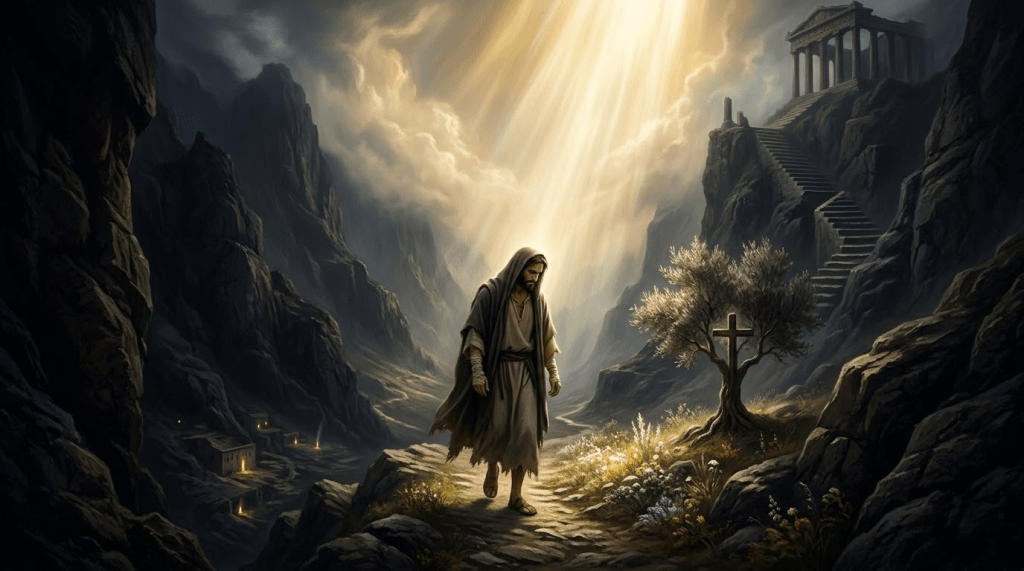
The contemplation of Tabor becomes grace for new journeys guided by light
True spirituality is not an uninterrupted ascent toward perfection, but the courage to look at one’s own misery without turning away from grace. In a time captured by the logic of inversion—where vanity disguises itself as holiness and the ego attempts to usurp the place of the Spirit—it is urgent that we recover our original fidelity to the Gospel of Christ.
For Conscious Transfiguration to take place, it is necessary to descend from our own illusions and ground ourselves in the reality of our human condition, sustained by three pillars of lucidity:
I. Renunciation of the Ego’s False Mastery
No matter how hardened we may be by the pains of the journey or how deep our reflections may seem, experience must never become a pedestal. The moment we believe we have mastered the mysteries of the spirit is precisely when we take a false step toward the abyss of pride.
To invest oneself with a false authority over the divine is the most subtle trap of the ego. The unimaginable complexity of existence will always remind us that we are insufficient. True Christian wisdom does not lie in displaying moral achievements, but in unmasking one’s own pretension—accepting that before God, we will forever be apprentices of His mercy.
II. The Archetype of the Good Thief: The End of Messianic Illusions
In the eagerness to find meaning in our vocation, the mind—numbed by vanity—often seeks refuge in grandiose identities. The ego flirts with pride by desiring the role of the anointed, the flawless predestined, or the heir of enlightened souls.
However, the Gospel of Humility offers us a far more liberating path: the archetype of the Good Thief.
The Good Thief carries no résumé of virtues nor delusions of greatness. He recognizes his own failure naked and raw, without excuses, and at the height of his pain and limitation, he fully entrusts himself to the crucified Christ beside him.
It is in the total stripping away of the grandiose “self” that we find the most unshakable peace and purpose. Salvation does not require us to be mythological heroes; it only requires that we be honest before the Cross.
III. Rescue in the Depths of Morality
Contemporary society has assumed for itself a usurped divine authority, creating hypocritical tribunals that exile the vulnerable into the basements of judgment. We create “moral lepers” in order to feel clean.
Yet the true descent into the valley of shadows reveals the great secret of the Gospel: there is an inextinguishable light within those whom the world condemns.
Many children of God, even when captured in the mechanisms of vice and inversion, still carry within themselves an essence of virtue and goodness that human moral standards—blinded by arrogance—are incapable of seeing.
Holiness is not a sterile formula.
If we wish to live the original fidelity that Christ entrusted to us, we must abandon the tribunal and descend into the depths. Essential love calls us to rescue, welcome, and love those who are far from the Father’s house—recognizing that, in the end, we were all found and healed in the same exile.
“There is no salvation without Calvary, and there is no ascent to the mountaintop without crossing the valley of shadows.”
The true path that leads us to elevation is not a climb of merits, but an emptying that allows us to be inhabited by the Spirit—the only condition for a legitimate experience of fidelity to Christ and His Gospel.
When the Spirit acts, that old inverted logic—which projects a premature holiness and a prideful intent of moral superiority over others—simply collapses. In its place, conversion to the logic of humility restores our inner space, revealing that the greatest spiritual wealth lies in the silent construction of being, acting, and becoming.
We begin, at last, to seek Heaven in a more dignified, worthy, confident, and real way.
And what truly changes?
We abandon the illusion of trying to reach God by building towers of vanity and human structures that lead only to emptiness. Instead, we retreat into the humility of our own condition. We honor the journey through pain, the sincere confrontation of the soul’s challenges, and the attentive living of human suffering—deep, intimate, and shared.
It is precisely on this ground, in our embraced imperfection, that Heaven descends and touches the sacred upon the tops of our heads.
And thus, without needing to climb a single step—not by magic, but by the pure mysticism of a faith awakened in virtue—we are finally launched into the infinity of existence in God.
 Escola da Transfiguração Consciente
Deixe um comentário