The Reconciliation of All Things in the Transfiguration of Christ
I. The Vision of Dimensions and the Transfigured Vitruvian Man
The School of Conscious Transfiguration begins from a simple yet profound truth: reality is dimensional and relational. Nothing exists in isolation. Nothing lives alone. Nothing finds meaning outside the networks of connection that structure the cosmos, consciousness, and spirit.
Living Attentively — the inaugural practice of the School — emerges precisely from this perception: life reveals itself only when the gaze opens to relationships.
By asking, “What is the relation?” the human being crosses the first threshold of expanded consciousness. They leave behind the superficial reading of existence and begin to see the world as an interwoven tapestry of layers:
• the visible dimension of matter (3D),
• the relational dimension of metaphysics, shaped by space and time (4D),
• and the dimension of full consciousness, where spirit, reason, and interiority join as one (5D).
These are not rigid hierarchies but permeable and complementary planes of operation of consciousness. The body lives in space and time; the soul moves within the relational field that connects all things; and the spirit integrates, illuminates, and transfigures these layers into one living unity.
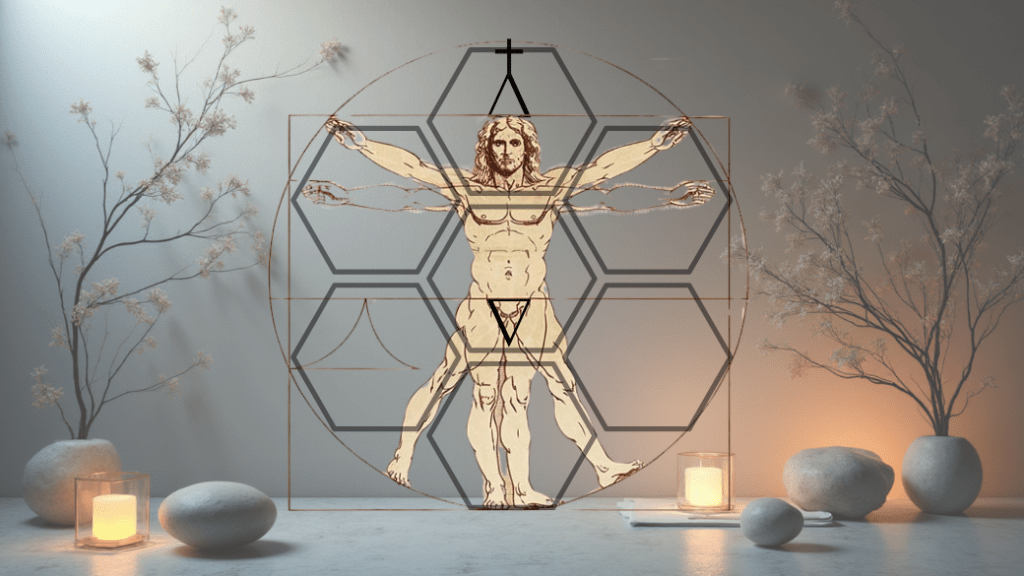
Within this dimensional view emerges the most powerful anthropological image of the School: the Transfigured Vitruvian Man.
Leonardo da Vinci’s original figure was already a metaphysical icon — a duplication of the human form that intuitively revealed the coexistence of body and soul. The circle and the square, the duplication of limbs, the geometric centrality — all of it suggested an ontology, not merely a study of proportions.
The transfigured version of the School makes explicit what the original whispered.
The honeycomb of hexagons — symbol of the universe’s relational fabric, of neural networks, of cosmic patterns, of the silent wisdom of creation — overlays the human figure and extends beyond the geometric square. It announces that reality exceeds human comprehension, that metaphysics surpasses the limits of reason, and that there are dimensions of creation not yet revealed, though intuited by the spirit.
Above the head of the transfigured human rises the spiritual Delta with the Cross — the vertex of mystery, symbol of divine verticality, of light descending, of consciousness opening. This Delta also exceeds the boundaries of the square, affirming what history always showed: the divine never fit within the rigid structures of human comprehension. The mystery is greater. The light is greater. The wisdom is greater.
Within the figure, two prisms — one pointing upward, one downward — form the vertical axis of being.
The upper prism represents the spiritual dimension, the human openness to the eternal, the light that descends.
The lower prism represents embodiment, the density of flesh, the rootedness of concrete life.
Between them, the human body lives in tension and connection — a bridge between what is above and what is below.
Thus, the Transfigured Vitruvian Man becomes the first map of the School:
the synthesis-image of the dimensional human, uniting matter, soul, and spirit; reason, intuition, and faith; the human ascending and the divine descending. It reveals the human as microcosm of creation — integrated, reconnected, and prepared for the path of transfiguration.
This dimensional vision is the root.
It is the ground of Living Attentively.
It is the starting point of the entire doctrine.
II. Trinitarian Neo-Humanism
Trinitarian Neo-Humanism is the anthropological heart of the School of Conscious Transfiguration. It arises when the human being, illuminated by the dimensional vision and awakened through Living Attentively, recognizes that their interior structure is trinitarian — not metaphorically, but essentially.
Every person carries within a living dance of three fundamental intelligences: faith, reason, and emotion-intuition. Historically separated or even placed in conflict, these expressions now reveal themselves as direct reflections of the Father, the Son, and the Holy Spirit within the human soul.
Trinitarian Neo-Humanism reconciles everything modernity fragmented. It returns the human being to their original integrity, dissolving dichotomies that no longer serve the world: science versus faith, rationality versus sensitivity, body versus spirit, matter versus consciousness.
Here, everything finds its place.
Faith becomes the axis that anchors the human being in meaning and mystery.
Reason is the axis that structures, clarifies, and understands.
Emotion-intuition is the axis that animates, connects, and inspires.
The three move in perichoretic unity, like the Trinity: distinct, yet never separated.
This new humanism rejects none of the traditions — it transfigures them. Spirituality is no longer seen as opposed to science; science is no longer seen as a threat to the sacred. Both become windows into the real. Emotion and intuition recover epistemological dignity — not irrationalities, but legitimate modes of wisdom. Reason is liberated from denying the invisible and returns to its true vocation: understanding the order of creation and serving the light that illumines it.
Within this Neo-Humanism, the human being is revealed as:
• a creature rooted in the Earth,
• a consciousness breathing within the universe’s relational field,
• a spirit open to divine transcendence.
This restores a lost greatness — not proud greatness, but humble greatness.
Not blind anthropocentrism, but the illumined human, aware of its role as a bridge between dimensions, worlds, knowledges, mystery, and matter.
Neo-Humanism thus becomes the table where Leonardo da Vinci, Einstein, Giordano Bruno, Augustine, Hildegard, Hawking, the mystics, the alchemists, and the philosophers sit side by side — not as rivals, but as seekers of one multifaceted truth.
It prepares the human being to welcome the most profound operation of grace: the Christological Prism.
III. The Christological Prism
The operation of grace in the spiritual, human, individual, and collective dimensions
If Neo-Humanism reveals who the human being is,
the Christological Prism reveals how God acts within them.
While the Transfigured Vitruvian shows the architecture of being,
the Prism shows the circulation of light —
the living dynamic between the above and the intimate,
the intimate and the world,
the world and the eternal.
The Christological Prism is the operative key of the School:
• the doctrine describing the path of divine light through the human,
• the transmutation of the sacred into virtue,
• and the expansion of this virtue through relationships and communities.
It is not metaphor. It is spiritual process.
1. Spiritual Dimension — The Light That Descends
From the upper vertex — the Delta with the Cross — the light of grace descends.
It is the light of the Holy Spirit:
• deep intuition,
• interior awakening,
• the breath of the soul,
• luminous visitation,
• the presence of the living Christ touching the innermost center of consciousness.
This light comes from beyond human limitation — beyond the geometric square of the world, beyond the mind’s reach, beyond time.
It does not invade; it invites.
It does not force; it illuminates.
It does not dominate; it reveals.
It is the continual gesture of God: descending in order to elevate.
2. Human Dimension — The Body as Prism
The human being — in body, soul, and spirit — is the prism.
Within them the light encounters:
• personal history,
• wounds,
• memories,
• desires,
• fears,
• virtues,
• shadows,
• choices,
• freedom.
There, the light is refracted — transformed.
The grace that enters as divine unity expands into multiple expressions:
courage, gentleness, justice, truth, compassion, humility, fidelity, patience, discernment, presence, service.
Each virtue is a color of the light.
Each good act is a ray emerging from the prism of the soul.
Here the doctrine becomes living reality:
grace is multiplied in the human being.
3. Individual Dimension — The Transfiguration of the Self
The light that passes through the interiority becomes personal transfiguration:
clarity of perception,
depth of feeling,
truthfulness of action,
lucidity of reaction,
consciousness in love,
presence in living.
A new Self emerges — reconciled, restored, whole.
Transfiguration is not self-improvement; it is grace welcomed.
4. Collective Dimension — Light That Illuminates Relationships and Forges Community
The light does not stop at the individual.
It moves through relationships, exactly as the honeycomb in the Vitruvian indicates.
Personal transfiguration becomes:
• family reconciliation,
• relational healing,
• pacification,
• active compassion,
• listening,
• presence,
• altruism,
• justice,
• responsibility,
• construction of the common good.
Where there was separation, light creates bridges.
Where there was fear, it creates trust.
Where there was individualism, it creates community.
Thus arises the Wheel of Virtue — the luminous circle around every transfigured person.
And as others are illuminated, the wheels multiply, connect, expand, and weave a network of light that embraces the community.
The Prism is not about the individual alone — it is about humanity.
The light God gives to one person is destined to reach the world.
IV. Conscious Transfiguration as Universal Reconciliation — “That they may all be one”
Conscious Transfiguration is the apex of the School’s doctrine: the moment when the human being, illuminated by descending light and transfigured interiorly by grace, becomes capable of reconciling everything once thought irreconcilable.
It is the living operation of the Holy Spirit in humanity.
Transfiguration begins inside, but it expands through relationships, reshapes communities, and quietly rebuilds the spiritual axis of the world.
It is the living fulfillment of John 17 — not as imposed uniformity, but as mystical unity, organic and luminous.
When individuals are reconciled, they reconcile others.
When relationships heal, communities transform.
When communities awaken, humanity moves toward the unity Christ revealed.
This is the spiritual destiny of the human race.
This is the vocation of the School of Conscious Transfiguration.
This is the promise of the Light.
V. Living Attentively — The Method of Transfigured Consciousness
If the dimensional vision reveals the architecture of reality,
if Neo-Humanism reveals the structure of the human being,
if the Prism reveals the dynamics of grace,
and if Conscious Transfiguration reveals the universal reconciliation,
then Living Attentively is the living method that allows the human being to inhabit this doctrine.
No light endures if it does not take form in life.
Living Attentively is not intellectual exercise nor isolated meditation — it is a way of existing, a protective epistemology, a living philosophy, a continuous movement of inner and outer transfiguration.
It reorganizes consciousness, rescues perception from automatism, awakens moral sensitivity, and restores spiritual coherence.
It stands on three foundations:
1. Embodied Epistemology
To know is not to accumulate, but to see.
To discern rather than react.
To understand in relationships rather than in isolated data.
2. Embodied Philosophy
To think is not to theorize, but to expand consciousness.
Not to explain the world, but to rediscover the depth of the soul.
3. Protective Method (Epistemic Shield)
Living Attentively protects the human being from manipulation, noise, ideological pride, and systems of domination — preserving the integrity of the person and the clarity of conscience.
The Transformative Triad — How Living Attentively Manifests
It generates three interior transfigurations:
• Transfiguration of Feelings
• Transfiguration of Symbols
• Transfiguration of Paradigms
Interior transfiguration generates exterior transformation.
The light that enters must leave.
Perception becomes life.
The Axioms — Humility, Justice, and Cohesion
Humility — the lucid recognition of one’s human condition.
Justice — integrity between value and action.
Cohesion — unity between what one thinks, feels, and does.
These three safeguard the trinitarian movement of the human being.
Living Attentively as the Path of Transfiguration
It restores:
• the mastery of consciousness,
• the integrity of being,
• the freedom from external structures,
• the capacity to recognize light in all things.
It is the method that transforms the world beginning within each person.
And it is the path through which the Church of the Spirit, the reconciled humanity, and the dream of Christ — “that they may all be one” — begin to take form.
 Escola da Transfiguração Consciente
Deixe um comentário