Demystifying Materialism
1. Introduction: the gaze as the spiritual axis of existence
The School of Conscious Transfiguration affirms that the contemporary moral and spiritual crisis does not arise merely from material excesses, but above all from a displacement of the gaze.
The way a human being sees — and what he chooses to see — determines how he relates to himself, to others, to the world and to God.
At the heart of this crisis, two symbolic figures represent two modes of perceiving reality:
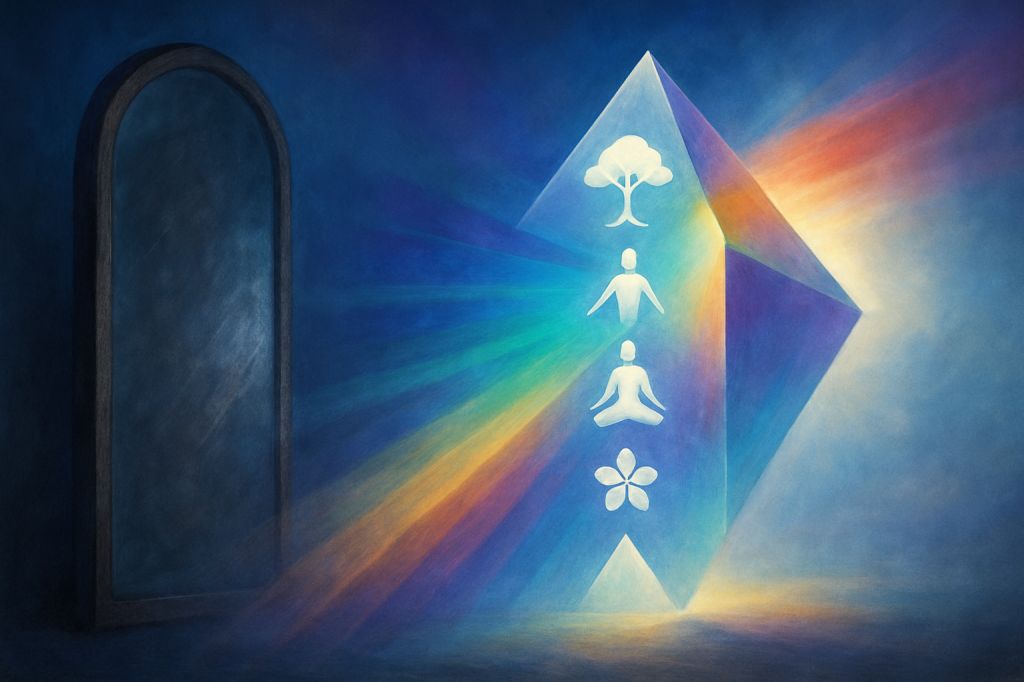
the mirror and the prism.
The mirror imprisons the gaze on the surface of things.
The prism opens the gaze to the depth of light.
This difference is not merely aesthetic.
It is ontological.
The Doctrine of the Transfiguration of the Gaze is born to restore this distinction and to offer a spiritual reading capable of demystifying materialism — giving things their proper place and returning sovereignty to the soul.
2. The Mirror: the logic of objectification
The mirror has become the symbolic object of the materialist era.
It reproduces form and returns to the subject an image that, although sharp, is empty of truth.
When one looks into the mirror, one sees oneself reflected among things — as if identity depended on what surrounds the person.
The mirror sustains three central illusions:
2.1 The illusion of material value
In the mirror, objects become extensions of the self.
A car, a garment, a house, a device — everything reflected seems to say who a person is.
Thus, the human being is measured not by the soul, but by possessions.
2.2 The illusion of appearance
The mirror transfers existential weight to outward form.
Appearance becomes the criterion of identity.
One lives to be reflected — not to be.
2.3 The illusion of inner fulfillment
Materialism promises to fill inner emptiness with objects.
But objects, being inanimate, can never fill the soul.
The mirror disguises this emptiness, trapping the person in an endless cycle of seeking more reflections.
Thus, the mirror is the symbolic technology of the ego:
it returns the image that pleases, but never the truth that liberates.
3. The Prism: the gaze transfigured by light
The prism operates in a radically different way.
While the mirror returns the surface, the prism reveals the essence.
While the mirror reflects, the prism transfigures.
The Doctrine of the Transfiguration of the Gaze declares:
the prism is the symbol of those who receive the light of God and diffuse it in many colors — clarifying reality.
3.1 The prism reveals light
Light, invisible to the naked eye, becomes visible when refracted through the prism.
Likewise, the spiritual gaze allows one to see what is hidden behind appearances.
3.2 The prism distinguishes the living from the inanimate
The light that passes through the prism illuminates everything:
– people,
– creation,
– nature,
– environments,
– matter.
But it also reveals, with clarity, the hierarchy of creation:
the soul above the object,
life above the thing,
the person above the possession.
3.3 The prism restores meaning to things
In the prism, matter regains its rightful place:
not as idol,
not as ego-extension,
not as substitute for God.
But as tool,
object of utility,
beautiful when rightly used,
capable of serving life, relieving pain, building comfort, producing good.
Without ever taking the place of the soul.
4. The Prism heals materialism through the restoration of vision
The Doctrine declares that the problem of materialism is not the existence of things, but the inversion of spiritual order.
The prism corrects this inversion.
It allows one to see:
– the human before the object,
– the spirit before the form,
– truth before appearance,
– value before price,
– life before consumption.
The prism does not reject matter — it purifies it.
It does not fight the existence of things — it fights their worship.
4.1 The prism prevents idolatry
Because it reveals the limited, instrumental and utilitarian nature of the object.
4.2 The prism combats emptiness
Because it offers no illusions: it shows that no material good can fill the space destined to divine light.
4.3 The prism restores the moral axis
Because it puts every element of life back in its rightful place.
5. To be a prism: a spiritual vocation
Being a prism is far more than having an elevated sensitivity.
It is to take a spiritual position in the world:
– to be a channel of light,
– to be a diffuser of goodness,
– to be living consciousness,
– to be harmony within environments,
– to guide through inner clarity.
The prism does not distort light.
It expands it.
For this reason, one who lives as a prism:
– does not bow to the world’s glitter,
– does not drown in reflections,
– does not measure himself by objects,
– does not adorn himself with illusions,
– does not confuse value with possession.
And at the same time:
– uses matter wisely,
– recognizes its beauty,
– welcomes its usefulness,
– honors human creation,
– but never gives the soul to the object.
To be a prism is to live with the eyes fixed on light — and the feet grounded in the world.
6. Conclusion: the transfigured gaze as an ethical path
The Doctrine of the Transfiguration of the Gaze teaches that the spiritual battle against materialism is not won by rejecting things, but by understanding their place.
The mirror imprisons.
The prism liberates.
The mirror seduces.
The prism clarifies.
The mirror offers false shine.
The prism reveals true light.
The transfiguration of the gaze is, therefore, a pedagogy of consciousness:
an invitation for humanity to see the world as it is — not as the mirror promises.
It is not a flight from matter,
but a reconciliation with the spirit.
Not a denial of things,
but the affirmation of the divine order of creation.
To see through the prism is to live with lucidity.
And to live with lucidity is to walk in the light.
 Escola da Transfiguração Consciente
Deixe um comentário