
An essay on Christ, glowing screens, and the transfiguracionist seedbed
For more than a century, while the institutional Church was discussing documents, dogmas, and internal disputes, another kind of “gospel” began to spread throughout the world without anyone’s authorization: the pagan gospel of pop culture.
It is not a gospel in the formal sense, of course. It has no canon, no council, no liturgy. But, whether religion likes it or not, it was through music, cinema, TV series, comic books, games, music videos and, today, through streaming platforms and social networks that millions of people found—for the very first time, in many cases—language for their pain, vocabulary for their loneliness, a mirror for their identity and some form of comfort in the face of chaos.
While the official discourse became, in many spaces, rigid, distant, moralistic and not very able to welcome concrete stories, pop culture opened its arms. It received the confused teenager, the LGBTQIAPN+ person expelled from church, the young Black man exhausted by violence, the girl crushed by beauty standards, the boy who can no longer bear the hypocrisy of the adult world. It did not ask for a creed. It simply said: “Come, sit here, listen to this song, watch this show, read this manga, play with me.”
It was a gospel without a Bible, but full of parables.
Parables in the form of songs, scripts, characters in crisis, protagonists who do not know who they are.
And the Church, for the most part, did not notice.
It labeled all this “worldliness,” “perdition,” “the devil’s work,” without realizing that, many times, the ones who were there were precisely the flock it had itself expelled—and whom the Spirit continued, stubbornly, to seek out by other routes.
K-pop, J-pop, streaming and social media: the ecumenism faith could not manage to build
Just look at our time: what institutional religion failed to accomplish, pop culture and the internet did almost without any theological effort.
While official discourses insisted on rigid borders—East versus West, Christians versus “pagans,” “right” versus “wrong”—a silent wave crossed the planet in the form of fandoms, timelines, concerts and livestreams.
Brazilian youths who would never sit together on a church pew cry with emotion over a K-pop group in Korea.
Girls from small towns learn Japanese to better understand J-pop lyrics and anime dialogues.
Boys from peripheral neighborhoods build real friendships with people from other continents because they play the same online game or follow the same show.
Without council, without encyclical, without doctrinal declaration, a kind of affective-cultural ecumenism emerged.
People began to recognize themselves in common pains and beauties without asking about one another’s religion.
It was pop culture that, with music videos, fanart and fanfics, built bridges that theology, isolated within itself, could not raise: bridges between languages, races, histories, traumas and hopes.
This does not mean that this movement is pure or perfect. It simply means that, while many temples were closing themselves inside their own walls, pop culture became a global public square, where an entire generation tried to survive, breathing some kind of beauty amid collapse.
Carlo Acutis: the first “pop saint” and the spiritual seal of the internet

In the middle of this scenario, something happened that the Church itself may not yet have fully understood: the canonization of Carlo Acutis.
Carlo is, in a certain sense, the first “pop saint” in Christian history.
Not because he was a celebrity—he was not—but because he embodies a combination that once seemed irreconcilable: video games, computers, the internet, digital culture and a radical passion for the Eucharist.
He did not merely “tolerate” technology: he used it creatively in order to serve. He built a website cataloguing Eucharistic miracles, sailed this digital ocean naturally, took the online world seriously without abandoning the centrality of Christ.
On the symbolic level, it is as if God had placed a seal upon the internet itself:
“Yes, I can dwell here as well. Yes, this field you call ‘virtual’ is also soil where grace can happen.”
Carlo is a silent, but extremely powerful message, especially to those who still see everything pop, digital and networked as an absolute threat: if holiness was able to blossom in the bedroom of a teenager with a notebook computer, then that simplistic division between “God’s world” and “the world of screens” no longer holds.
The problem is not the medium.
The problem is what you do with it—and whom you allow to dwell in your heart while you use it.
The social Christ and pop culture
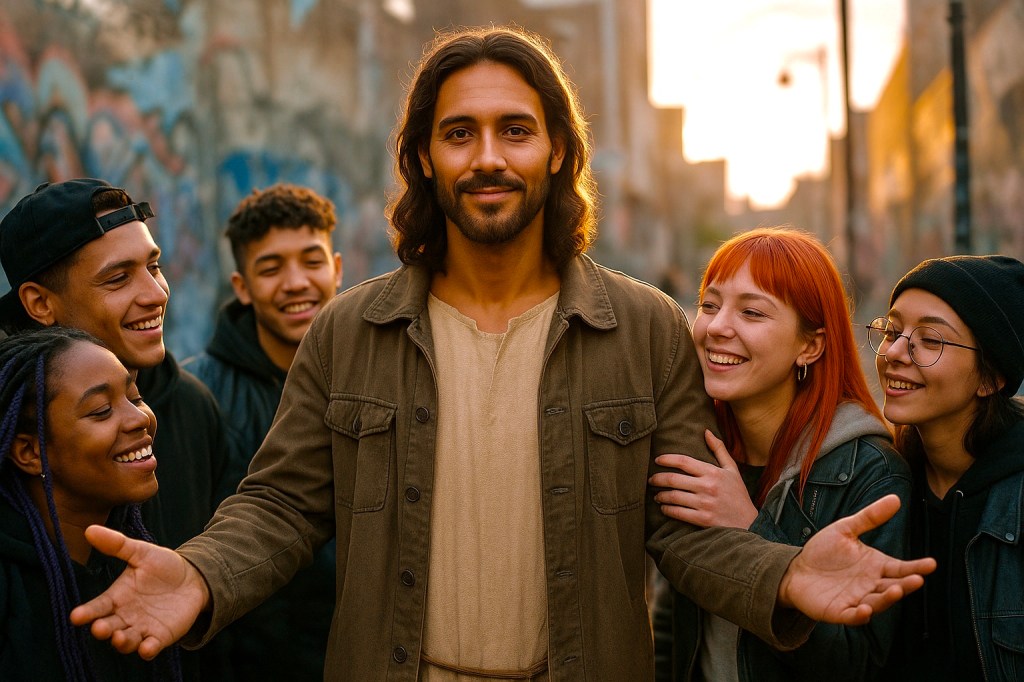
Deep down, what the School of Conscious Transfiguration calls the social Christ appears constantly inside pop culture, even when nobody pronounces the name of Jesus.
He manifests Himself:
- in the friendship that does not abandon the character in crisis;
- in the narrative that denounces unjust structures and gives a face to the oppressed;
- in the series that shows the cost of pride and the dignity of those who choose care;
- in the film that speaks of forgiveness without religious melodrama;
- in that song which gives a lap to someone who wanted to give up.
The social Christ is the Christ who walks inside concrete life, in gestures of justice, compassion, inclusion, and defense of the little ones, long before He becomes doctrine.
Pop culture, with all its contradictions, is one of the places where this social Christ keeps showing up clandestinely:
- when a music video values diverse bodies and says, “you are worthy as you are”;
- when a concert becomes a space of welcome for those who have always heard they were worthless;
- when a fandom organizes itself to raise donations, support causes, take care of someone who is unwell.
It is not a Christ of rulebooks; it is a Christ in movement. A Christ who prefers the square to the palace, the backstage to the high office, the wounded heart to the perfect speech.
Welcoming diversity: what pop culture offered and religion often denied
One of the most delicate points of our time is this: in many places, it was pop culture—not religion—that first welcomed diversity.
LGBTQIAPN+ people, for instance, found more support in bands, artists, influencers, TV characters and online communities than in religious structures which, many times, offered them only silence, condemnation or expulsion.
Women exhausted by patterns of submission found in art and in music a place where their strength was recognized and celebrated.
Black and peripheral people saw, in certain musical genres and narratives, the affirmation of their identity, their pain and their struggle, while they remained invisible in religious environments that were excessively white, patriarchal and elitist.
This is not about idealizing pop culture. It also exploits, reduces, fetishizes, and profits from other people’s pain. But the fact is that, amid all these distortions, it offered welcome where many “sacred” spaces offered only a closed door.
And this, from a transfiguracionist perspective, is a very serious sign:
if those who claim to represent the Gospel repel, and those who are supposedly “just entertainment” welcome, then something has been reversed on the spiritual map of the world.
Transfiguracionism and pop culture: from idolatry to discernment
It is in this scenario that Transfiguracionism takes its stance.
The School of Conscious Transfiguration neither idolizes pop culture nor demonizes it.
It rejects idolatry, which turns artists, products and narratives into substitutes for God and for meaning. But it also rejects arrogant disdain, which calls everything trash without realizing that the soul of a generation is breathing there.
The transfiguracionist gaze does something else: it discerns.
It asks, in the face of a song, a series, a fandom, a viral video:
- Does this generate more or less humanity?
- Does this honor the dignity of the other, or reduce them to an object?
- Does this encourage justice, empathy, responsibility, or does it feed cruelty, pride, indifference?
- Does this numb the conscience, or awaken real questions?
When it finds signs of the social Christ—care, compassion, justice, truth, beauty that elevates—the Transfiguracionism recognizes there a seed of the Word.
When it finds disguised forms of violence and dehumanization, it does not pretend not to see them. It reads them as a symptom of a deeper illness that needs to be healed at the root: the pride that has turned the other into a thing, a spectacle, a disposable object.
What the School proposes, then, is not that people “run away” from pop culture, nor that they consume it without any criteria. It is that they learn to inhabit this field as someone who walks barefoot on rocky ground: feeling the earth, recognizing the thorns, gathering the flowers, refusing the traps.
Seen this way, pop culture ceases to be an enemy or an idol and becomes what it has always been, underneath everything:
a living field, a public square full of questions, a pagan gospel that does not know it is crying out for Christ—and one of the main seedbeds of the transfiguracionist movement, which is born precisely there where the world still dares, despite everything, to sing, to tell stories, to dream and to ask, sometimes without words:
“Does anyone see me?
Does anyone understand me?
Can anyone love me without destroying me?”
What “saints” or “gospels” have we been finding in our playlists today, that religion was unable to show us?
It is for this cry that Transfiguracionism exists.
Not to compete with pop culture, but to move through it with a more lucid, humbler and more loving gaze—and, step by step, to help transfigure into a path that which, today, is for many the last remaining way of still believing that it is worth staying alive.

 Escola da Transfiguração Consciente
Deixe um comentário